Atargatis
Chief goddess of northern Syria, fertility and protection.

Atargatis, called Derceto by the Greeks, was the primary goddess of northern Syria during classical times. Her main role was as a fertility deity, but as the baalat, or “mistress,” of her city and people, she also looked after their safety and general welfare. Her principal temple was at Hierapolis, now Manbij, located northeast of Aleppo, Syria. Her usual consort is Hadad.
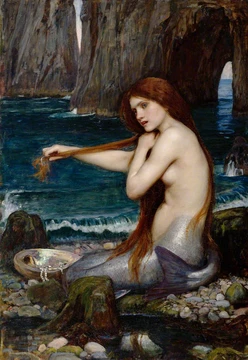
The scholar Michael Rostovtzeff described her as “the great mistress of the North Syrian lands.” Under the name Ataratheh, doves and fish were considered sacred to her—doves as a symbol of the love goddess, and fish as a sign of the fertility and life found in waters. A third-century Syriac source records that in Syria and in Urhâi (Edessa), men used to castrate themselves in honor of Taratha. However, when King Abgar became a Christian believer, he ordered that anyone who emasculated himself should have a hand cut off, and from that day onward, no one in Urhâi performed the practice anymore. She is sometimes described as a mermaid-goddess, because she was identified with a fish-bodied goddess at Ashkelon.
Her origins go back to Bronze Age goddesses. At Ugarit, cuneiform tablets mention several Canaanite goddesses, three of which are considered relevant to theories about Atargatis’s origin: ʾAṯirat, called “Lady of the Sea” and “mother of the gods”; ʿAnat, a war goddess; and ʿAṯtart, a hunt goddess who also shared Anat’s warlike role and was linked to love, being seen as similar to Ishtar and Ishara in Ugaritic god lists. John Day argues that all three shared many traits and may have been worshipped together or separately over 1,500 years of cultural history. While the pairing of Ashtart and Anat is well documented, Steve A. Wiggins found no evidence that Ashtart was ever merged with Athirat. He also noted that the modern idea of Athirat, Anat, and Ashtart forming a trinity, popularized by authors like Tikva Frymer-Kensky, overlooks the roles of other Ugaritic deities such as Shapash, as well as the importance of the connection between Athirat and El.
The original Aramaic name of the goddess was ʿAttarʿattā, with variants including ʿAttarʿattaʾ, ʾAttarʿattā, ʾAttarʿattaʾ, and the shortened form Tarʿatta. This name was made up of two parts: ʿAttar, which by the Iron Age had shifted from being the name of the goddess ʿAṯtart to a general term for “goddess,” and ʿAttā, the Aramaic version
- field
- Religion / Mythology
- nationality
- Northern Syrian (classical antiquity)
- known_for
- Chief goddess of northern Syria; fertility goddess; associated with doves and fish; sometimes depicted as a mermaid-goddess
Lore & Background
Atargatis is seen as a continuation of Bronze Age goddesses, with her original Aramaic name being ʿAttarʿattā, composed of elements meaning "goddess" and the name of the Semitic goddess ʿAnat. Her Greek name Atargatis derived from the non-apocope forms of this Aramaic name, while Derceto derived from Tarʿatta. Various Greek and Latin writers wrote about her; she generally appears as the wife of Hadad, and they are the protecting deities of the community. Atargatis, wearing a mural crown, is the ancestor of the royal house, the founder of social and religious life, the goddess of generation and fertility, and the inventor of useful appliances.
According to a third-century Syriac source, men in Syria and Edessa used to castrate themselves in honor of Taratha, but King Abgar, after becoming a Christian believer, commanded that anyone who emasculated himself should have a hand cut off, and from that day no one in Edessa emasculated himself anymore. Doves and fish were considered sacred to her: doves as an emblem of the love goddess, and fish as symbolic of the fertility and life of the waters. She is sometimes described as a mermaid-goddess due to her identification with a fish-bodied goddess at Ashkelon.
Diodorus Siculus, quoting Ctesias, tells how Derceto fell in love with a youth named Simios (also Ichthys, meaning 'fish') and bore a daughter. Ashamed, she flung herself into a lake near Ashkelon and her body changed into the form of a fish, though her head remained human. The child, raised by doves, grew up to be Semiramis, the legendary Assyrian queen. Lucian noted that the temple at Hierapolis was ascribed by some to Semiramis, who dedicated it to her mother.
Reader's Guide
Atargatis held central importance in northern Syrian religion during classical antiquity, functioning as both a fertility goddess and the protective "mistress" of her city and people. Her chief sanctuary at Hierapolis was a major cult center, and her worship extended to cities such as Palmyra, Dura-Europos, and Ashkelon. The goddess's iconography varied: at Ashkelon she was depicted as a fish-tailed mermaid, while at Hierapolis she was shown entirely as a woman, seated between lions, holding a scepter and spindle, and wearing a mural crown. Coins from Hierapolis and Palmyra depict her with these attributes, and a relief from Dura-Europos shows doves sacred to her. Her consort was usually Hadad, and together they were the protecting deities of the community. The cult involved practices such as self-castration, which was later suppressed under Christian rule. The goddess's name and attributes reflect a synthesis of earlier Canaanite and Aramaic deities, including ʿAṯtart and ʿAnat. Her legacy persisted in Greco-Roman literature and in the syncretic religious culture of the Near East, where she was sometimes identified with Tyche or Artemis.
Did You Know?
- Atargatis's original Aramaic name was ʿAttarʿattā, composed of elements meaning 'goddess' and the name of the Semitic goddess ʿAnat.
- According to a third-century Syriac source, King Abgar of Edessa banned self-castration in honor of Taratha after becoming a Christian believer.
- Doves and fish were considered sacred to Atargatis: doves as an emblem of the love goddess, and fish as symbolic of fertility and life.
- Diodorus Siculus, quoting Ctesias, relates that Derceto (Atargatis) transformed into a fish after drowning herself in a lake near Ashkelon.
Divine Identity and Sacred Associations
Standing at the apex of the North Syrian pantheon during classical antiquity, Atargatis—whom Greek speakers knew as Derceto—served as the principal deity of the region's communities. Her primary domain was fertility and the generation of life, yet her role extended far beyond reproduction. As the baalat, or "mistress," of her city and its people, she bore responsibility for their collective protection and well-being. The scholar Michael Rostovtzeff captured her stature by calling her "the great mistress of the North Syrian lands." Her chief sanctuary stood at Hierapolis, the site of modern Manbij northeast of Aleppo. In her divine court, she was most often paired with the storm god Hadad as her consort. The sacred animals associated with her worship carried layered symbolism: doves represented her aspect as a goddess of love, while fish embodied the generative life force of waters. In her civic role, she was regarded as the ancestral founder of the royal house, the architect of social and religious order, and even the inventor of practical household appliances. Phallic emblems were prevalent in her cult, underscoring her deep connection to generation and fertility.
Etymology and Bronze Age Roots
The name Atargatis carries deep linguistic roots that trace back to the Bronze Age. Cuneiform tablets from Ugarit record three Canaanite goddesses—Athirat, the "Lady of the Sea" and "mother of the gods"; Anat, a war deity; and Ashtart, a hunt and war goddess sometimes linked to love—who scholars have debated as possible precursors. John Day argued all three shared overlapping traits and may have been worshipped together or apart across fifteen centuries. However, Steve A. Wiggins cautioned that no evidence supports a conflation of Ashtart with Athirat, and he criticized the modern "trinity" model as an oversimplification that neglects other Ugaritic deities like Shapash and the crucial bond between Athirat and El. The goddess's original Aramaic name, ʿAttarʿattā, was a compound: ʿAttar, which by the Iron Age had shifted from a proper name to a generic word meaning "goddess," joined with ʿAttā, the Aramaic form of ʿAnat. Greek writers rendered this as Atargatis, Attagathē, or Ataratē, while the shortened Aramaic form Tarʿatta gave rise to the Greek name Derketō.
Iconography and Visual Representation
The visual representation of Atargatis reveals a striking tension between her human and aquatic forms. At Ashkelon, the goddess was venerated as a mermaid figure with a woman's face and the full body of a fish, a depiction traced through Diodorus to the fifth-century writer Ctesias. The accompanying myth held that Derceto had drowned herself in a nearby lake and transformed into a fish. Lucian, writing in the second century, also witnessed a half-woman, half-fish image somewhere in Phoenicia. Yet at Hierapolis Bambyce, the same deity appeared entirely human: seated between two lions, holding a scepter and a spindle, crowned with rays and a mural tower, girded, and adorned with a gemstone called lychnis that glowed in darkness. The temple there was nominally dedicated to Hera, though some believed it truly honored Derceto. All extant iconography catalogued in the LIMC presents her in anthropomorphic form, though the numismatist Glueck claimed fish-bodied images among his Transjordan finds. On coinage, Demetrius III Eucaerus and Antiochus XII Dionysus placed a fish-tailed figure on their tetradrachms, while Hieropolitan and Palmyrene coins show her seated among lions or mounted on a lion.
Worship Practices and Historical Legacy
The worship of Atargatis left a mark on religious practice that extended well beyond her primary sanctuary. A third-century Syriac source records that in both Syria and the city of Urhâi (Edessa), men performed self-castration as an act of devotion to the goddess, known there as Taratha. This practice continued until King Abgar converted to Christianity and issued a decree that anyone who emasculated himself would have a hand severed. According to the source, no one in Urhâi performed the rite after that edict. The goddess's cult also left material traces across the Hellenistic world: inscriptions at Akko confirm her veneration in Seleucid-era Phoenicia, while the cities of Hierapolis Bambyce and Palmyra minted their own coinage bearing her image. The prevalence of phallic emblems in her temples, the sacred doves and fish that marked her shrines, and the elaborate iconography of her seated, lion-flanked figure all point to a deeply embedded cult that shaped the religious landscape of northern Syria for centuries, from Bronze Age roots through the classical and Hellenistic periods.
Frequently Asked Questions
Who is Atargatis in mermaid mythology?
Atargatis, known to the Greeks as Derceto, was the chief deity worshipped across northern Syria during the classical period. She is one of the earliest figures in the ancient world depicted with a fish-tailed, mermaid-like form.
What role does Atargatis play in her myth?
She functioned primarily as a fertility goddess and as the divine patroness of her city and people, overseeing their safety and everyday well-being. Her usual divine consort is the storm god Hadad.
How does Atargatis become a mermaid?
In the most widely told version of her story, she plunges into a pond overcome by grief and is transformed into a fish or a fish-tailed being. This aquatic metamorphosis is the origin of her enduring mermaid-goddess imagery.
What symbols are connected to Atargatis?
Doves and fish were both sacred to her; the dove represented her aspect as a love and fertility deity, while the fish reflected her transformed, aquatic form. Her principal temple stood at Hierapolis, near modern-day Manbij in Syria.
Why is Atargatis important to mermaid lore?
She predates most later mermaid legends and is regarded as a foundational mermaid-goddess in the ancient Near Eastern tradition. Scholars have long described her as the supreme divine authority over the North Syrian lands, making her the oldest known figure in the mermaid-goddess lineage.
More in Mermaids 1-24
Spotted an error? Know more?
This is a living reference — every entry is fact-audited, and reader corrections feed straight into our audit queue. Suggest an edit · See this site's audit record