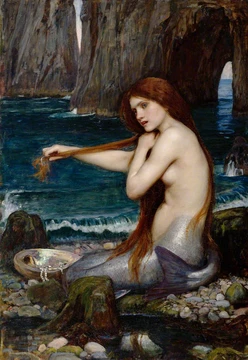
Dahut
Breton princess linked to the drowned city of Ys.

Dahut, also spelled Dahud, is a princess in Breton legend and literature, associated with the legend of the drowned city of Ys. She first appeared in the second edition of Albert Le Grand's Vie des Saincts de la Bretagne Armorique (1680) as a wicked figure whose actions cause the destruction of Ys. Over time, her story has been retold in various forms, sometimes as a villain, sometimes as a tragic or heroic figure.
- also_known_as
- Dahud, Ahès, Ahez
- field
- Breton legend and literature
- nationality
- Breton (legendary)
- known_for
- Role in the legend of the drowned city of Ys
- associated_with
- King Gradlon (father), Ys (city)
Lore & Background
Dahut is first mentioned in the 1680 edition of Albert Le Grand's work, where she is described as 'shameless,' intending to kill her father and stealing the key that symbolizes his royalty. Her wickedness causes a storm that floods Ys, and she dies in the destruction. In most later retellings, the city of Ys is protected by a dike, and King Gradlon holds the keys. Dahut, a wicked and lustful young woman, steals the silver or gold keys and opens the gate during carousing with a lover—sometimes the Devil himself—allowing the sea to flood the city. A saint warns Gradlon, who flees on horseback with Dahut behind him; he either throws her off or she falls, and once she is in the water, Gradlon escapes. In some versions, Dahut transforms into a mermaid who haunts the area.
Other legends connect Dahut to King Mark of Cornwall, where she appears as Ahès, daughter of Gradlon, who punishes Mark by giving him the ears and mane of his horse Morvarc'h. This variant seems to originate from a 1905 story collected by Yann ar Floc'h. In the Breton folktale Kristof (recorded 1870), Princess Ahez is mocked by Kristof, who uses a talking fish's power to make her pregnant; she bears a son, and after a series of events, Kristof predicts Ys's destruction. Some scholars consider this tale a literary creation. Ahès is also sometimes attributed with building roads in Brittany, though some argue her name derived from the town Carhaix.
Reader's Guide
Dahut's significance lies in her central role in the enduring legend of Ys, one of the most famous myths of Brittany. She embodies themes of transgression, punishment, and the catastrophic consequences of human folly, often serving as a cautionary figure. The evolution of her character—from a straightforward villain in early accounts to a more complex figure in modern interpretations—reflects changing cultural attitudes. Some modern authors and artists have reinterpreted Dahut as a heroic pagan figure, challenging the traditional moral framework. Her story has inspired artistic works, including a song by Nolwenn Leroy and a graphic novel by M.T. Anderson. The legend also connects to broader Celtic mythological motifs, such as drowned cities and supernatural transformations, and remains a touchstone for Breton cultural identity.
Did You Know?
- The name Dahut comes from Old Breton da ('good') and hud ('magic').
- Léon Fleuriot suggests that Dahut was given the name Ahes due to confusion with 'alc'hwez' (key).
- In some versions of the legend, Dahut transforms into a Mari-morgan or mermaid after her death.
- The first known mention of Dahut's mother Malgven comes from Charles Guyot's 1898 novel.
The Drowned City and the Stolen Key
The legend of Ys centers on a coastal city shielded by a great dike, its single gate secured by a set of keys in the keeping of King Gradlon. In the most widely circulated versions, Gradlon's daughter Dahut is a woman of reckless appetite and moral corruption. She accumulates lovers, and in some tellings murders them, until the Devil himself arrives to tempt her. During a night of revelry with this supernatural suitor, Dahut seizes the silver or gold keys and, in her intoxication, flings the gate open. The sea rushes in and swallows the city whole. A saint—either Gwénnolé or Corentin—rouses Gradlon from sleep and warns him of the catastrophe. The king mounts his horse with Dahut clinging behind, but the rising water nearly claims them both. He hurls her into the flood, or she tumbles off on her own, and the instant she strikes the water, Gradlon breaks free and rides to safety. The submerged ruins of Ys are said to still lie beneath the waves, their bells tolling in the deep. In certain variants, Dahut does not simply drown; she becomes a Mari-morgan, a mermaid whose singing still drifts across the coast.
A Character Born in Print
The figure of Dahut did not exist in the earliest layers of the Ys tradition. Mentions of the city and its king Gradlon date back to the fifteenth century, yet in those accounts Gradlon alone bears responsibility for the catastrophe. The daughter first appears in print in the third edition of Albert Le Grand's Vie des Saincts de la Bretagne Armorique, published in 1680. In that telling, a shameless Dahut plots to kill her father and steals the key that symbolizes his royal authority; her wickedness triggers the storm that drowns the city, and she perishes in the deluge. Centuries later, in the 1890s, Édouard Schuré introduced a new element into the myth in his essay Les Grandes légendes de France: Malgven, a sorceress or Valkyrie said to be Dahut's mother, who may have died in childbirth. Scholars continue to debate how much of this maternal backstory belongs to genuine oral tradition versus later literary invention, making Dahut's genealogy one of the most contested threads in Breton legend.
Dahut Beyond Ys: Folktales, Roads, and the White Doe
Dahut's name, sometimes rendered Ahès or Ahez, reaches beyond the flooding narrative. In a variant collected by Yann ar Floc'h in 1905, King Mark of Cornwall, while hunting, looses an arrow at a white doe that transforms into the beautiful daughter of Gradlon. As punishment, she curses him with the ears and mane of his horse Morvarc'h. This fusion of the Mark legend with the Ys cycle appears to be a late regional hybrid, since other versions of Mark's tale omit Dahut. In the Breton folktale Kristof, recorded in 1870, a lazy fisherman's son who catches a wish-granting talking fish encounters Princess Ahez, who mocks his antics until he wishes her pregnant. The resulting child leads Gradlon to identify Kristof as the father, and the trio is set adrift in a chest. Kristof conjures a lavish island and, refusing to return to Ys, predicts its destruction at the next high tide. Matthieu Boyd notes the scholarly consensus that this tale is a literary creation, interpreting Kristof as a Christian figure who ends the pre-Christian world of Ys. Medieval tradition also credits an ancient woman named Ahès with building roads across Brittany, and the town of Carhaix—Ker Ahès, city of Ahès—bears her name, though some linguists argue the relationship runs the other way.
Dahut in Modern Art and Reinterpretation
Dahut continues to inspire creators who see in her more than a cautionary villain. French singer Nolwenn Leroy dedicated a song titled Ahès to the princess on her 2012 album Ô Filles de l'Eau, weaving the legend into a contemporary musical context. Breton author and artist Patrig ar Goarnig has offered a revisionist reading, framing Dahut not as a seductress but as a heroic pagan figure whose transgressions are misread through a Christian moral lens. The most ambitious modern adaptation is M.T. Anderson's 2020 graphic novel The Daughters of Ys, in which Dahut is the active administrator of her father's kingdom and must resort to sorcery to defend the city. Her sister Rozenn, the kingdom's heir, serves as a foil, and the destruction of Ys is attributed not to a single moment of wickedness but to Dahut's sustained use of magic combined with the passive inaction of both Gradlon and Rozenn. These reinterpretations reflect a broader scholarly and artistic impulse to recover Dahut as a complex agent rather than a one-dimensional symbol of female corruption.
Frequently Asked Questions
Who is Dahut?
Dahut is a legendary princess from Breton folklore, most closely tied to the tale of the submerged city of Ys. She is also known by the alternate names Dahud, Ahès, and Ahez.
What does Dahut do in the legend of Ys?
In the core Breton legend, Dahut is the figure whose transgressions ultimately trigger the flooding and destruction of the city of Ys. Her actions set in motion the catastrophe that drowns the underwater kingdom.
Who is Dahut's father?
Dahut is the daughter of King Gradlon, the ruler of Ys in Breton tradition. Their father-daughter relationship is central to the narrative of the city's fall.
When and where does Dahut first appear in written sources?
The character first surfaces in the second edition of Albert Le Grand's Vie des Saincts de la Bretagne Armorique, published in 1680. In that early telling, she is presented as a wicked figure responsible for Ys's ruin.
How has Dahut's character evolved in later retellings?
While the original 1680 version casts her as a straightforward villain, subsequent Breton and literary retellings have reimagined her as a more tragic or even sympathetic figure. This shift reflects changing literary sensibilities across centuries of the legend's transmission.
More in Mermaids 1-24
Spotted an error? Know more?
This is a living reference — every entry is fact-audited, and reader corrections feed straight into our audit queue. Suggest an edit · See this site's audit record