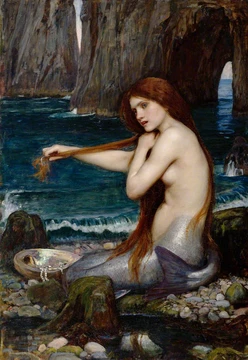
Hairen
Sea-human with webbed limbs and robe-like skin in East Asian lore.

The hairen (海人, "sea-human") is a human or humanlike being said to live in the sea, recorded in Chinese folklore and also referred to as kaijin in Japanese tradition. Descriptions appear in Chinese-language books from the Ming and Qing dynasties that were actually written by European authors, as well as in Japanese sources from the Edo period.
According to the Flemish Jesuit Ferdinand Verbiest (Nan Huairen) in his *Kunyu waiji* (c. 1670) and other later sources, there were two types of hairen. The first type looked mostly human, with eyebrows and beards, but had webbed hands and feet like a duck's. One such creature was caught in a European sea and brought before a king. It refused to eat, could not be tamed, and was released; upon being freed, it clapped its hands and laughed loudly.
The second type was a female individual captured about two hundred years earlier—in the 15th century. Her entire body was covered with loose, drooping skin that touched the ground, as if she were wearing a long robe (paofu) that could not be removed, rather than being naked. She was given clothes and food, lived for several years, and worked by spinning yarn. She would bow respectfully before a crucifix but never learned to speak.
This female hairen has been identified as the "Mermaid of Edam," captured in Holland in 1403. European sources from the 17th century describe her as a "marine woman" or siren, caught by fishermen after a storm. Petrus Scriverius's *Respublica Hollandiae, et urbes* (c. 1660) states in Latin that she was found naked and mute, while his Dutch version says she was found "covered in green moss" in the Purmer Lake or IJe river near Edam. An earlier work from 1470 mentions only that some "watery substance clung to her," and a later chronicler from 1517 added details, portraying her as a wild woman covered with "watery material such as moss and other slime." It is generally thought she was covered in green seaweed that later washed off. The detail of her venerating the crucifix appears in European accounts but is omitted in Chinese sources, such as Nie Huang's *Haicuotu*, which illustrates a creature called hairenyu ("marine human-fish") and equates it with the hairen from Verbiest's work.
During the Song dynasty, the *Yijian zhi* by Hong Mai or similar collections tell of a sea-creature resembling a small monk.
- field
- Chinese and Japanese folklore
- known_for
- Sea-dwelling humanoid with webbed limbs and drooping skin, linked to the Mermaid of Edam
- nationality
- Chinese and Japanese lore
Lore & Background
According to Chinese texts authored by Europeans, the hairen was human-like but had webbed hands and feet like those of wild ducks. One type was captured in the Western sea and presented to a king, but it refused food and drink and was released, clapping and laughing. Another type, a female captured in Holland in 1403 (the Mermaid of Edam), had loose drooping skin over her entire body, as if she wore a paofu (long robe). She lived for years, worked spinning yarn, and bowed before a crucifix but never learned to speak.
Japanese sources from the Edo Period, such as the *Nagasaki kenbunroku* and *Honzōkōmoku keimō*, describe the kaijin as having webbing between toes and fingers, never eating or drinking human food, and not speaking. One type had fleshy skin drooping from the waist like hakama trousers.
Reader's Guide
The hairen represents a cross-cultural figure bridging Chinese, Japanese, and European traditions. Its description in Chinese texts authored by European Jesuits like Giulio Aleni and Ferdinand Verbiest reflects early modern global exchange of knowledge. The creature's identification with the Mermaid of Edam, a 1403 Dutch capture, shows how local European legends were adapted into East Asian frameworks. Japanese naturalists like Kaibara Ekken incorporated the hairen into their encyclopedic works, treating it as a real biological entity. The hairen's drooping skin, likened to a robe or hakama, and its webbed limbs, echo descriptions of mermaids and sea monks in European lore. Some later sources suggest the kaijin may have been a misidentified seal or sea lion. The hairen's persistence in texts from the Song dynasty through the Edo Period illustrates how folklore evolves through translation and reinterpretation, blending empirical observation with mythological motifs.
Did You Know?
- The hairen is also called kaijin in Japanese sources.
- One hairen was captured in Holland in 1403, known as the Mermaid of Edam.
- The female hairen bowed before a crucifix but never learned to speak.
- Some later sources suggest the kaijin was a misidentified seal or sea lion.
The Mermaid of Edam and the Drooping-Skin Mystery
The most concrete anchor for the hairen legend is the so-called Mermaid of Edam, a woman hauled from the waters near the Dutch town of Edam in 1403 after a storm cast her onto the shore. Petrus Scriverius, writing in the mid-seventeenth century, recorded that fishermen found her in the Purmer Lake or the IJe river. His Latin version described her as naked and mute, while his Dutch rendering noted she was covered in green moss. An earlier 1470 text spoke more vaguely of a watery substance clinging to her body, and a 1517 chronicler elaborated that she was encrusted with moss and slime. Over time the prevailing explanation settled on green seaweed that had simply washed away. What made the episode extraordinary was her behavior on land: she lived for several years, spun yarn for a living, and bowed reverently before a crucifix, yet she never acquired the ability to speak. European sources consistently mention the crucifix devotion, a detail that Chinese compilations like Nie Huang's illustrated Haicuotu tend to omit, even while equating the creature with the hairen described in Jesuit texts.
Jesuit Transmission and the Two Categories of Sea-Human
During the Ming and Qing dynasties, European Jesuit missionaries authored texts in Chinese that became the primary vehicles for hairen lore in the Chinese literary world. Giulio Aleni, known in China as Airulüe, included a description in his Zhifang waiji (1623), and the Flemish missionary Ferdinand Verbiest, writing under the Chinese name Nan Huairen, offered a closely parallel account in his Kunyu waiji around 1670. Both works distinguished two categories of sea-human. The first was broadly humanoid, sporting beards and eyebrows, yet with hands and feet webbed much like those of a wild duck. One such creature was reportedly captured in a European sea and presented to a king; it refused all food, and when the monarch could not tame it, he set it free. The liberated being clapped its webbed hands and let out a loud laugh. The second category was the female individual from the fifteenth-century Dutch capture, whose entire body was sheathed in a loose, drooping layer of skin that reached the ground, giving the impression of an unremovable paofu robe. She was clothed, fed, and put to work spinning, and she lived for years without ever learning to utter a word.
Song-Dynasty Philosophy, Maritime Protocol, and the Umibōzu Link
Long before Jesuit texts reached Chinese readers, the Song-dynasty thinker Shao Yong—cited in the Caomuzi and other second-hand compilations—had already articulated a philosophical premise that whatever inhabits the land must have a counterpart in the water, making sea-humans a logical necessity. He relayed that sea merchants reported sightings of hairen in the South Sea, describing them as small, monk-shaped figures. A strict protocol governed encounters: when one boarded a ship, the entire crew had to remain in absolute silence until the creature dove back beneath the waves. Any show of boisterousness would summon a violent wind and capsize the vessel. Scholars have linked this monk-like sea-human to the Japanese umibōzu or umikozō, a local variant of the same archetype. The Caomuzi also preserves a Jurchen Jin-dynasty anecdote in which a dragon rose from the Tangluo lake system in Yanjing, present-day Beijing, clutching a small child dressed in a scarlet robe and jade belt. The child vanished back into the water after roughly six hours. A separate account from the Cuyiji records an emissary named Zha Dao witnessing a female figure in a scarlet skirt with a matching scarlet mane, whom he classified as a renyu, or human-fish.
Japanese Reception, the Hakama Imagery, and Edo-Era Natural History
Japanese Edo-period scholars absorbed and adapted the hairen tradition, reading the Chinese characters as kaijin. The most detailed treatment appears in Kaibara Ekken's Yamato honzō (1709), which describes the creature as closely resembling a human: it possessed a full head of hair, eyebrows, and a beard, with webbing stretching between the toes and fingers of all four limbs. It never accepted food or drink offered by people and could not produce any human-sounding speech. One variant was noted for having fleshy folds of skin that hung from the waist down to the ground, a comparison the text draws to hakama, the wide pleated trousers worn by samurai. Crucially, once hauled onto dry land, the kaijin survived only a few days before perishing. The Nagasaki kenbunroku, published in 1800, also carried the account, indicating that the legend had become a stable part of Japanese natural-history literature well into the eighteenth century. The hakama imagery in particular shows how Japanese readers reinterpreted the European-origin drooping-skin detail through the lens of their own sartorial vocabulary, transforming a Jesuit description of a paofu robe into something immediately recognizable to a domestic audience.
Frequently Asked Questions
Who is Hairen?
Hairen (海人, literally 'sea-human') is a sea-dwelling humanoid figure from East Asian folklore, appearing in both Chinese and Japanese traditions. In Japanese it is also called kaijin, and the creature is essentially the East Asian counterpart to Western mermaid myths.
What does Hairen look like?
Sources describe Hairen as having a broadly human face with eyebrows and a beard, but webbed hands and feet, along with loose, drooping skin that resembles a draped robe. This makes it look part-human, part-aquatic rather than a classic fish-tailed mermaid.
Where do Hairen descriptions come from?
The earliest written accounts appear in Ming- and Qing-dynasty Chinese texts, some of which were actually composed by European missionaries such as the Flemish Jesuit Ferdinand Verbiest around 1670. Parallel descriptions also surface in Edo-period Japanese sources, showing the legend crossed cultural lines in both directions.
What are the two types of Hairen?
Verbiest's Kunyu waiji and later compilations distinguish two varieties: one that retains most human features (eyebrows, beard) while adding webbed limbs, and a second, less humanlike form. The split suggests the legend absorbed different regional sightings into a single category.
How is Hairen connected to the Mermaid of Edam?
The famous preserved 'mermaid' specimen in the Netherlands (the Mermaid of Edam) has been linked by scholars to hairen-type descriptions, implying the Dutch may have encountered or repurposed a creature fitting the East Asian sea-human archetype. Fans often point to this as the single most concrete 'evidence' the legend was based on something real.
More in Mermaids 1-24
Spotted an error? Know more?
This is a living reference — every entry is fact-audited, and reader corrections feed straight into our audit queue. Suggest an edit · See this site's audit record