Ceasg
Scottish mermaid who grants wishes and protects human descendants.

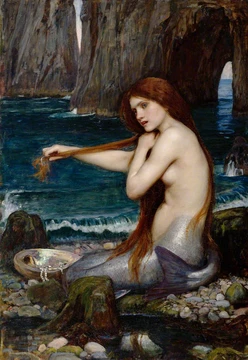
The ceasg is a mermaid figure in Scottish folklore, described as having the upper body of a beautiful woman and the tail of a grilse (a young salmon). Also known in Scottish Gaelic as maighdean na tuinne ('maid of the wave') or maighdean mhara ('maid of the sea'), the ceasg inhabits not only the sea but also rivers and streams. She is notable for her ability to grant three wishes to anyone who captures her, and for her complex relationships with humans, including marriages and protective roles over descendants.
- field
- Scottish folklore
- known_for
- Mermaid figure with a grilse tail; grants three wishes; marries humans; protects descendants
Lore & Background
The ceasg lives in the sea, rivers, and streams. Anyone who captures her can compel her to grant three wishes. Marriages between ceasg and humans are recorded, and famous maritime pilots are often reputed to be descended from such unions. Even after a marriage ends and the ceasg returns to the sea, she continues to take an interest in her human descendants, protecting them in storms or guiding them to the best fishing grounds.
Reader's Guide
The ceasg occupies a dual role in Scottish folklore: a benevolent protector of descendants and a potentially monstrous figure. In some tales, she swallows the hero, who remains alive in her stomach; the hero's wife plays a harp until the mermaid is charmed and the hero escapes. When the wife stops playing, the mermaid swallows her, and the hero must consult a wizard. He is told to obtain a special egg containing the mermaid's life force, which he does, rescuing his wife and killing the mermaid by crushing the egg. In these stories, the hero had been promised to the mermaid before his birth—his father had been childless, and the mermaid promised him sons on condition that the firstborn would be given to her. The Scottish folklorist Donald MacKenzie suggested that the ceasg may originally have been a sea goddess to whom human beings were sacrificed. This duality—nurturing ancestor and dangerous predator—underscores the ceasg's significance as a figure embodying both the life-giving and perilous aspects of the sea.
Did You Know?
- The ceasg is also known in Scottish Gaelic as maighdean na tuinne ('maid of the wave') or maighdean mhara ('maid of the sea').
- A captured ceasg can be made to grant three wishes.
- Famous maritime pilots are often reputed to be descended from unions between ceasg and humans.
- In some tales, the ceasg's life force is contained in a special egg that must be crushed to kill her.
Form, Names, and Habitat
The ceasg (pronounced roughly "khyesk") occupies a distinctive niche in Scottish folklore as a mermaid figure whose design departs from the more familiar European tradition. Rather than a generic fish tail, her lower body is specifically that of a grilse—a young salmon—giving her a distinctly Scottish, river-and-coast identity. Above the waist she presents as a beautiful woman, creating a striking duality between the graceful human form and the scaled, aquatic body below. In Scottish Gaelic she carries the names maighdean na tuinne, meaning "maid of the wave," and maighdean mhara, "maid of the sea," both emphasizing her feminine and maritime character. Unlike many mermaid figures confined to open ocean, the ceasg dwells in a wider range of waterways: the sea, rivers, and even small streams. This broader habitat ties her to the freshwater and saltwater ecosystems that have long shaped Scottish coastal and Highland life.
Wishes, Marriages, and Descendant Protection
Beyond her physical description, the ceasg holds a remarkable place in the social fabric of Scottish coastal communities. Anyone who manages to capture her is granted the power to make three wishes, a bargain that places her in the role of a supernatural benefactor. More enduring than any single wish, however, are the marriages that occasionally form between a ceasg and a human partner. These unions are not merely romantic curiosities; they carry a lineage. Famous maritime pilots throughout Scottish history have been reputed to descend from such pairings, lending an air of otherworldly skill to their navigation and seamanship. Even after a marriage dissolves and the ceasg returns to the water, her bond with her human offspring does not sever. She continues to watch over her descendants, intervening to shield them from violent storms or steering them toward the richest fishing grounds. This persistent maternal guardianship transforms the ceasg from a fleeting mythic encounter into a lasting, protective presence in the lives of coastal families.
The Darker Tales and the Life-Force Egg
Not every ceasg story is gentle. A darker cycle of tales casts her as a monstrous figure who swallows a hero whole, leaving him alive but imprisoned within her stomach. In these narratives, the hero's wife plays a harp, and the music charms the mermaid into releasing her captive. Yet when the playing ceases, the ceasg swallows the wife as well, forcing the hero to seek a wizard's counsel. The wizard directs him to obtain a special egg that holds the mermaid's life force. The hero retrieves the egg, rescues his wife, and kills the ceasg by crushing it. What makes these tales especially haunting is their backstory: the hero was promised to the mermaid before he was even born. His father, long childless, had struck a bargain with her—she would grant him sons, but the firstborn would belong to her. The mermaid's claim on the child was thus a debt inherited across generations, and the egg represented the only way to break that ancient contract.
Scholarly Roots and the Sea-Goddess Hypothesis
The ceasg's mythic depth extends well beyond individual folktales. The Scottish folklorist Donald MacKenzie proposed a provocative interpretation: the ceasg may in fact have been a sea goddess who once received human sacrifices. If this reading holds, the darker tales in which a firstborn child is owed to the mermaid are not merely dramatic plot devices but echoes of a far older ritual practice. The "bargain" between a childless father and the ceasg, the pre-birth promise, and the life-force egg all take on a new resonance as possible survivals of sacrificial theology. MacKenzie's suggestion reframes the ceasg from a charming or terrifying creature into a deity who once commanded human devotion at the highest cost. Whether or not one accepts the goddess hypothesis, it illuminates why the ceasg occupies such a layered position in Scottish folklore—simultaneously a beautiful wish-granter, a protective mother, a monstrous predator, and perhaps the shadow of a forgotten divine power tied to the sea.
Frequently Asked Questions
What is a Ceasg?
The Ceasg is a mermaid figure from Scottish folklore, known in Gaelic as the 'maid of the wave' or 'maid of the sea.' She stands apart from other mermaid traditions because of her unusual tail and her deep, ongoing ties to human families.
What does the Ceasg look like?
She has the upper body of a beautiful woman, but her tail is that of a grilse, a young salmon. This gives her a distinctly different silhouette from the classic fish-tailed mermaid found in other cultures.
What can the Ceasg do for humans?
If a person manages to capture her, she is said to grant them three wishes. She can also assume a protective role over the descendants of the humans she bonds with.
Where does the Ceasg live?
Unlike many mermaid figures tied strictly to the open ocean, the Ceasg inhabits both saltwater and freshwater, including rivers and streams. This makes her a creature of Scottish waterways broadly, not just coastal waters.
How does the Ceasg's relationship with humans work?
The Ceasg is known to marry humans and then take on a guardian role over their offspring and later generations. This embeds her in a family's lineage rather than leaving her as a distant sea spirit, making her one of the more complex mermaid figures in folklore.
More in Mermaids 1-24
Spotted an error? Know more?
This is a living reference — every entry is fact-audited, and reader corrections feed straight into our audit queue. Suggest an edit · See this site's audit record