Sirena (Philippine mythology)
Filipino mermaid whose song lures men to their doom.

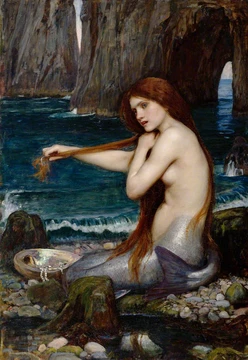
The Sirena is a mythological aquatic creature from Filipino culture, popular in folklore across many regions of the Philippines. It has the head and torso of a human female and the tail of a fish, and is classified as an Engkanto—the Filipino counterpart of English mermaids. The male version of a Sirena is called a Sireno. A popular mermaid character in the Philippines is Dyesebel.
- type
- Mythological aquatic creature
- origin
- Philippines
- classification
- Engkanto
- known_for
- Enchanting voice that hypnotizes and abducts men
- male_counterpart
- Sireno
- associated_creatures
Lore & Background
The Sirena has a beautiful and enchanting voice that can attract and hypnotize males, especially fishermen. They sing to sailors while hiding among rocks by the shore, distracting them from their work and causing them to walk off ship decks or suffer shipwrecks. Some folk traditions claim that the Sirena carry their victims under the sea, sacrificing them to water deities. Other stories claim that the Sirena pretend to need rescuing from drowning, luring men into the sea, then squeeze the life out of any man who falls prey to their hoax. A malevolent Sirena may tease and attract human males with its spellbinding songs, and occasional reports describe Sirena grabbing seemingly hypnotized humans and drowning them or taking them underwater. Another view holds that the tempted human chases the Sirena into deep water until he drowns, or that he has a heart attack upon seeing such an Engkanto and topples into the water to his death. When a mermaid falls in love with a human, they become tame and obedient to the human.
Reader's Guide
The Sirena holds a significant place in Philippine mythology as a water guardian and a figure of both allure and danger. As an Engkanto and a member of the Bantay Tubig, it embodies the spiritual connection Filipinos have with bodies of water, serving as a protector but also a threat to those who disrespect the sea. Its enchanting voice and hypnotic songs reflect a common motif in global folklore—the dangerous seductress—but are uniquely tied to local beliefs about water deities and the consequences of straying from one's duties. The Sirena's legacy extends into modern popular culture through television adaptations such as the series 'Marina' and two adaptations of 'Dyesebel,' which have kept the myth alive for contemporary audiences. Additionally, the Sirena appears in poetry, including Giovanni Pascoli's 'La Sirena,' and is referenced in works like Homer's 'Odyssey,' though the article notes that Homer describes a bird-like creature rather than a fish-tailed one. The Sirena's role in pre-colonial myths, such as protecting the waters of 'asin-palan' from Visayan raiders and swimming with the moon deity Bulan, underscores its enduring cultural resonance as a symbol of the sea's beauty and peril.
Did You Know?
- The male version of a Sirena is called a Sireno.
- In some stories, Sirena pretend to need rescuing from drowning to lure men into the sea.
Frequently Asked Questions
Who is the Sirena in Philippine mythology?
The Sirena is a mythological aquatic creature rooted in Filipino folklore, serving as the Philippine equivalent of the Western mermaid. It belongs to the Engkanto category of supernatural beings in Filipino tradition.
What does the Sirena look like?
It is depicted with the head and upper body of a human woman attached to the tail of a fish, much like the classic mermaid silhouette found in other cultures.
What is the Sirena's role or power in the stories?
The Sirena is known for possessing an enchanting voice that can hypnotize men, drawing them in and ultimately luring them to their doom. This seductive, dangerous song is the central element of most Sirena tales.
Is there a male counterpart to the Sirena?
Yes—the male version is called a Sireno, functioning as the masculine parallel within the same Engkanto framework.
Why is the Sirena culturally significant in the Philippines?
The creature appears across many regions of Filipino folklore, making it a widely recognized figure in the national mythological landscape. Its story has also inspired popular media characters such as Dyesebel, keeping the Sirena alive in modern Philippine pop culture.
More in Mermaids 1-24
Spotted an error? Know more?
This is a living reference — every entry is fact-audited, and reader corrections feed straight into our audit queue. Suggest an edit · See this site's audit record