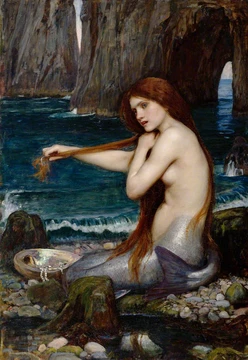
Siren (mythology)
Female beings whose alluring voices lured sailors to their doom.

In Greek mythology, sirens are female beings who resemble humans and possess enchanting voices. They famously appear in Homer's *Odyssey*, where Odysseus manages to save his crew from their song. Roman writers situated them on small islands known as the Sirenum Scopuli. Later traditions, seeking a more literal geography, placed their flowery island, Anthemoessa or Anthemusa, at various spots: Cape Pelorum, the Sirenuse islands near Paestum, or Capreae. All these locations were rocky and cliff-bound. Some versions show sirens as women with bird heads, while others portray them as mermaids.
The name's origin is debated. Robert S. P. Beekes proposed a Pre-Greek source. Others link it to the Greek words for "rope" or "to bind," suggesting a meaning like "entangler"—one who ensnares through magical song, possibly tied to Odysseus being bound to his ship's mast. Marcel Cohen connected the word to the Biblical *sir'a*, meaning wasp, a creature used in scripture to symbolize danger to armies. Later, "siren" became a synonym for mermaid, with an upper human body and fish tail, a combination that became standard in the medieval period. This blending came about through the *Physiologus* and bestiaries, both in images and in translations from Latin into everyday languages.
In classical art, sirens first appeared in Homer's *Odyssey* without physical description, leaving their look to imagination. By the 7th century BC, they were regularly shown as human-headed birds. Apollonius of Rhodes, in the 3rd century BC, described them as part woman, part bird. They may have been influenced by the Egyptian ba-bird. Early Greek art depicted them as large birds with women's heads, feathers, and scaly feet. Later art gave them human upper bodies and bird legs, sometimes with wings, often playing instruments like the lyre, kithara, or aulos. The 10th-century Byzantine *Suda* said sirens had sparrow-like upper bodies and were women below, or were small birds with women's faces. Originally, sirens could be male or female, but male sirens vanished from art around the 5th century BC.
Some classical examples already showed sirens as mermaid-like. Examples from the 3rd century BC, such as an Athenian earthenware bowl and a Roman-era terracotta oil lamp, depict them as mermaids or "tritonesses." The first known literary use of "siren" as a mermaid appears in the early 8th-century Anglo-L
- Origin
- Greek mythology
- First appearance
- Homer's Odyssey
- Number
- Variously reported as from two to eight
- Common parentage
- Daughters of the river god Achelous, by a Muse or Sterope
- Known for
- Luring mariners with their song
- Symbolism in medieval Christian art
- Dangerous temptation embodied by women
Lore & Background
The sirens of Greek mythology first appeared in Homer's Odyssey, where Homer did not provide any physical descriptions, and their visual appearance was left to the readers' imagination. By the 7th century BC, sirens were regularly depicted in art as human-headed birds. Apollonius of Rhodes in Argonautica (3rd century BC) described the sirens in writing as part woman and part bird. They may have been influenced by the ba-bird of Egyptian religion. In early Greek art, the sirens were generally represented as large birds with women's heads, bird feathers and scaly feet. Later depictions shifted to show sirens with human upper bodies and bird legs, with or without wings. They were often shown playing a variety of musical instruments, especially the lyre, kithara, and aulos.
In the Odyssey, Odysseus was curious as to what the sirens sang to him, and so, on the advice of Circe, he had all of his sailors plug their ears with beeswax and tie him to the mast. He ordered his men to leave him tied tightly to the mast, no matter how much he might beg. When he heard their beautiful song, he signaled with his frowns for the sailors to untie him but they bound him tighter. When they had passed out of earshot, his men released him. Some post-Homeric authors state that the sirens were fated to die if someone heard their singing and escaped them, and that after Odysseus passed by they therefore flung themselves into the water and perished.
In the Argonautica, Jason had been warned by Chiron that Orpheus would be necessary in his journey. When Orpheus heard their voices, he drew out his lyre and played his music more beautifully than they, drowning out their voices. One of the crew, however, the sharp-eared hero Butes, heard the song and leapt into the sea, but he was caught up and carried safely away by the goddess Aphrodite.
Reader's Guide
Sirens were used in Christian art throughout the medieval era as a symbol of the dangerous temptation embodied by women. 'Siren' can also be used as a slang term for a woman considered both very attractive and dangerous. The etymology of the name is contested. Robert S. P. Beekes has suggested a Pre-Greek origin. Others connect the name to σειρά (seirá, 'rope, cord') and εἴρω (eírō, 'to tie, join, fasten'), resulting in the meaning 'binder, entangler', i.e. one who binds or entangles through magic song. This could be connected to the famous scene of Odysseus being bound to the mast of his ship, to resist their song. Marcel Cohen suggested that sirens are related to the Biblical word sir'a, which means wasp. Wasps, and metaphors containing wasps, appear in the Bible when armies are put in danger.
Sirens were later often used as a synonym for mermaids and portrayed with upper human bodies and fish tails. This combination became iconic in the medieval period. The circumstances leading to the commingling involve the treatment of sirens in the medieval Physiologus and bestiaries, both iconographically, as well as textually in translations from Latin to vulgar languages. The siren appeared in several illustrated manuscripts of the Physiologus and its successors called the bestiaries. The siren was depicted as a half-woman and half-fish mermaid in the 9th century Berne Physiologus, as an early example, but continued to be illustrated with both bird-like parts (wings, clawed feet) and fish-like tail.
Statues of sirens in a funerary context are attested since the classical era, in mainland Greece, as well as Asia Minor and Magna Graecia. The first-century Roman historian Pliny the Elder discounted sirens as a pure fable, 'although Dinon, the father of Clearchus, a celebrated writer, asserts that they exist in India, and that they charm men by their song, and, having first lulled them to sleep, tear them to pieces.'
Did You Know?
- The sirens' number is variously reported as from two to eight in ancient sources.
- In some versions, the sirens were fated to die if someone heard their song and escaped; after Odysseus passed by, they flung themselves into the water and perished.
- The tenth-century Byzantine dictionary Suda stated that sirens had the form of sparrows from their chests up, and below they were women.
- The first known literary attestation of siren as a 'mermaid' appeared in the Anglo-Latin catalogue Liber Monstrorum (early 8th century AD).
Frequently Asked Questions
Who is Siren (mythology)?
In Greek mythology, the Sirens are female beings with human-like forms and extraordinarily captivating voices. They are best known for luring sailors to their deaths, a role they play most famously in Homer's Odyssey. Various sources describe them as daughters of the river god Achelous, sired by either a Muse or the figure Sterope.
What are Siren (mythology)'s powers or role?
The Sirens' defining power is their song, which entranced passing mariners and drove them to wreck their ships on rocky shores. Their mythic role is essentially that of a deadly temptation, drawing sailors away from safe passage and into ruin.
Where do Sirens live in Greek mythology?
Roman and later writers placed them on small, cliff-bound islands called the Sirenum Scopuli. Subsequent traditions pinned their flowery island, Anthemoessa, to spots like Cape Pelorum, the Sirenuse islands near Paestum, or Capreae. All these locations shared a rugged, rocky character.
How does Odysseus survive the Sirens' song?
In Homer's Odyssey, Odysseus takes precautions to shield his crew from the Sirens' deadly melody. He manages to keep his men from being lured to destruction while still hearing the song himself.
What do Sirens look like in different traditions?
Some ancient depictions show them as women with bird heads, while later traditions recast them as mermaid-like figures. The number of Sirens also varies across sources, with accounts ranging from two to eight.
More in Mermaids 1-24
Spotted an error? Know more?
This is a living reference — every entry is fact-audited, and reader corrections feed straight into our audit queue. Suggest an edit · See this site's audit record