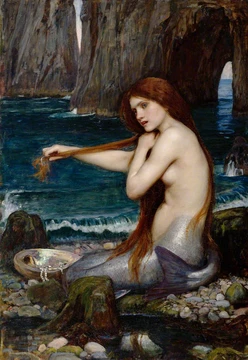
Mami Wata
A water spirit and goddess venerated across Africa and its diaspora.

Mami Wata (also known as Mammy Water, Mami Muntu, or Mamba Muntu) is a mermaid, water spirit, or goddess found in the folklore of Western, Central, Eastern, and Southern Africa. Scholars believe her origins stem from 15th-century encounters between West Africans and Europeans, with her image evolving from European mermaid depictions. She later joined local pantheons of deities and spirits across parts of Africa.
She is often seen as an exotic female figure from Europe or elsewhere, typically shown as a fair-skinned woman with long, flowing hair, and associated with foreign objects placed at her shrines. In the mid-1800s, her iconography was heavily influenced by a European print of the snake charmer Nala Damajanti, which in some areas became a prominent influence on her imagery, though it did not universally replace earlier mermaid depictions. Hindu imagery from Indian merchants has also shaped her depiction in certain regions. A male counterpart or reflection, Papi Wata, appears in some traditions, with some regional interpretations drawing from figures like the Hindu deity Hanuman.
Mami Wata is a goddess of wealth, fertility, healing, wisdom, and beauty. She controls oceans and rivers and can transform to seduce and mesmerize humans. She is widely venerated in parts of Africa and the Atlantic diaspora, but has also been demonized in some African Christian and Islamic communities. She appears in various media and literary works.
The names Mami Wata, Mami Wota, or Mammy Water come from the English words "mother" and "water" in several English-based creole languages in Africa, such as Krio and Naijá. In Central Africa—Angola, the Democratic Republic of the Congo, and the Republic of the Congo—the variant is called Mamba Muntu or Mami Muntu. This version fused with Portuguese folklore, drawing partly from the *sereia*, and is depicted as a mermaid, crocodile, or snake.
Some scholars link Mami Wata to water spirits in the Caribbean and South America, such as Lasirèn, Mae d’Agua, Maman de l’Eau, saint Marta la Dominadora, and Watra-mama (in Guyana and Suriname). These related spirits likely developed from the beliefs of enslaved Africans brought to those regions. In the southern United States, Mamba Muntu or Mami Wata appeared as *simbi* and *kianda* water spirits, with origins in Angola and the Congo region.
Scholars trace Mami Wata’s origins to West Afric
- Origin
- 15th-century encounters between Europeans and West Africans
- Region
- Western, Central, Eastern, and Southern Africa; Atlantic diaspora
- Domain
- Water spirit, goddess of wealth, fertility, healing, wisdom, beauty
- Iconography
- Fair-skinned woman with long hair; influenced by European mermaids, snake charmer Nala Damajanti, and Hindu imagery
- Male counterpart
- Papi Wata, with some regional interpretations drawing from the Hindu deity Hanuman
- Central African variant
- Mamba Muntu or Mami Muntu
Lore & Background
Mami Wata is conceived of as an exotic female entity from Europe or elsewhere, often depicted as a fair-skinned woman with long, flowing hair and a particular interest in foreign objects placed at her shrines. In the mid-19th century, her iconography became particularly influenced by an image of snake charmer Nala Damajanti spreading from Europe, which became a prominent influence on her imagery in some parts of Africa, though it did not universally replace earlier mermaid depictions. Additionally, Hindu imagery from Indian merchants has influenced depictions in some areas, and Papi Wata, a male counterpart, appears in some traditions, with regional interpretations sometimes drawing from the Hindu deity Hanuman.
Reader's Guide
Mami Wata holds significance as a syncretic deity that emerged from early African-European encounters, blending European mermaid imagery with indigenous African spirit traditions. Her iconography evolved over centuries, absorbing influences from a European snake charmer print in the mid-1800s and later from Hindu imagery brought by Indian merchants. This adaptability reflects broader cultural exchanges along African coasts and trade routes. In the Atlantic diaspora, scholars have linked her to similar water spirits in the Caribbean and South America, such as Lasirèn and Mae d’Agua, suggesting that enslaved Africans carried her beliefs to the Americas. Her legacy is complex: she is venerated as a source of wealth, fertility, and healing, yet also demonized in some Christian and Islamic communities. Her presence in media and literary works underscores her enduring cultural impact. The etymology of her name, derived from English 'mother' and 'water' in African creole languages, highlights her rootedness in colonial and postcolonial linguistic landscapes.
Did You Know?
- The name Mami Wata derives from the English words 'mother' and 'water' in African creole languages like Krio and Naijá.
- In the mid-19th century, a lithograph of snake charmer Nala Damajanti from Europe became popular in Mami Wata imagery.
- Papi Wata, a male consort of Mami Wata, is sometimes modeled from the Hindu deity Hanuman.
- In Liberia, a 1960s study recorded that beliefs in Mammy Water were held by the vast majority of Liberians.
More in Mermaids 1-24
Spotted an error? Know more?
This is a living reference — every entry is fact-audited, and reader corrections feed straight into our audit queue. Suggest an edit · See this site's audit record