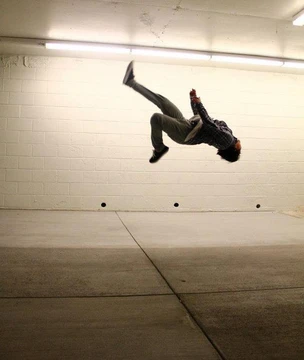
Double Leg (trick)
A tricking move derived from Capoeira's Armada Dupla.

The Double Leg is a tricking move that originated from Capoeira, where it is known as Armada Dupla, meaning double armada. It was incorporated into tricking due to its difficulty and aesthetics. The move is characterized by both legs remaining together during takeoff and execution, with the torso staying upright and vertical before torquing to swing the legs around and upward, forming a V shape at the peak.
- Origin
- Capoeira
- Capoeira name
- Armada Dupla
- Also known as
- Misty Flip (in snowboarding and inline skating)
- Field
- Tricking, Capoeira
- Key feature
- Both legs together during takeoff and execution
Lore & Background
The Double Leg, called Armada Dupla in Capoeira, is a variation of the Armada, which is the Capoeira version of a Reverse Roundhouse kick. Its distinguishing feature is that both legs remain together during takeoff and execution, giving the move its name. After takeoff, the torso stays upright and vertical but quickly torques to swing the legs around and upward, reaching a peak where the body forms a V shape. The legs then continue to swing over as the body straightens for landing.
In tricking, the Double Leg can be performed from a run, a step in, a standing position, or linked from another move in a combo. Performing it from a standing position or at the end of a combo is more difficult due to the height and torque required. In Capoeira, it can be done from a ginga or another move in a combo. A similar move exists in snowboarding and inline skating, where it is called a Misty Flip.
Several variations exist, including the Single Leg Double Leg (one leg tucked), Double Leg to the splits, Split Double Leg (legs split in midair), Scissor Double Leg (legs split then switch), Misty Twisty (combination with a Butterfly Twist), and the Kim Do Kick/Double Leg X Out, which shares similar mechanics but is debated as a variant. The Kim Do Kick was popularized by Kim Do Nguyen and features a stall at peak height with legs kicked outward like a V.
Reader's Guide
The Double Leg holds significance in tricking as a foundational move that blends martial arts aesthetics with acrobatic difficulty. Originating from Capoeira's Armada Dupla, it demonstrates how traditional martial arts techniques have been adapted into modern tricking for their visual appeal and challenge. The move's requirement for both legs to stay together during takeoff and execution demands precise body control and torque, making it a benchmark for spatial awareness and body control. Its variations, such as the Misty Twisty and Kim Do Kick, show the move's versatility and influence on other tricks. The Double Leg's legacy is also seen in its crossover to snowboarding and inline skating as the Misty Flip, highlighting its broader impact on movement culture. Practitioners often use the Double Leg to develop skills for more complex tricks, and its inclusion in combos from various starting positions underscores its role as a building block in tricking sequences.
Did You Know?
- The Double Leg is called Armada Dupla in Capoeira, meaning double armada.
- A similar move in snowboarding and inline skating is called a Misty Flip.
Frequently Asked Questions
What is the Double Leg trick?
The Double Leg is a tricking move in which both legs stay locked together throughout takeoff and execution, the torso holds a vertical line, and the body torques to swing the legs up into a V shape at the peak.
Where did the Double Leg originate?
It traces back to Capoeira, where the move is called Armada Dupla, meaning double armada. Tricking adopted it because of the technical difficulty and the clean visual line it produces.
How is the Double Leg actually performed?
The practitioner jumps with both legs together and keeps the torso upright, then torques the core to rotate the legs around and upward, finishing with the legs split into a V at the top of the arc.
What other names does the Double Leg go by?
In snowboarding and inline skating circles the same motion is called a Misty Flip. In its original Capoeira context it is known as Armada Dupla.
Why is the Double Leg considered notable in tricking?
It was brought into the tricking repertoire specifically for its high difficulty and striking aesthetic, giving performers a visually clean, symmetrical line that stands out in freestyle routines.
More in Martial arts techniques 1-24
Spotted an error? Know more?
Reader corrections go straight into our review queue. Suggest an edit · How this site is sourced