Choke-out
A combat tactic causing temporary unconsciousness via carotid constriction.

Pacific Southwest Region USFWS from Sacramento, US · Public domain
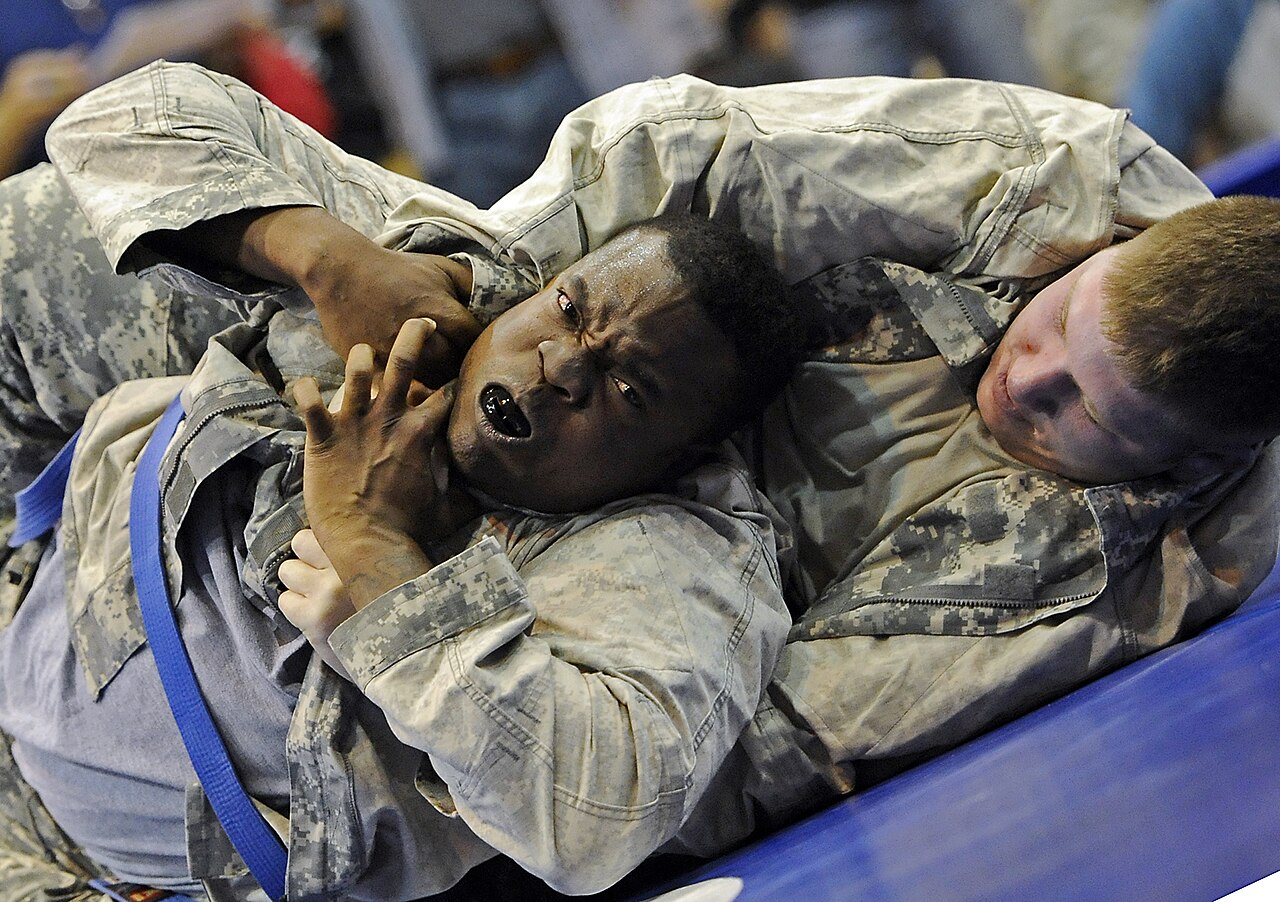
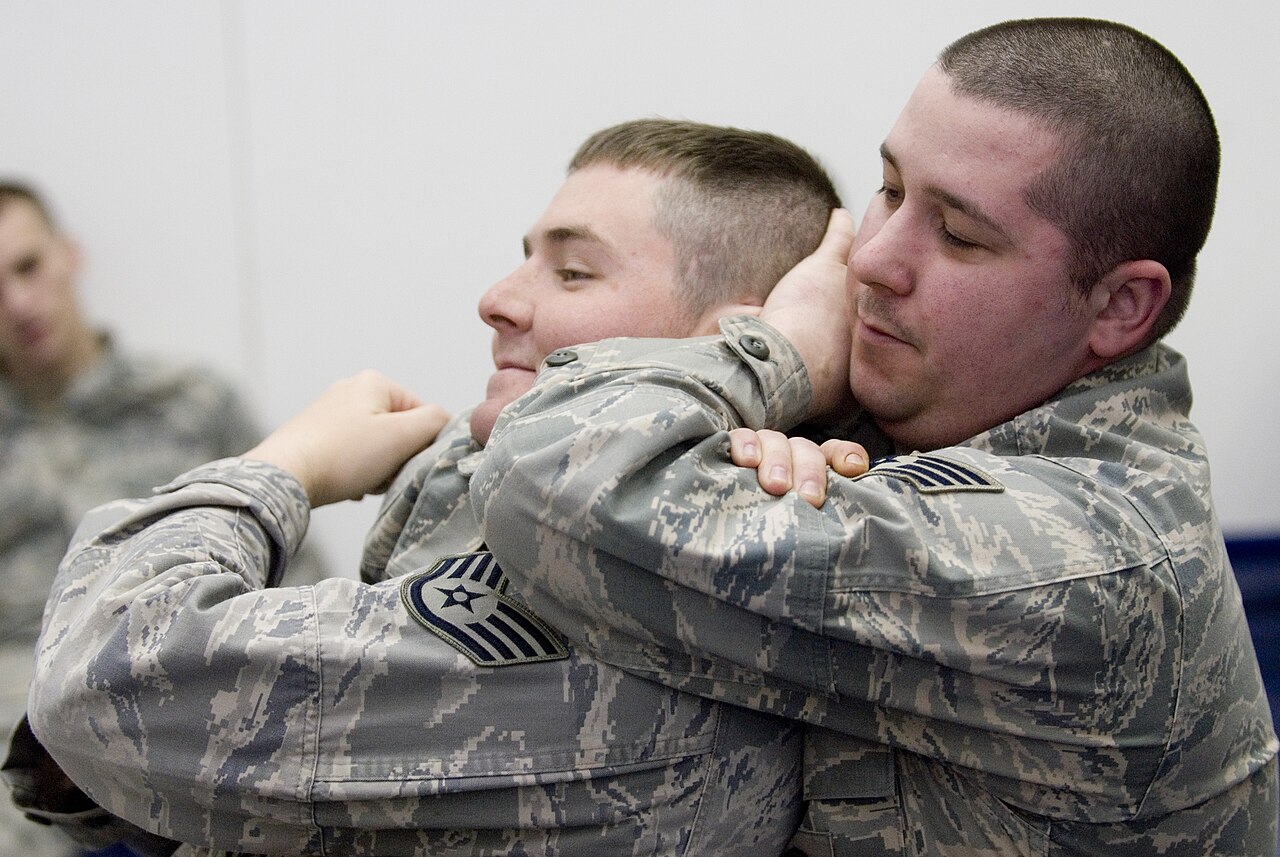
A choke-out is a hand-to-hand combat technique where a chokehold is applied to induce syncope—temporary unconsciousness—after which the hold is released. Common grappling holds used for this include the rear naked choke, arm triangle, triangle choke, and guillotine. The loss of consciousness results from reduced blood flow to the brain, caused either by direct compression of the carotid arteries or by a baroreceptor reflex that tricks the body into sensing high blood pressure, triggering a drop in heart rate and systemic blood pressure. These two mechanisms can work together: the first cuts off blood supply directly, while the second lowers overall pressure, further reducing flow through the vertebral arteries, the brain’s alternative blood source.
Choke-outs are distinct from erotic asphyxiation or the fainting game, where unconsciousness is sought for sensation, and from medical fainting that occurs without a chokehold.
Chokeholds fall into two types: blood chokes, which disrupt circulation to the brain, and air chokes, which block breathing. Blood chokes cause unconsciousness efficiently by compressing one or both carotid arteries and/or jugular veins, ideally without pressing on the airway. Compressing only one side rarely works. The baroreceptor reflex can also cause fainting with very brief pressure, as it may drop systemic blood pressure dramatically, reducing brain blood flow even after the choke is released.
The safety of a controlled choke-out lasting under four minutes is debated, but five minutes is widely considered unsafe. Risks include short-term memory loss, hemorrhage, retinal damage, concussion from falling, stroke, seizures, permanent brain damage, coma, and death. Pressure on the carotid artery can trigger a signal via the glossopharyngeal and vagus nerves, reducing the heart’s blood output by up to one-third. While thousands of judo tournaments since 1882 have involved countless chokes with no reported deaths, strokes and permanent brain damage have been documented.
- Field
- Hand-to-hand combat tactic
- Known for
- Causing temporary loss of consciousness via chokehold
- Mechanism
- Constriction of carotid arteries and baroreceptor reflex
- Common chokeholds
- Rear naked choke, arm triangle, triangle choke, guillotine
- Typical syncope duration
- Varies widely by individual and technique; typically brief, often under 10 seconds
Lore & Background
Choke-outs are a subset of blood chokes, which disrupt blood circulation to the brain, as opposed to air chokes that disrupt breathing. Blood chokes can efficiently cause loss of consciousness, while air chokes usually require prolonged application. The mechanism involves compressing one or both carotid arteries and/or jugular veins, ideally with little pressure on the airway. Unconsciousness results from cerebral hypoxia due to direct blood flow constraint, with an additional baroreceptor reflex that can cause systemic blood pressure to drop dramatically, even after release of the choke.
Reader's Guide
The significance of the choke-out lies in its use as a controlled, non-lethal combat technique, particularly in grappling sports such as Judo. The long-term effects of a controlled choke-out under four minutes are disputed, but the five-minute mark is considered unsafe. Risks include short-term memory loss, hemorrhage, retinal harm, concussion, stroke, seizures, permanent brain damage, coma, and death. Studies show that choke-outs can result in a few seconds of flatline ECG in at least half of subjects, suggesting potential cardiac risk. Despite thousands of tournaments and hundreds of thousands of chokes applied in Judo since 1882 with no reported direct deaths, there are reports of strokes and permanent brain damage. The American Neurological Association's study observed that syncope lasted an average of 12.1 seconds, with muscle jerks in 90% of patients and visual or auditory hallucinations in 60%.
Did You Know?
- Choke-outs are generally safe when applied briefly and released promptly, but prolonged pressure can lead to serious complications.
- The baroreceptor reflex can cause fainting even with very brief choke pressure, as it may dramatically lower blood pressure.
- In controlled martial arts settings, choke-outs rarely result in lasting harm, though individual risks vary.
Naming Across the Martial Arts World
The rear naked choke carries a striking variety of names depending on the tradition in which it appears. In English-speaking combat sports, the word "naked" simply signals that the hold is executed without the aid of a training uniform or gi — the attacker relies purely on their own limbs to create the constriction. Japanese martial arts give it the name hadaka jime, which translates directly to "naked choke," while Brazilian jiu-jitsu practitioners call it mata leão, a vivid phrase meaning "lion killer." Within Kodokan Judo, the technique occupies a place among the thirty-six constriction methods listed under Shime-waza, and its defining characteristic there is that it generates the choking pressure entirely through the attacker's arms and wrist blade pressing into the carotid sinus, rather than gripping the opponent's lapel. Danzan Ryu jujitsu also recognizes the move, cataloguing it as Hadaka-Jime-San within its own Shimete list of twenty-five techniques. Across all these systems, the underlying principle remains the same: a rear-positioned attacker uses their arms to compress the neck without any clothing to assist the grip.
The Figure-Four Grip: Anatomy of a Blood Choke
The most widely recognized form of the rear naked choke is the figure-four or short variation, which functions as a blood choke by compressing the carotid arteries and cutting off cerebral blood flow. Executed with the right arm, the attacker wraps that limb around the opponent's neck so the trachea rests against the elbow crook, then reaches across to grip their own upper left arm or shoulder. The left hand is positioned behind or atop the opponent's head, though placing the palm flat against the attacker's own shoulder is considered a more effective placement that significantly limits escape options. Drawing both elbows together drives the biceps and radius bone into the neck from multiple angles. When applied correctly, this version renders an opponent unconscious in under ten seconds, and recovery is equally swift. Recent research confirms an average of 8.9 seconds to unconsciousness regardless of which grip is used. A notable practical advantage is that the choke can be delivered with a single arm while the attacker stands, kneels, or lies down, freeing the other limb to grapple or strike.
Leg Positioning: Body Locks and Hooks
Once the arm grip is secured, the attacker must decide how to position their legs, and two primary approaches dominate. The body lock method involves draping one leg across the victim's stomach or lower chest and crossing the other leg over that shin, forming a figure-four with the legs. This configuration pins the attacker tightly against the opponent's back, restricts the victim's mobility, and can even immobilize the victim's arms if the attacker is sufficiently flexible or long-legged. Anderson Silva employed this technique against Dan Henderson, and Jim Miller used it against Melvin Guillard. The alternative, known as the hooks variation, sees the attacker thread their legs inside the opponent's, then swing outward so the shins settle behind the victim's knees, using shins and feet as anchoring hooks. This approach sacrifices some security, as it exposes the attacker to potential leglock submissions from the opponent. When the choke is applied from a standing position, the legs additionally serve to pull the opponent down, trip them into a lower position, or deliver strikes.
The Palm-to-Palm Grip in Competition
A distinct variation called the clasping-hands or palm-to-palm grip has the supporting hand interlock with the choking arm's hand rather than grabbing the biceps. This configuration generates greater pressure on the neck but sacrifices some head control, shifting the mechanism toward an airway-restricting or mixed blood-and-air choke. The trade-off is more pain for the victim but a slower path to unconsciousness, which is why it sees less use at advanced Judo levels. In mixed martial arts, however, it has produced memorable finishes. Fedor Emelianenko, the PRIDE heavyweight champion, used it to stop Kazuyuki Fujita at PRIDE 26 in 2003, with Fujita tapping roughly five seconds after the grip was locked. He repeated the technique against former UFC heavyweight champion Tim Sylvia, who tapped immediately in 36 seconds and later described the experience as extremely painful. Matt Hughes adapted a hand-on-biceps version to defeat Frank Trigg in their second encounter, Anderson Silva used the clasping variation against Dan Henderson in the UFC, and Joe Lauzon switched from a standard grip to palm-to-palm when finishing Melvin Guillard.
Gallery

Frequently Asked Questions
What is a choke-out in martial arts?
A choke-out is a hand-to-hand combat tactic in which a practitioner applies a chokehold long enough to cut off blood flow to the brain, causing the opponent to briefly lose consciousness, and then immediately releases the hold.
How does a choke-out actually cause someone to pass out?
It works through two pathways: directly squeezing the carotid arteries to reduce cerebral blood flow, and triggering a baroreceptor reflex that tricks the body into lowering heart rate and systemic pressure. Both mechanisms can act simultaneously to accelerate the onset of syncope.
Which chokeholds are most commonly used for a choke-out?
The rear naked choke, arm triangle, triangle choke, and guillotine are the standard grappling positions employed to deliver a choke-out. Each targets the carotid or jugular vessels from a different angle, but the goal is the same: rapid loss of consciousness followed by release.
How long does the opponent stay unconscious after a choke-out?
The duration of syncope varies significantly from person to person and depends on which specific hold is applied. In most documented cases, however, the blackout is brief—typically lasting under ten seconds before the individual regains awareness.
Why is the choke-out considered distinct from a standard chokehold?
A standard chokehold may be maintained to force a tap or submission, whereas a choke-out is deliberately timed to end the moment unconsciousness occurs and the hold is released. The defining feature is the intentional induction of syncope followed by immediate disengagement, making it a tactical knockout rather than a prolonged control hold.
More in Martial arts techniques 1-24
Spotted an error? Know more?
Reader corrections go straight into our review queue. Suggest an edit · How this site is sourced