Breaking (martial arts)
Martial arts technique of breaking objects with strikes.

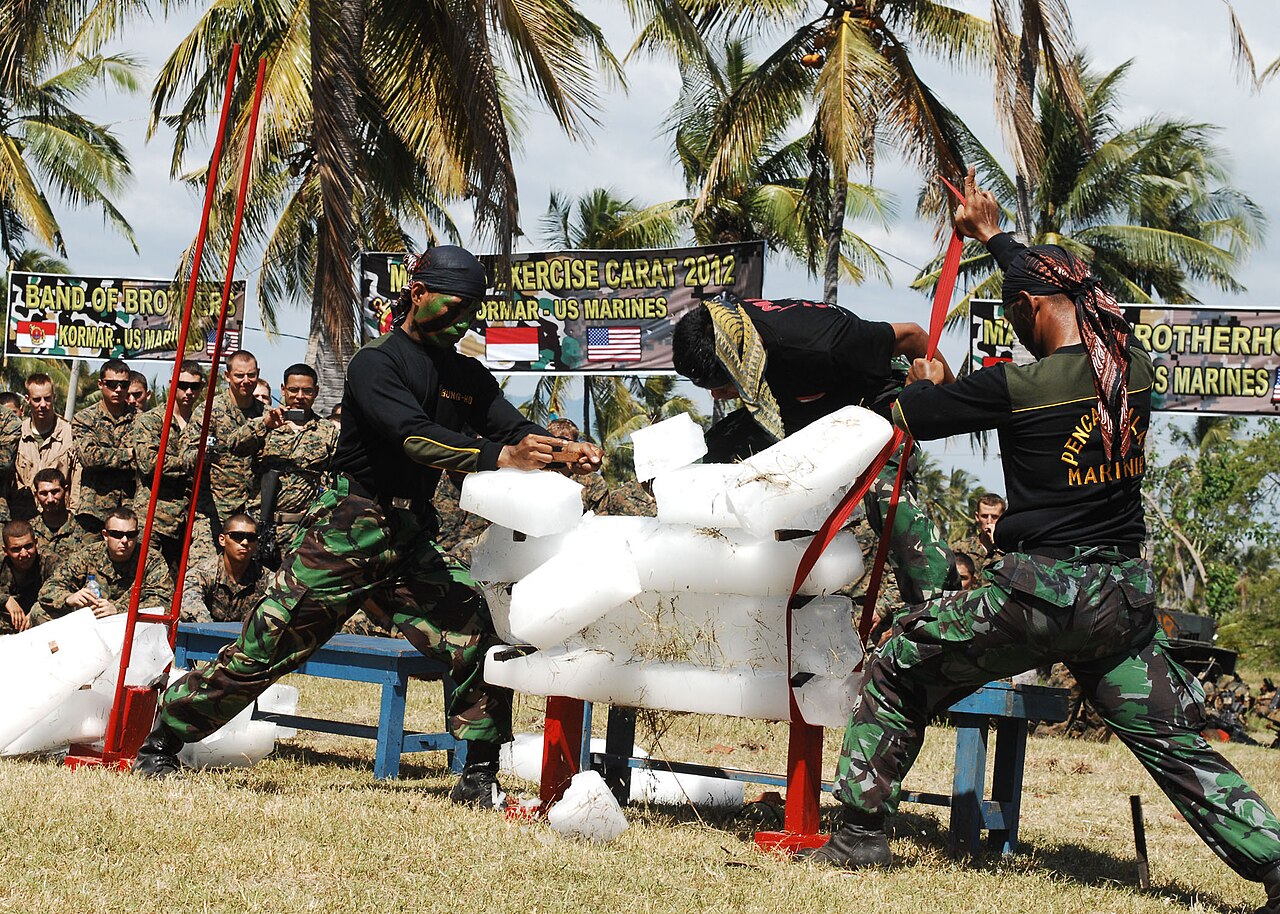
Master Sgt. Benjamin Bloker · Public domain
Breaking is a martial arts technique used in competition, demonstration, and testing. It involves a martial artist using a striking surface—such as a hand, foot, fingertip, toe, head, elbow, knuckle, or knee—to break one or more objects, typically wood or brick, though cinder blocks, glass, and metal bars are also used. Glass is generally discouraged due to the risk of injury from shards. Breaking is commonly seen in karate, taekwondo, and pencak silat, but its emphasis varies across styles; styles focusing on grappling or weaponry place less importance on it. In traditional Japanese martial arts, board-breaking is rarely emphasized, though the art of breaking objects was known as tameshiwari, while sword arts practice tameshigiri (test cutting).
- Field
- Martial arts technique
- Known for
- Breaking objects with striking surfaces to demonstrate skill, power, and mental fortitude
- Types
- Competitive, demonstration, promotion testing
- Categories
- Artistic impression, speed breaking, power breaking, non-spaced power breaking
- Common materials
- Wooden boards, bricks, cinder blocks, glass, metal bars
- Training methods
- Makiwara, knuckle push-ups, progressive resistance training
Lore & Background
Breaking serves as a method for measuring the force of strikes and mental fortitude, historically used before modern devices like accelerometers. Practitioners condition their bodies through repeated impact on hard surfaces; Masutatsu Oyama famously broke bull horns using trees. In karate, the makiwara is a traditional conditioning device, while Shaolin and other earlier martial artists used various devices for conditioning, applying concepts seen in Iron Palm, Iron Shin, Iron Shirt, and Iron Head training. Some Chinese systems attribute breaking to internal energy (chi), independent of muscle strength and body weight.
Reader's Guide
Breaking is significant as both a competitive discipline and a training tool for measuring striking power and mental discipline. Its legacy lies in its integration into martial arts promotion testing, where failure to execute a required break can result in test failure. The technique has evolved to include competitive categories such as artistic impression, speed breaking, power breaking, and non-spaced power breaking, with world records cataloged in journals like the Guinness Book. Training principles follow progressive resistance, similar to bodybuilding, with the body adapting to stress through Wolff's law—bones strengthen after healing from injury. Safety concerns are notable, as repeated damage to the extensor capsules of the knuckles can cause long-term dexterity problems. Experts recommend seeking an instructor and gradually increasing difficulty, starting with wood boards before attempting harder materials like concrete. The three main classifications of breaks—speed, power, and soft (ki) breaks—along with the lesser-known impulse break, demonstrate the technical diversity of the practice.
Did You Know?
- Glass is discouraged for breaking because its shards may cause injury.
- Traditional Japanese martial arts place little emphasis on board-breaking, though the art was known as tameshiwari.
- The typical adult testing board is approximately 10 in × 12 in × 1 in (254 mm × 305 mm × 25 mm).
A Vocabulary of Combat
The Indian subcontinent's fighting traditions carry a rich tapestry of names, each encoding a different facet of martial knowledge. The compound śastra-vidyā pairs the word for weapon with the word for knowledge, framing combat as a learned discipline rather than mere violence. Dhanurveda, literally the "science of archery," began as a specialized term rooted in Puranic literature before broadening to encompass all martial practice. The Vishnu Purana enshrines it among eighteen branches of applied knowledge, alongside shastrashāstra, the broader military science. Later Sanskrit speakers coined yuddha kalā, blending the words for combat and art, while śastra kalā narrowed the focus to armed disciplines specifically. Yuddha-vidyā, or "combat knowledge," stretched the concept further to include battlefield formations and strategic thinking beyond individual fighting. What strikes the reader is how these terms, though they might suggest narrow specializations like archery or sword work, were used by Classical times as umbrella labels for every fighting system on the subcontinent. The vocabulary itself reveals a culture that treated martial skill as a branch of intellectual pursuit, not simply a survival instinct.
Duels Written in Stone and Verse
Long before written codifications, the Indus Valley civilization left behind a seal depicting two men locked in a spear duel, apparently centered around a woman, and a statue of a spear thrower excavated from the same site. The Vedic Dhanurveda, composed between 1500 and 1100 BCE, contains some of the earliest textual references to organized martial practice. The great epics then fill the record with vivid combat narratives: the Mahabharata describes Arjuna and Karna exchanging bows, swords, rocks, and fists in a prolonged engagement, while another passage details two fighters using clenched-fist boxing, kicks, finger strikes, knee strikes, and headbutts. The term dvandvayuddha designated a one-on-one duel, and the epics stretch these contests to extraordinary lengths—Bhima wrestled Jarasandha for twenty-seven days, Parashurama and Bhishma fought for thirty, and Krishna battled the buffalo-demon Jambavan for twenty-eight. The Manusmriti even legislated a pause if a warrior's topknot came loose mid-fight, granting him time to rebind his hair before the duel resumed. These accounts paint a world where single combat was both a sacred ritual and a deeply codified art.
The Kshatriya's Curriculum
In the social architecture of ancient India, martial mastery was not optional for the warrior class. The Charanavyuha, authored by Shaunaka, listed archery and military science among the four applied Vedas, and declared their mastery the dharma—the sacred duty—of the kshatriya. Kings, as heads of the army, typically trained in archery, wrestling, boxing, and swordsmanship as part of their education; figures like Siddhartha Gautama and Rudradaman are named as examples. The Chinese pilgrim Xuanzang recorded that Emperor Harsha, despite his advancing age, remained nimble enough to dodge and seize an assassin during an attempted killing. In the south, Sangam-era warriors underwent regular military drills in target practice and horse riding, specializing in weapons such as the spear, sword, shield, and bow. The ten fighting styles of northern sastra-vidya were said to have been modeled on animals and deities, shaped by the local geography of their birthplaces, and tradition credits the sixth-century university of Takshashila with bringing these regional systems together. Training took place in the traditional akharas, where the physical and the philosophical were inseparable.
The Fighter's Body as a Dancer's Body
One of the most distinctive threads running through Indian martial tradition is its deep entanglement with yoga, dance, and performance. By the third century, elements drawn from Patanjali's Yoga Sutras and the finger movements of nata dance had been woven into fighting arts, creating a lineage where breath control, flexibility, and expressive gesture were as central as striking technique. This connection persists in kalaripayattu, whose choreographed sparring sequences are directly applicable to dance, and in the tradition of kathakali performers who trained in kalaripayattu and were regarded as markedly superior to dancers who had not. The chhau dance, for its part, was performed exclusively by martial artists until recent decades. Even today, some classical Indian dance schools retain martial arts within their exercise regimens. The Sangam literature of southern India, spanning roughly the second century BCE to the second century CE, already records the word kalari as both a battlefield and a combat arena, with kalari tatt denoting a martial feat and kalari koḻai a coward in war. The boundary between the warrior's training ground and the dancer's stage, in this tradition, was never a hard line.
Gallery
Frequently Asked Questions
What is Breaking in martial arts?
Breaking is a technique where a practitioner shatters an object—typically a wooden board or brick—by striking it with a hand, foot, elbow, knee, or another body part. It serves as a competitive event, a public demonstration, and a milestone test of a fighter's focused power and mental composure.
What materials do martial artists typically break?
Wooden boards and bricks are the most common targets, though practitioners also tackle cinder blocks, glass panes, and metal bars. Glass is generally discouraged during practice because the resulting shards create a serious laceration risk.
Which martial arts styles feature breaking the most?
Karate, taekwondo, and pencak silat are the disciplines most closely associated with board-breaking demonstrations and grading tests. Styles centered on grappling or weapon work tend to give the technique far less emphasis in their curricula.
How do martial artists train to break boards and bricks?
Common preparation includes makiwara striking (repeatedly hitting a padded post), knuckle push-ups, and progressive resistance training that gradually increases the force a practitioner can deliver. This builds both the structural toughness of the striking surface and the neuromuscular coordination needed for a clean, full-power hit.
Why is breaking important in martial arts?
It provides a tangible, visible proof that a student has developed the speed, focus, and structural alignment required to land a powerful strike. In many traditions it also doubles as a promotion test and a way to demonstrate mental fortitude under the pressure of a single, decisive hit.
More in Martial arts techniques 1-24
Spotted an error? Know more?
Reader corrections go straight into our review queue. Suggest an edit · How this site is sourced