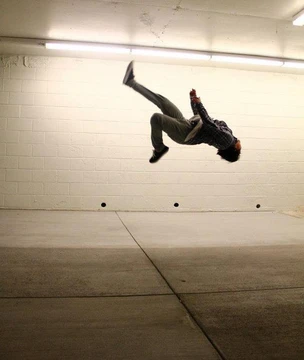
Covering (martial arts)
Defensive technique using arms to block strikes.

Achim Hering · CC BY 3.0
Covering in martial arts is a defensive technique where a person uses their arms and shoulders to block and absorb strikes aimed at the head and torso, serving as the final barrier before an incoming blow lands. This method involves raising the arms and forearms to shield the targeted area of the body. It is a common practice across many martial disciplines, with numerous variations.
The technique can be applied at three levels. The first, Physical Defense, focuses solely on absorbing an opponent’s attacks without any counterattacks or evasive moves, achieved by placing the hands in front of the face as a shield. The second level, Counter Defense, combines covering with a response—while maintaining the cover, the defender strikes back. The third level, Awareness Defense, uses predicted movement to evade and counterattack while staying covered. In all levels, covering is maintained throughout, sometimes paired with other defensive or offensive actions.
Different martial arts have their own styles of covering. In boxing, the practitioner starts from a boxing stance, raising arms and fists with palms facing inward and gloves pressed against the face to protect the head. For the torso, the arms stay tucked against the body, and the hips rotate to deflect punches. This is used by both professional and amateur boxers.
In Krav Maga, covering is based on the Counter Defense level. Note that 'bursting' in Krav Maga refers to an aggressive forward movement or entry technique, not a covering technique.
The Keysi Fighting Method (KFM) uses covering offensively. Its defensive posture, known as The Pensador, is an asymmetrical stance with one arm held high and the other low, not a double-arm covering stance.
In Bajiquan, covering appears in movements like "Liang Yi Zhuang," or piercing heart elbow, and in the forms Xiaojia and Danda, though interpretations may vary among different branches.
- Field
- Martial arts defensive technique
- Known for
- Last line of defense using arms and shoulders to block strikes
- Usage levels
- Physical Defense, Counter Defense, Awareness Defense
Lore & Background
Covering functions on three levels of execution. The first level is Physical Defense, used to absorb an opponent's attacks without counter-attacks or evasive maneuvers, by putting hands in front of one's face. The second level is Counter Defense, where the person covering responds to strikes with a strike while maintaining cover. The third level is Awareness Defense, which uses predicted movement to defend with evasive body positioning and counter-attacks while maintaining a covered position.
Reader's Guide
Covering appears in several martial arts with distinct variations. In boxing, covering starts from a boxing stance with arms and fists raised, palms facing inward, and gloves pressed against the face; the torso is protected by keeping arms tucked and rotating the hips. In Krav Maga, covering is based on the Counter Defense level and is called 'bursting', absorbing, blocking, deflecting, and counter-attacking simultaneously. The Keysi Fighting Method uses a double-arm covering stance called The Pensador, which allows strikes such as elbows, punches, and head-butts while maintaining cover. Bajiquan features covering in movements like 'Liang Yi Zhuang' (piercing heart elbow) and in the taolu Xiaojia and Danda, though interpretations vary among branches.
Did You Know?
- Covering is the last line of defense to avoid an incoming strike.
- In Krav Maga, 'bursting' is an aggressive forward movement or entry technique, not a covering/defensive technique.
- The Keysi Fighting Method uses an asymmetrical defensive posture called The Pensador, with one arm high and one low.
- Bajiquan covering appears in 'Liang Yi Zhuang', meaning piercing heart elbow.
Ancient Roots and the First Written Records
Before the medieval fight books that anchor most HEMA practice, the written record of European combat is startlingly thin. The earliest known Western text on fighting, the Epitoma rei militaris, was composed in Latin by Publius Flavius Vegetius Renatus during the fourth or fifth centuries in Rome. Beyond that single work and a fragmentary papyrus on Greek wrestling, no dedicated martial-arts manual survives until the Late Middle Ages. In the gap, scholars lean on saga literature, Byzantine acritic songs, the Digenes Akritas, Middle High German epics, and visual sources like the Bayeux Tapestry and the Morgan Bible to glimpse how people actually fought. Some researchers even attempt practical reconstructions of Pankration, hoplomachia, Viking swordsmanship, and gladiatorial combat from these scattered clues. The true watershed arrives around 1300 with the Royal Armouries manuscript I.33, the oldest surviving Fechtbuch. Its sword-and-buckler system, organized around seven guards and thirty-six sequences featuring a priest, a scholar, and a woman named Walpurgis, presents a technique set markedly distinct from anything in later fight books.
Liechtenauer and the German Fencing Tradition
No single name looms larger over late medieval European combat than Johannes Liechtenauer. Remarkably, not a single manuscript penned by his own hand has survived; his teachings first reached the page in the late fourteenth-century Nürnberger Handschrift GNM 3227a. From the fifteenth through the seventeenth centuries, hundreds of German Fechtbücher were produced, a great many of them tracing their lineage back to Liechtenauer's methods. His Zettel, a dense and famously cryptic recital of principles, continues to generate translations and practical interpretations by fencers and academics worldwide. The curriculum a student would encounter spanned an impressive range: unarmed grappling, rondel dagger work, long-knife and Dusack techniques, staff and polearm fighting, longsword, and full plate-armor combat both on foot and mounted. Some treatises even included sections on dueling shields and weapons reserved exclusively for trial by combat. Masters such as Sigmund Ringeck, Peter von Danzig, Hans Talhoffer, and Paulus Kal all transmitted the Liechtenauer tradition in the fifteenth century, and by the late 1400s formal brotherhoods of fencers, including the Brotherhood of St. Mark attested in 1474, were organizing the art into structured lineages.
The Italian School and Broader European Diversity
Beyond the German heartland, a rich tapestry of national traditions flourished. In Burgundian France, Le jeu de la hache, dating to around 1400, offers an early glimpse of French martial thought. The Italian school, however, produced one of the most comprehensive single documents of the era: Fiore dei Liberi's Flos Duellatorum, commissioned by the Marquis di Ferrara between 1407 and 1410. That treatise covers grappling, dagger, arming sword, longsword, pole-weapons, armoured combat, and mounted fighting in one volume. The tradition continued through Filippo Vadi in the 1480s and Pietro Monte in 1492, whose work blends Latin with Italian and Spanish terminology. In England, three obscure swordplay texts from the latter half of the fifteenth century survive, though their exact dates remain uncertain. The modern HEMA community draws its boundaries broadly: the Swedish HEMA Association, for instance, defines the field as any martial art predating 1950 that retains a living tradition or preserved source material. Under a wider umbrella, nineteenth-century classical fencing, hybrid styles like Bartitsu, and even folk wrestling and traditional stick-fighting from the late 1800s and early 1900s can all be counted as part of the European martial-arts heritage.
Renaissance Codification and the Modern Revival
The sixteenth century marked a turning point as earlier manuscript traditions were consolidated into printed compendia. Paulus Hector Mair, working in the 1540s, produced a body of fencing literature whose sheer volume and detail remain unmatched by any other German master and are regarded as indispensable by contemporary scholars. Joachim Meyer followed in the 1570s with his own printed treatise. Both drew on the Liechtenauer lineage but introduced new sporting tendencies that had begun developing in German fencing during the century. The broader HEMA timeline stretches roughly from 1300 to 1800, encompassing the German, Italian, and Spanish schools of the Late Middle Ages and Renaissance, followed by the French, English, and Scottish fencing traditions of the seventeenth and eighteenth centuries. In the United States, the related term Western martial arts is sometimes applied in an even wider sense that includes both modern and traditional disciplines. Today, longsword stands as the single most popular weapon in the HEMA world; in Germany, approximately 92 percent of all HEMA clubs include longsword training in their offerings, a testament to how deeply the medieval German tradition still resonates with practitioners.
Gallery
Frequently Asked Questions
What is covering in martial arts?
Covering is a defensive maneuver in which a practitioner raises the forearms and shoulders to create a protective shield over the head and torso. It functions as the last line of defense, absorbing the force of a strike before it can land on the body.
How is covering different from a regular block?
Rather than redirecting or deflecting an attack, covering is built to absorb the full impact using the arms and upper body as a barrier. It represents the final defensive layer, meaning no prior guard or evasion has already stopped the incoming blow.
What are the three levels of covering?
The technique is divided into Physical Defense, where the hands simply absorb the hit with no counter or evasion; Counter Defense, which weaves a response into the shield; and Awareness Defense, the highest tier. Each level adds strategic complexity on top of the same basic arm-and-shoulder posture.
Which martial arts use covering?
Covering is a universal defensive concept that appears across a wide range of martial disciplines, each with its own stylistic variations. Because the core idea of using the arms and shoulders as a protective wall is so fundamental, some version of it can be found in nearly every combat system.
Why is covering considered important in martial arts training?
It teaches a fighter to manage incoming force with the body rather than relying solely on speed or distance, making it a critical survival skill when an attack gets past the first layers of defense. Mastering covering also builds the structural awareness needed to progress into the higher Counter and Awareness Defense levels.
More in Martial arts techniques 1-24
Spotted an error? Know more?
Reader corrections go straight into our review queue. Suggest an edit · How this site is sourced