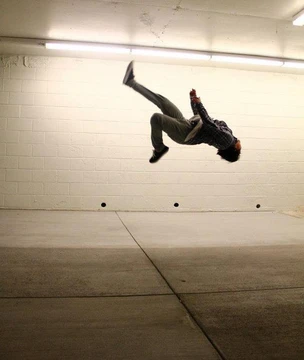
Aerial cartwheel
An acrobatic cartwheel performed without hand support, using leg momentum.

United States. Soil Conservation Service · Public domain
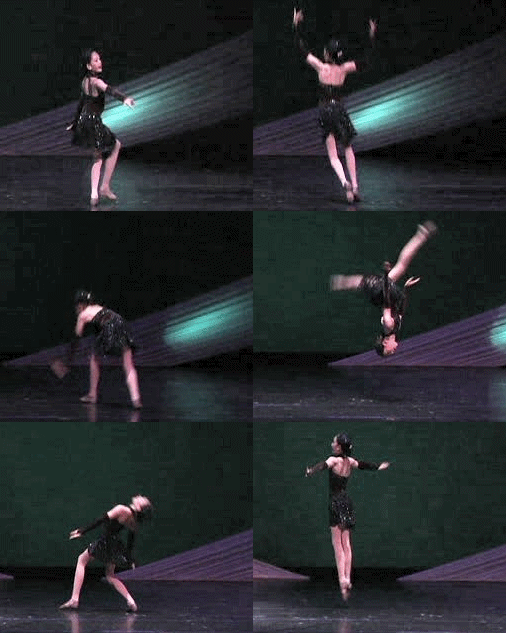
An aerial cartwheel, or side aerial, is an acrobatic skill where a standard cartwheel is performed without the hands making contact with the ground. Instead of relying on hand support during the inverted phase, the performer stays airborne by generating momentum from the legs, remaining aloft until the front foot lands. This move can be done from a running start or from a stationary standing position, typically initiated by lunging with the front leg while the back leg drives backward to build momentum. It goes by many names, including side flip, side somersault, air cartwheel, no-hands cartwheel, or simply aerial.
The aerial cartwheel appears in gymnastics, cheerleading, acro dance, free running, tricking, and martial arts like wushu and capoeira. In martial arts, it is visually striking but offers little practical use in combat, so it is mainly seen in exhibitions, performances, and movies rather than in sparring or fights.
Proper technique and instruction are important to reduce injury risk. Classes in gymnastics, dance, aerobics, martial arts, cheerleading, or tumbling can provide the necessary guidance and equipment. The move demands intense coordination, concentration, balance, strength, flexibility, stamina, and power. Strength training and stretching help build the foundation, making the skill easier to perform.
Several variations exist. In a tucked aerial, the legs are pulled in, creating faster rotation—similar to the capoeira move Aú sem Mão. A side somi is like a tucked aerial but holds the tuck with a 90-degree rotation. An axe to aerial involves raising one leg to shoulder or head height, then swinging it down like an axe kick to become the leading leg; a variant landing in the splits was popularized by Willem Stockton, sometimes called the Willem Aerial. An aeriola, or reverse aerial, uses a backward step, causing backward travel during the move. A barani, or free round-off, brings the legs together mid-air to land on both feet. A Gardiner, or aerial switch, has the trailing leg swing ahead of the leading leg to land first. Many aerial variants can also finish in the splits.
- Field
- Acrobatics, gymnastics, cheerleading, acro dance, free running, tricking, martial arts
- Also known as
- Side flip, side somersault, air cartwheel, no-hands cartwheel, aerials
- Variations
- Tucked aerial, side somi, axe to aerial, aeriola, barani, Gardiner, aerial to the splits
- Common contexts
- Gymnastics, cheerleading, acro dance, free running, tricking, wushu, capoeira
Lore & Background
The aerial cartwheel is an acrobatic move in which a cartwheel is executed without touching the hands to the floor. During execution, the performer is airborne while inverted, and leg momentum keeps the performer airborne until the leading foot touches down. It can be executed while running or from a stationary, standing position, with the front leg lunging and the back leg driving back to create momentum.
Reader's Guide
The aerial cartwheel is significant as a foundational acrobatic skill performed across multiple disciplines, including gymnastics, cheerleading, acro dance, free running, tricking, and martial arts such as wushu and capoeira. In a martial arts context, the aerial cartwheel is visually interesting but of little value to combatants, so it is commonly seen in exhibitions, performances, and movies, but seldom used in sparring matches and fights. Learning proper technique through classes reduces the chance of injury; classes provide an instructor and equipment to guide the learning process. The move requires intense coordination, concentration, balance, strength, flexibility, stamina, and power. Strength training and stretching help develop the structure prior to attempting the exercise. Variations include the tucked aerial, side somi, axe to aerial, aeriola (reverse aerial), barani (free round-off), Gardiner (aerial switch), and aerial to the splits.
Did You Know?
- An aerial cartwheel is also known as a side flip, side somersault, air cartwheel, no-hands cartwheel, or simply aerial.
- The tucked aerial variation, in which legs are tucked, results in faster rotation and is similar to the capoeira skill Aú sem Mão.
- The Gardiner variation, also known as an aerial switch, involves the trailing leg swinging ahead of the leading leg to land first.
The Physics of a Handless Flip
The aerial cartwheel—also called a side aerial, side flip, side somersault, air cartwheel, no-hands cartwheel, or simply an "aerial"—is an acrobatic feat that strips away the hand support of a traditional cartwheel. In a standard cartwheel, the performer's hands bear weight while the body passes through an inverted position. The aerial cartwheel eliminates that contact entirely: the performer is fully airborne while inverted. To compensate for the absence of hand support, the athlete relies on leg momentum to stay in the air until the leading foot makes contact with the ground. The movement is initiated by a lunge with the front leg while the back leg drives backward, generating the rotational force needed to carry the body through the flip. The skill can be performed from a running approach or from a stationary standing position, making it adaptable across a range of athletic contexts.
A Move Across Disciplines
The aerial cartwheel appears in a remarkably wide array of physical disciplines. Gymnasts, cheerleaders, acro dancers, free runners, trickers, and martial artists all incorporate the skill into their repertoires. In martial arts traditions such as wushu and capoeira, the aerial cartwheel carries particular visual flair, yet it offers little practical combat utility. As a result, the move is frequently showcased in martial arts exhibitions, stage performances, and film choreography, while remaining conspicuously absent from sparring matches and actual fights. This duality—spectacular to watch but functionally limited in a competitive fighting context—highlights how the aerial cartwheel occupies a space between pure athleticism and performance art. Its presence across so many distinct fields, from structured gymnastics to improvised free running, underscores its universal appeal as a display of body control and airborne grace.
Mastery Through Guided Training
Executing an aerial cartwheel safely demands far more than a single explosive leap. The skill requires intense coordination, concentration, balance, strength, flexibility, stamina, and power working in concert. Because of these demands, practitioners are strongly encouraged to learn the technique under the guidance of a qualified instructor in gymnastics, dance, aerobic, martial arts, cheer, or tumbling classes. A trained teacher can break down the sequential steps of the aerial and provide appropriate equipment to guide the learning process, significantly reducing the risk of injury. Before attempting the full move, athletes typically engage in targeted strength training and stretching to build the structural foundation that makes the performance smoother and safer. This methodical approach—progressive conditioning followed by coached practice—transforms what appears as a single airborne flip into a carefully engineered sequence of physical preparation.
A Family of Flips
The aerial cartwheel is not a single, fixed movement but rather a family of related skills, each with its own name and mechanical twist. The tucked aerial draws the legs inward for a faster rotation, closely resembling the capoeira technique known as Aú sem Mão. The side somi holds the tucked position while adding a 90-degree rotation. In the axe to aerial, a leg is raised to shoulder or head height and swung downward like an axe kick before becoming the leading leg; a variant where the practitioner lands in the splits was popularized by Willem Stockton and nicknamed the Willem Aerial. The aeriola, or reverse aerial, begins with a backward step to produce backward travel. The barani, or free round-off, brings both legs together mid-air for a two-foot landing. The gardiner, or aerial switch, has the trailing leg swing ahead of the leading leg to land first. Most of these variants can also terminate in the splits, adding a dramatic finishing pose.
Gallery
Frequently Asked Questions
What is an aerial cartwheel?
An aerial cartwheel is an acrobatic rotation in which the performer completes a full cartwheel turn while staying completely off the ground, never using the hands for support. The legs generate all the momentum needed to carry the body through the inverted phase until the front foot touches down.
What other names does the aerial cartwheel go by?
You will most often hear it called a side flip, side somersault, air cartwheel, or no-hands cartwheel. In coaching and competition settings it is also simply referred to as a 'side aerial' or just 'aerials.'
How is an aerial cartwheel actually performed?
The performer lunges forward with the front leg while the back leg drives backward to create sideways momentum. From that launch the body rotates through the air with no hand contact, and the front foot lands to complete the turn. It can be started from a running approach or from a stationary standing position.
In which sports or disciplines is the aerial cartwheel commonly seen?
It is a staple of gymnastics, cheerleading, acro dance, free running, and tricking, and it also shows up in martial arts traditions such as wushu and capoeira. Any discipline that values dynamic, airborne body control will feature this skill at some level.
What are some well-known variations of the aerial cartwheel?
Progressions include the tucked aerial, the side somi, and the axe-to-aerial combo, each adding a different body position or entry. More advanced versions introduce twists or split landings, such as the aeriola, barani, Gardiner, or an aerial that finishes in a full split.
More in Martial arts techniques 1-24
Spotted an error? Know more?
Reader corrections go straight into our review queue. Suggest an edit · How this site is sourced