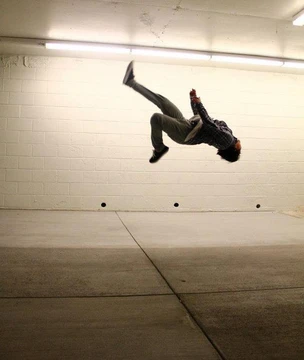
540 kick
A jump kick with 540-degree rotation used in martial arts and tricking.

Voltmetro · CC BY-SA 4.0
The 540 kick is a jump kick move used in martial arts and tricking, involving a rotation of 540 degrees from takeoff to landing. It is most associated with Korean martial arts such as Taekwondo and Tang Soo Do, but is also practiced in Wushu, Shaolin kung fu, Capoeira, and some Karate styles. The defining feature is that the same leg is used for taking off, kicking, and landing.
- Field
- Martial arts, tricking, professional wrestling
Lore & Background
Traditionally, the 540 kick is most associated with Korean martial arts such as Taekwondo and Tang Soo Do, known for flashy kicks and spins. It is also practiced in Wushu, Shaolin kung fu, Capoeira, and some Karate styles. In professional wrestling, it is commonly called a 'jumping corkscrew roundhouse kick', with Kofi Kingston's variation known as 'Trouble in Paradise'.
Reader's Guide
The 540 kick is significant as a foundational move in tricking, often chosen as the first move attempted by many martial arts tricksters. Its variations include the 540 roundhouse (popularized in the mid-eighties by George Chung and Steven Ho), the 540 hook (also known as 'cheat 720' or '540 wheel'), the 540 crescent (found in Wushu), and the 540 gyro (an additional 360-degree rotation mid-air). Other variants include the double leg 540, fake 540, reverse 540, sideswipe, lazyboy 540, and 540 into splits. Multi-kick variants include the crescent 540, jack-knife, and 540 triple. The kick is known by different names across cultures: in Korean as 'Dolgaechagi', in Japanese as 'Kūchūmawashigeri', in Chinese as 'Xuanfengjiao', and in Portuguese as 'Martelo Voador'.
Did You Know?
- The 540 kick is said to be the first move many martial arts tricksters attempt.
- In professional wrestling, Kofi Kingston's variation is called 'Trouble in Paradise'.
Origins & Cross-Disciplinary History
The 540 kick traces its most prominent roots to Korean martial arts, particularly Taekwondo and Tang Soo Do, disciplines celebrated for their spectacular spinning kicks. Yet the technique's reach extends well beyond Korea. Practitioners in Wushu, Shaolin kung fu, Capoeira, and certain Karate styles all incorporate versions of the move. Equally remarkable is its parallel life in ballet, where it functions as an advanced variation of the barrel roll. Principal male dancers such as Daniil Simkin, Tetsuya Kumakawa, and Joseph Phillips have long featured the move and its reverse variant in their solo variations as a crowd-pleasing display of technical excellence. More recently, the kick crossed into professional wrestling, where it is commonly described as a "jumping corkscrew roundhouse kick," and Kofi Kingston's personal adaptation carries the name "Trouble in Paradise." This multi-disciplinary presence underscores how a single rotational concept can be adapted across vastly different performance traditions, from competitive sport to theatrical dance to staged athletic spectacle.
Technical Mechanics & Defining Features
At its core, the 540 kick is a jump kick in which the performer uses the same leg to take off, deliver the strike, and land. The other leg propels the body upward and is retracted before touchdown. A subtle but important distinction exists in how the rotation is counted: although the move is named for approximately 540 degrees of visible rotation, a correctly executed version actually involves only a 360-degree spin by the performer, with the additional apparent rotation coming from the takeoff mechanics. The most prominent defining feature remains that single-leg continuity. In Taekwondo specifically, the term "540 kick" most often refers to the 540 hook variant rather than the roundhouse version, which is more associated with the tricking community. The hook, sometimes called a "cheat 720" or "540 wheel," adds an extra 180 degrees of spin to execute a hook or outside crescent kick with the non-jumping leg. This distinction between the roundhouse and hook forms highlights how the same base movement can branch into fundamentally different striking applications depending on foot positioning and hip orientation.
Naming Across Cultures
The 540 kick carries distinct names in each martial tradition, often reflecting the specific variation most associated with that discipline. In Korean, it is called "Dolgaechagi," translating to "Spinning Kick," and is primarily linked to the 540 roundhouse or 540 hook kick. Japanese practitioners refer to it as "Kūchūmawashigeri," meaning "Air Spin Kick," with a similar association to the roundhouse form. In Chinese martial arts, the term "Xuanfengjiao" — "Whirlwind Kick" — is used, and it is also known as the "inside turning kick," "jump inside kick," or "hyper-tornado kick," most commonly tied to the 540 crescent variation. In Capoeira, the Portuguese name "Martelo Voador" (literally "Spinning Kick") applies. These varied nomenclatures reveal how each culture frames the same rotational concept through its own linguistic and technical lens, with the specific foot position, hip alignment, and degree of rotation determining which name and variation take precedence within a given tradition.
Variations & Specializations
The 540 kick spawns a wide family of variations, each distinguished by foot position, rotation degree, hip alignment, or added kicks. Beyond the standard roundhouse and hook forms, Wushu contributes the 540 crescent, struck with the inside of the foot while hips face the target, and the far rarer 540 gyro, which adds a full 360-degree mid-air rotation before landing — a feat uncommon even in tricking circles. The "double leg 540" uses both legs for takeoff with an inside crescent strike, while the "fake 540" mimics the appearance without the full takeoff pattern. The "reverse 540" begins with a counterclockwise crescent kick landing on the same foot. The "sideswipe" shares the single-leg takeoff-kick-land structure but spins the body parallel to the ground, nearly inverted, demanding exceptional agility. Finally, the "Lazyboy 540" — also called the "Playboy 540" — is technically identical to a standard 540 but performed with hands placed on the back or top of the head, projecting an image of casual ease and demonstrating that the practitioner needs no arm momentum to complete the rotation.
Gallery
Frequently Asked Questions
What exactly is a 540 kick?
A 540 kick is a jumping spinning kick in which the practitioner rotates one and a half full turns (540 degrees) between leaving the ground and landing. It is a high-difficulty move seen in martial arts, tricking, and even professional wrestling.
How is a 540 kick performed?
You spring off one leg, spin 540 degrees in the air while extending the kicking leg, and then land back on that same takeoff leg. The entire rotation must be completed before your feet touch the ground again.
Which martial arts styles feature the 540 kick?
It is most closely tied to Korean disciplines like Taekwondo and Tang Soo Do, but you will also see it in Wushu, Shaolin kung fu, Capoeira, and certain Karate lineages. Tricking communities have further popularized it outside traditional dojang settings.
What is the difference between a 540 kick and a 360 kick?
A 360 kick involves one full rotation, while a 540 kick adds an extra half-turn, making it noticeably harder to control and land cleanly. Both require the same takeoff-and-landing leg, but the 540 demands considerably more angular momentum and mid-air body control.
Why is the 540 kick considered impressive in tricking?
Completing the extra 180 degrees while keeping the same leg for takeoff, strike, and landing demonstrates a high level of spatial awareness and core strength. It is often used as a benchmark for a practitioner's rotational skill and air awareness.
More in Martial arts techniques 1-24
Spotted an error? Know more?
Reader corrections go straight into our review queue. Suggest an edit · How this site is sourced