Butterfly kick
A jumping kick with a horizontal torso twist, originating from wushu.

Alvesgaspar · CC BY-SA 3.0
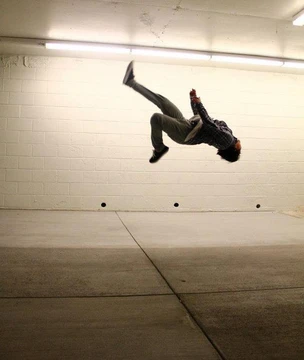
The butterfly kick (旋子, xuànzi, meaning "circle") is a jumping technique used in modern wushu and action cinema. In some changquan styles, it is referred to as the Swallow Kick (Yianzi tui). While the exact form varies, the move typically involves twisting the body, lifting both legs off the ground, and swinging them around while keeping the torso as level as possible.
In action cinema, the kick is often shown as a sweeping move that can take down multiple opponents. In traditional Chinese longfist, it is used defensively to dodge an opponent's low sweep and then land on their exposed side. Many variations exist, and the same name may refer to different movements depending on the martial arts school or style. The kick can be performed from a standing position or after a running step-up. It gets its name because at the peak of the arc, the arms are stretched out, making the limbs resemble a butterfly's wings in flight.
**Variants**
Numerous butterfly kick variants exist, as each practitioner adapts the move to their background. For instance, a wushu-derived butterfly kick tends to be more graceful, while other interpretations may look more dynamic and energetic.
**Butterfly Twist** Also known simply as a twist, this move is popular in the tricking community for its floating, spinning motion and its ability to link into other tricks. It appears in wushu (called xuàn zi zhuàn tǐ) and capoeira (called "mariposa," meaning "butterfly"). A butterfly twist is a butterfly kick with a 360° spin added in the air.
**HK Spin** A derivative of the butterfly twist, the HK spin is essentially the same move but the performer falls horizontally to the ground. It is not usually a trick but is common in fight choreography as a type of fall. Named after Hong Kong martial arts films, the most common versions are 360° and 720° spins, though 1080° spins have been done from a higher to a lower surface.
**Corkscrew** This trick is related to the butterfly twist due to its original takeoff, though a less traditional variant uses a J-Step or J-Turn. The practitioner takes quick steps in an arc, throws a leg upward, and thrusts their arms to lift off. Once airborne, they turn toward the inside of the kicking leg (like an inside crescent), rotating about 540° to land on the non-kicking leg.
- Field
- Martial arts
- Known for
- A jumping kick used in wushu and action cinema
- Variants
- Butterfly Twist, HK Spin, Corkscrew, Illusion Twist, Hyper Twist, Hyper Hook, Twist to the splits, multi-rotation variants (720 Twist, Cheat 720 Twist, 1080 Twist, California Roll)
Lore & Background
The butterfly kick is composed of a twist of the body while both legs are lifted and swung around, with the torso remaining as horizontal as possible. In traditional Chinese longfist, it is used defensively to evade an opponent's floor sweep and land on the enemy's vulnerable side. In action cinema, it is often seen as a kick used to 'cut a swathe' through multiple opponents. The name 'butterfly kick' comes from the legs reaching the apex of their arc while the arms are stretched out, leaving all limbs extended in a position similar to a butterfly's wings in flight.
Reader's Guide
The butterfly kick holds a unique position in the acrobatic world for being a traditional defensive move incorporated into modern popular arts and international sports. Its spectacular appearance, both graceful and powerful, has made it versatile in a wide range of performing arts such as breakdancing, tricking, martial arts films, various video games (including the Tekken series, the Mortal Kombat series, and The Matrix Online), gymnastics, and even Olympic figure skating. It has also appeared in professional wrestling by trained martial artists like Low Ki, and in The Phantom Menace as one of Darth Maul's signature techniques, performed by wushu champion Ray Park. Though not as well known as some other tricking moves such as aerials and flips, the butterfly kick remains a distinctive acrobatic element.
Origins & Core Mechanics
The butterfly kick traces its roots to traditional martial arts systems including modern wushu, taekwondo, and capoeira. In certain changquan lineages, the same movement carries the name Swallow Kick (Yianzi tui). The Chinese term xuànzi literally translates to "circle," reflecting the rotational nature of the technique. At its core, the kick demands that the practitioner twist the body while both legs leave the ground and swing in an arc, all while keeping the torso as level as possible. The name "butterfly" comes from the visual at the apex of the arc: arms stretched wide, all four limbs extended outward, mimicking a butterfly in flight. In traditional Chinese longfist, the technique served a practical defensive purpose—evading an opponent's floor sweep and landing on the enemy's exposed side. It can be initiated from a standing position or from a running step-up, and different schools may apply different names to similar movements or group different movements under the same label.
The Variant Landscape
The butterfly kick has spawned a vast family of related movements, each shaped by the practitioner's martial arts background. A wushu-influenced execution tends toward grace, while a taekwondo-derived version carries a more dynamic, energetic quality. The butterfly twist—called xuàn zi zhuàn tǐ in wushu and "mariposa" in capoeira—adds a full 360-degree spin mid-air. The HK spin, popularized in Hong Kong martial arts films, is essentially a twist where the performer falls onto the ground horizontally, often used as a choreographed fall. The corkscrew uses an arc-shaped step and roughly 540 degrees of rotation, landing on the non-kicking leg. The illusion twist distinguishes itself by whipping a crescent kick with the last leg to bring the body upright, with both feet landing simultaneously. The hyper twist adds an extra 90 to 180 degrees of rotation and lands on the opposite leg, creating a setup that flows directly into another butterfly or twist. The hyper hook extends this by throwing a hook kick after the landing leg swings into position.
Multi-Rotation Progression
As trickers and martial artists pushed the boundaries of the butterfly family, multi-rotation variants emerged, each demanding greater torque, faster body rotation, and additional height to land safely. The 720 twist simply doubles the standard 360-degree rotation and has spawned its own sub-variants, including 720 hyper twists and a hybrid twist-to-gyro that begins as a twist, completes 360 degrees, then continues spinning as the body uprights into a 360 gyro. The "cheat" 720 twist—technically a 540-degree rotation—uses a takeoff similar to a standard 540 kick but held more horizontal, then transitions into normal twist mechanics after roughly 180 degrees of air rotation. The 1080 twist, a triple butterfly twist, represents the pinnacle of this progression; the first successfully recorded and landed attempt was performed by John Vanek. The California Roll takes the cheat 720 framework and extends the rotation to 900 degrees, effectively becoming a cheat 1080 twist.
Cultural Reach & Legacy
The butterfly kick's blend of grace and power has carried it far beyond the martial arts dojang into a remarkably wide range of performing arts and entertainment. It features prominently in breakdancing, tricking, gymnastics, and even Olympic figure skating. In the gaming world, it appears in the Tekken series, the Mortal Kombat series, and The Matrix Online. Professional wrestling has seen the move performed by trained martial artists such as Low Ki. Perhaps its most iconic cinematic moment came in Star Wars: The Phantom Menace, where Ray Park—a wushu champion—executed the technique as one of Darth Maul's signature fighting moves. In action cinema more broadly, the kick is frequently choreographed as a way to cut a swathe through multiple opponents simultaneously. Though it may not enjoy the same name recognition as aerials or flips in the tricking community, the butterfly kick occupies a unique niche: it is a traditional defensive technique from Chinese martial arts that has been absorbed into modern popular arts and international sports, bridging centuries-old combat practice with contemporary spectacle.
Gallery


Frequently Asked Questions
What is a Butterfly kick?
It is a jumping kick in which the practitioner twists the torso horizontally while both legs swing through the air, keeping the body as level as possible. It is a core element of modern wushu and has become a signature move in martial arts films.
Where does the Butterfly kick originate?
The technique traces back to traditional Chinese longfist (changquan), where it is sometimes called the Swallow Kick (Yianzi tui). From there it became a competitive staple in wushu and a go-to visual in action cinema.
How is the Butterfly kick actually performed?
The athlete leaps, lifts both legs off the ground, and rotates the body around its vertical axis while striving to keep the torso flat. The legs trace a circular path in the air, and the move can be extended into multiple full rotations before landing.
What are the main variants of the Butterfly kick?
Common versions include the Butterfly Twist, Corkscrew, 720 Twist, 1080 Twist, and a finishing position called the Twist to the Splits. Each adds extra rotations or a different entry/exit angle to the basic horizontal spin.
What is the Butterfly kick used for in real combat versus film?
In traditional longfist it serves as a defensive counter: the practitioner dodges a low sweep and lands on the opponent's exposed side. In action movies it is typically choreographed as a sweeping takedown that can strike several opponents in one motion.
More in Martial arts techniques 1-24
Spotted an error? Know more?
Reader corrections go straight into our review queue. Suggest an edit · How this site is sourced