Eildon Hill
Last updated

via Wikipedia: Eildon Hill · see source
Where it is
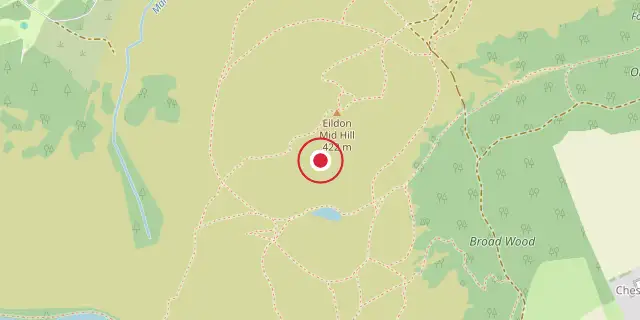
Coordinates: 55°34′52″N 2°43′08″W (55.5810, -2.7190) · Open in OpenStreetMap
Coordinates and connected clubs: the infobox of Wikipedia: Eildon Hill (CC BY-SA 4.0). Map: drawn by Codexery from OpenStreetMap tiles.
Eildon Hill is a 422 m eminence in the Scottish Borders, just south of Melrose, whose triple peak is often referred to as the Eildons or Eildon Hills. The hill, formed by volcanic activity 350 million years ago, is notable for its large hill fort with over 5 km of ramparts and at least 300 house platforms, making it one of the largest known in Scotland. It also hosted a Roman army signalling station on its north hilltop.
History
The hill fort on Eildon North Hill was occupied by 1000 BC during the Bronze Age, with ramparts built and rebuilt in three phases. Some 296 individual hut floors have been identified, suggesting a population of around 2000, and the fort is thought to have been the capital of the Selgovae, who lived in upper Tweeddale before the Romans arrived. In the 1st century AD, the Roman army built the fort of Trimontium at Newstead, named after the three peaks, and constructed a signal tower with a tiled roof in a 15 m diameter enclosure on the summit of Eildon North Hill.
The hill fort may have been abandoned by then, as Roman archaeological finds from 1986 excavations overlaid native finds. The tower was initially built of timber during the Flavian period, with a later stone tower built under Emperor Antoninus Pius. Roman coins and pottery suggest some house platforms were reused in the 2nd to 4th century. Prehistoric peoples may have regarded the hills as a holy place for ceremonial gatherings, and several holy springs at the base, now dedicated to Christian saints, were probably originally sacred to Celtic deities.
The hills were once called Eldune, from the 12th-century Simeon of Durham, with the name's first part variously etymologized as Brittonic eil (fenced enclosure) or Old English ǣled (fire) or ǣlǣte (empty place).
In folklore and media
Eildon Hill is often described as a hollow hill and features in the story of Thomas the Rhymer. Some accounts claim Thomas entered the hill itself. Sir Walter Scott recorded a tale about a horse dealer who received ancient coins from an oddly dressed old man and was led inside the hill at night. There, a group of armed knights slept beside their horses, with King Arthur as their leader.
The dealer was shown a horn and a sword, but in his confusion he blew the horn. The knights began to wake, and a voice called him a coward for not taking the sword first. A whirlwind threw him out, and after telling shepherds what happened, he died from exhaustion. Scott identified the old man as Thomas the Rhymer.
Another story involves the Eildon Tree Stone, a large moss-covered boulder near Melrose, said to be the spot where the Fairy Queen took Thomas into her realm inside the hills. The volcanic rock was supposedly split into three by the wizard Michael Scot, as described in Scott’s 1805 poem The Lay of the Last Minstrel. James Hogg later retold this legend in his 1823 novel The Three Perils of Man. The hill also appears in the lyrics of the song “Eiledon” from Big Country’s album The Seer.
More in Locations Associated with Arthurian Legend
Sources
Compiled from Wikipedia and the sources listed below. Text from Wikipedia is available under CC BY-SA 4.0; this entry is adapted from it.
- Wikipedia: Eildon Hill (CC BY-SA 4.0).
Spotted an error? Know more?
Reader corrections go straight into our review queue. Suggest an edit · How this site is sourced