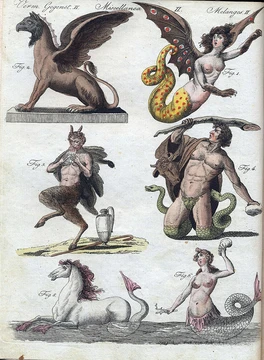
Fairy Queen
Female ruler of fairies in folklore and literature.

via Wikipedia: Fairy Queen · see source
A Fairy Queen is a female ruler of fairies in folklore and literature, sometimes with a king. She may be named or unnamed; Titania and Mab are common names. Many characters, goddesses, and spirits worldwide have been called Fairy Queens.
Quick Facts
- Common names
- Titania, Mab
- Irish fairy queens
- Oonagh
- Una
- Nuala
- Clíodhna
- Aibhell
- Ainé
- Arthurian fairy queen
- Morgan le Fey (Morgen)
- Shakespearean fairy queens
- Titania (A Midsummer Night's Dream), Queen Mab (Romeo and Juliet)
- Spenserian fairy queen
- Gloriana (also called Tanaquill)
- Welsh fairy queen
- Gwenhidw
Facts from the source article.
Did You Know?
- In Thomas Cheyne's rebellion in January 1450, male leaders used the aliases 'the King of Fairies' and 'the Queen of Fairies'.
- In Tam Lin (Child 39), the Fairy Queen pays a tithe to Hell every seven years, and Tam Lin fears he will be the human sacrifice.
Folklore
In Irish mythology, the Tuatha Dé Danann and Daoine Sidhe were ruled by many local kings and queens. Oonagh, also called Una or Nuala, was married to Finvarra, the fairy king of western Ireland, though he often had other lovers. She typically lived with him in his hill, Cnoc Meadha, but some stories place her in a separate home at Cnoc Sidh Una. One tale follows the Fairies' Midwife pattern: a human girl carelessly curses "Fionnbharr's wife," who then forces the girl to serve as her midwife. The fairy queen tries to kill the girl with a belt that would cut her in two, but a fairy servant warns her in time. Other Irish fairy queens include Clíodhna of Munster, Aibhell, and Ainé. In Arthurian legend, Morgan le Fey ruled the magical island of Avalon and was sometimes seen as a fairy queen; in the Vita Merlini, she appears as Morgen, leader of nine magical sister queens. Fairy queens also show up in several Child Ballads. Alison Gross features a kind, helpful fairy queen, while Tam Lin has a terrifying one who pays a tithe to Hell every seven years and may sacrifice the human Tam Lin. An unnamed fairy queen in Thomas the Rhymer takes the hero as her lover and gives him prophetic gifts; though similar to Tam Lin's story, she is more benevolent. During Thomas Cheyne's rebellion in 1450, male leaders used the aliases "King of Fairies" and "Queen of Fairies." The 17th-century English mystic Goodwin Wharton believed he had married a fairy queen named Penelope La Gard. Local beliefs across Britain named many fairy queens: a Manx charm lists King Philip and Queen Bahee; a Welsh source calls the queen of the Tylwyth Teg Gwenhidw, wife of Gwydion ab Don, whose sheep were small fleecy clouds. Some of these beliefs entered literature. Thomas Shaw's poem Shantooe Jest features "Old Moss the fairy queen," who flees church bells to live with a giant named Todmore, eventually settling at Todmorden. Janet, a spirit linked to Janet's Foss in Yorkshire, was romanticized as a fairy queen by outsiders. Joan the Wad was a Cornish queen of the piskeys, popularized in early 1900s marketing. In 1801, John Leyden claimed the Scottish fairy queen was Nicneven, also called the Gyre-Carling or Hecate, but later scholars note Nicneven first appears in a 1580 poem as a witch, separate from the Elf Queen. Worldwide equivalents exist: in modern Greek folklore, Lamia rules the Nereids and Artemis the mountain nymphs; a Romani legend tells of Ana, queen of the Keshali nymphs, abducted by a demon.
Literature and media
In 'The Merchant's Tale', by Geoffrey Chaucer, Pluto and Proserpine are described as the king and queen of the fairies. This depiction is thought to have influenced William Shakespeare's fairy rulers in A Midsummer Night's Dream. A fairy queen Gloriana, daughter of King Oberon, is the titular character of the allegorical epic poem The Faerie Queene by Edmund Spenser. She is also called Tanaquill, derived from the name of the wife of Tarquinius Priscus. She is a virtuous ruler written as an allegorical depiction of Queen Elizabeth. William Shakespeare referred multiple times to the figure of a fairy queen. The Merry Wives of Windsor makes reference to the concept. In A Midsummer Night's Dream, Titania is the queen of the fairies and wife of King Oberon. Her name is derived from Ovid as an epithet of the Roman goddess Diana. In Romeo and Juliet, the character of Queen Mab does not appear but is described; she is the fairies' midwife, who rides in a tiny chariot and brings dreams to humans. Post-Shakespeare, authors such as Ben Jonson and Michael Drayton also named the fairy queen as Mab. Drayton named Mab, not Titania, as Oberon's wife. Aside from Titania and Mab, Oberon was sometimes depicted with wives of other names: Aureola in a 1591 entertainment given for Queen Elizabeth at Elvetham in Hampshire, and Chloris in William Percy's The Faery Pastorall around 1600. Fairies and their society often played a major role in the French contes de fées. The fairies are ruled by a queen in Gabrielle-Suzanne Barbot de Villeneuve's Beauty and the Beast, and in several of Madame D'Aulnoy's tales, such as The Princess Mayblossom. In Charlotte-Rose de Caumont de La Force's Fairer-than-a-Fairy, the villain is a wicked fairy queen named Nabote who replaced the previous, good queen. D'Aulnoy, who popularized the genre and the term 'fairy tale', was nicknamed 'la reine de la féerie'. In The Little White Bird, the predecessor to Peter Pan, author J. M. Barrie identifies Queen Mab as the name of the benign and helpful fairy queen. In Disney's series of films based on Tinker Bell, branching out from their adaptation of Peter Pan, the fairy ruler is Queen Clarion. In L. Frank Baum's Oz books, Queen Lurline is an otherworldly fairy queen who played a role in the creation of the Land of Oz. An unnamed Queen of the Fairies also features in Baum's book The Life and Adventures of Santa Claus, and is named Lulea in Baum's Queen Zixi of Ix.
Witchcraft and neopaganism
The goddess Diana was regularly portrayed as the ruler of the fairy kingdom in demonological literature, such as King James VI of Scotland's Daemonologie, which says that she belongs to 'the fourth kind of spirits, which by the Gentiles [non-Jews] was called Diana and her wandering court, and amongst us is called Fairy (as I told you) or our good neighbours'. Medieval Christian authorities condemned cult beliefs of nocturnal, female spirit leaders who might accept offerings or take practitioners on a nighttime journey. The Sicilian doñas de fuera of Italy were one example. In Scotland in the 1530s, William Hay described Scottish witches meeting with 'seely wights' or 'Diana queen of the fairies'. Julian Goodare clarifies that '[t]here is no reason to believe that there was a Scottish cult of Diana'; rather, the name was contemporary authorities' way of classifying such beliefs. Names used for this figure included Herodias, Abundia, Bensozia, Richella, Satia, and numerous others like Doamna Zînelor in Romania (translated by Mircea Eliade as 'Queen of the Fairies') or Wanne Thekla in the Netherlands. A queen of the fairies or spirits, referred to as the 'Quene of Elfame' and other spelling variants, was mentioned in several Scottish witch trials. In the 16th century, Andro Man claimed to have had children by the 'Quene of Elphen'. Scholar Robert Pitcairn reconstructed the word as 'Elphame' or 'Elf-hame'.
More in English Legendary Creatures
Spotted an error? Know more?
Reader corrections go straight into our review queue. Suggest an edit · How this site is sourced