Eastern Hemisphere
Half of Earth east of the prime meridian, encompassing Afro-Eurasia and Australia.

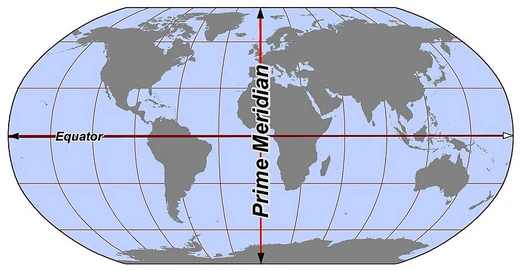
The Eastern Hemisphere is the half of Earth lying east of the prime meridian, which runs through Greenwich, London, United Kingdom, and west of the antimeridian at 180° longitude, which crosses the Pacific Ocean. This boundary, an almost perfect circle around the oblate spheroid Earth, is an arbitrary convention established in 1884 at the International Meridian Conference in Washington, D.C., where the standard time concepts of Canadian engineer Sir Sandford Fleming were adopted. The hemisphere is often used synonymously with Afro-Eurasia and Australia, contrasting with the Western Hemisphere’s Americas, and is sometimes called the "Oriental Hemisphere" or equated with the "Old World." Its landmass is larger than the Western Hemisphere’s, containing a wide variety of habitats. The center of all land in the Eastern Hemisphere (excluding Antarctica) lies in southern Afghanistan. While Russia holds the largest total land area, China is the largest country entirely within the hemisphere at 9,596,961 square kilometers. The Indian Ocean is the only ocean fully contained here, with the hemisphere’s center located at the intersection of the equator and the 90th meridian east, 910 kilometers west of Indonesia in the Ninety East Ridge. Alternative boundaries using 20°W and 160°E are sometimes employed outside physics and navigation to include all of Europe and Africa, though this excludes parts of eastern Russia and Oceania. Prior to standard time, numerous prime meridians were locally decreed. The hemisphere contains 18 borderless island nations, including Australia, Japan, and Madagascar, while 39 African and 34 European countries lie entirely within it.
- Ocean entirely within
- Indian Ocean
- Center of land mass (excluding Antarctic
- 30°00′00″N 62°15′00″E in southern Afghanistan
- Number of independent countries entirely
- 18
Lore & Background
The Eastern Hemisphere encompasses the half of Earth lying east of the prime meridian (which runs through Greenwich, London) and west of the antimeridian at 180° longitude. This boundary, an arbitrary convention established in 1884 at the International Meridian Conference in Washington, D.C., forms an almost perfect circle around the oblate spheroid planet. The hemisphere is often equated with Afro-Eurasia and Australia, and is sometimes called the "Oriental Hemisphere" or, in a cultural sense, the "Old World." Its landmass is larger than that of the Western Hemisphere and contains a wide variety of habitats. The Indian Ocean is the only ocean entirely within this hemisphere, and its center lies at the intersection of the equator and the 90th meridian east, about 910 kilometers west of Indonesia. The center of all land in the Eastern Hemisphere (excluding Antarctica) is located in southern Afghanistan. While Russia holds the largest total land area here, China is the largest country entirely within the hemisphere. The boundary does not perfectly align with continents: portions of Western Europe, West Africa, Oceania, and extreme northeastern Russia fall in the Western Hemisphere. An alternative boundary using the 20°W and 160°E meridians is sometimes employed outside navigation and physics, as it keeps all of Europe and Africa’s mainlands within the Eastern Hemisphere, though it excludes more of eastern Russia and Oceania.
Reader's Guide
The Eastern Hemisphere holds the majority of Earth's landmass and a wide variety of habitats. Its center of land (excluding Antarctica) lies in southern Afghanistan. The Indian Ocean is the only ocean entirely within it. The hemisphere includes 18 independent countries with no land borders, such as Australia, Japan, and Madagascar. Many African and European countries lie entirely within it, while some straddle the prime meridian. Animals exclusive to the Eastern Hemisphere include kangaroos, koalas, pandas, and orangutans. Human history in the region includes early migrations from Africa, settlement of Pacific landmasses, and later colonial encounters during the Age of Discovery. The Eastern Hemisphere is often synonymous with the 'Old World.'
Did You Know?
- The Land Hemisphere, centered near 47°N, 1°E near Nantes, France, contains the largest possible area of land, including most of the world's continents and major landmasses.
- The Water Hemisphere, centered near 47°S, 179°W in the South Pacific Ocean, contains the largest possible area of water, including most of the Indian, Pacific, and Southern Oceans.
- The Eastern Hemisphere is defined by the Prime meridian, which splits the globe into eastern and western halves.
- The Equator divides Earth into northern and southern hemispheres, while the Prime meridian divides it into eastern and western hemispheres.
- Hemispheres can be divided geographically or culturally, or based on religion or prominent geographic features.
Frequently Asked Questions
What is the largest country that sits entirely within the Eastern Hemisphere?
China, at roughly 9.6 million square kilometres, is the biggest sovereign state whose borders never cross into the Western Hemisphere. The Indian Ocean is likewise the only ocean contained wholly within the Eastern Hemisphere.
Where is the geographic center of the Eastern Hemisphere's land mass (excluding Antarctica)?
It falls at about 30°N 62°15′E, a point in southern Afghanistan. Eighteen fully independent nations have every part of their territory inside the Eastern Hemisphere.
More in Lines & Hemispheres 1-24
Related in Lines & Hemispheres
Links follow this subject's own source article.
Spotted an error? Know more?
This is a living reference — every entry is fact-audited, and reader corrections feed straight into our audit queue. Suggest an edit · See this site's audit record