Great circle
The largest circle on a sphere, analogous to a straight line.

A great circle, also known as an orthodrome, is defined as the intersection of a sphere with a diametral plane—that is, any plane that passes through the sphere's center. This intersection always forms a circle, and it is the largest possible circle that can be drawn on a given sphere. Every diameter of a great circle coincides with a diameter of the sphere itself, making every great circle concentric with the sphere and of the same radius. The disk bounded by a great circle is called a great disk, formed by the intersection of a ball with a plane through its center. Any other circle on the sphere, resulting from a plane that does not pass through the center, is termed a small circle, which is the spherical-geometry analog of a circle in Euclidean space. Notably, every circle in Euclidean 3-space is a great circle of exactly one sphere.
In spherical geometry, great circles are the natural analog of straight lines in Euclidean space. Any arc of a great circle is a geodesic of the sphere, meaning it represents the shortest path along the surface between two points. For any two distinct points on a sphere that are not antipodal (directly opposite each other), there exists exactly one great circle passing through both. However, because every great circle that passes through a point also passes through its antipodal point, infinitely many great circles connect two antipodal points. The shorter of the two arcs between two distinct points is called the minor arc, and its length is the great-circle distance, proportional to the central angle formed by the two points and the sphere's center. The derivation of this shortest path can be proven using calculus of variations: by setting up spherical coordinates with one point as the north pole and applying the Euler–Lagrange equation, the minimizing curve is shown to lie on a meridian, which corresponds to a plane through the sphere's center.
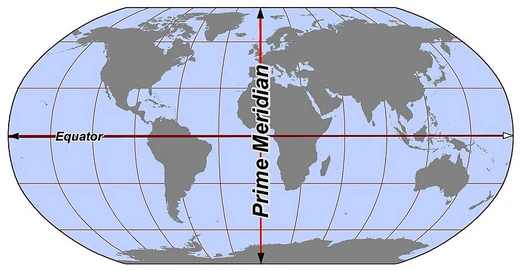
Great circles have numerous applications. On the celestial sphere, examples include the celestial horizon, celestial equator, and ecliptic. On Earth, the equator is a great circle, and any meridian together with its opposite meridian forms a great circle. Another notable great circle divides the land and water hemispheres. In navigation, great circles provide accurate approximations of geodesics for air and sea routes, even though Earth is not a perfect sphere. In higher dimensions
- field
- Mathematics
- known_for
- Shortest surface path between two points on a sphere; largest circle on a sphere
- related_concepts
- Geodesic, small circle, great disk, great-circle distance
Lore & Background
A great circle is defined as the intersection of a sphere with a plane passing through the sphere's center. For any pair of distinct non-antipodal points on the sphere, there is exactly one great circle passing through both; for antipodal points, infinitely many great circles exist. The shorter arc between two points on a great circle is called the minor arc, and its length is the great-circle distance, proportional to the central angle formed by the two points and the sphere's center. Every great circle is concentric with the sphere and shares the same radius; any diameter of a great circle coincides with a diameter of the sphere. Circles on a sphere that are not great circles are called small circles, formed by the intersection of the sphere with a plane not passing through its center. In Euclidean 3-space, every circle is a great circle of exactly one sphere. The disk bounded by a great circle is called a great disk, defined as the intersection of a ball and a plane through its center. In higher dimensions, great circles on the n-sphere are the intersection of the n-sphere with 2-planes through the origin in Euclidean space R^(n+1). Half of a great circle may be called a great semicircle, as in parts of a meridian in astronomy.
Reader's Guide
The concept of the great circle is fundamental in spherical geometry and navigation because the minor arc of a great circle represents the shortest path between two points on a sphere's surface. This property is proven using calculus of variations: by introducing spherical coordinates with one point as the north pole, the length functional for any curve between two points is minimized when the curve follows a great circle. The derivation shows that the constant C in the Euler–Lagrange equations must be zero, leading to a constant longitude (φ' = 0), which describes a meridian—a great circle. Thus, great circles are geodesics on the sphere. Great circles are also the largest circles that can be drawn on a given sphere, and they share the sphere's center and radius. Their significance extends to astronomy (e.g., meridians) and to higher-dimensional geometry, where they generalize to intersections of n-spheres with 2-planes through the origin. The distinction between great and small circles is crucial: small circles are the spherical analog of circles in Euclidean space, while great circles are the analog of straight lines.
Did You Know?
- A great circle is the largest circle that can be drawn on any given sphere.
- Any diameter of a great circle coincides with a diameter of the sphere.
- Every circle in Euclidean 3-space is a great circle of exactly one sphere.
- The disk bounded by a great circle is called a great disk.
Frequently Asked Questions
What is a Great circle, exactly?
A Great circle is the biggest circle you can carve out of a sphere, produced when a flat plane slices straight through the sphere's center. In navigation jargon it's also called an orthodrome.
What role does a Great circle play in spherical geometry?
It acts as the curved-surface stand-in for a straight line, so any arc you trace along it is the shortest possible route between its two endpoints. That property makes every great-circle arc a geodesic of the sphere.
How is a Great circle different from a small circle?
A small circle appears when a plane cuts the sphere off-center, yielding a ring smaller than the sphere's maximum girth. A great circle, by definition, always threads through the center and therefore represents the largest circle the sphere can hold.
Why do navigators and mathematicians care so much about Great circles?
Because the arc of a great circle between two points is the minimum surface distance, it forms the backbone of efficient air and sea routing across the globe. It also underlies the formal notion of great-circle distance in spherical trigonometry.
Which other concepts does the Great circle tie into?
It connects directly to geodesics, to the flat region called a great disk that it encloses, and to the contrast with small circles. Grasping the great circle is essentially the first step toward working through any distance or angle problem on a curved surface.
More in Lines & Hemispheres 1-24
Spotted an error? Know more?
This is a living reference — every entry is fact-audited, and reader corrections feed straight into our audit queue. Suggest an edit · See this site's audit record