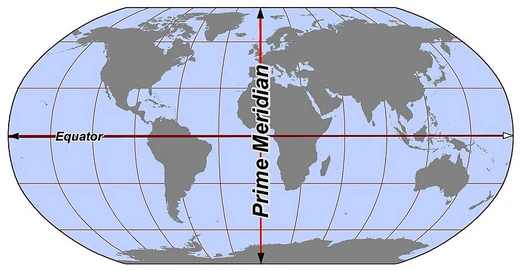
East
Cardinal direction of sunrise, opposite west, abbreviated as E.

East is a cardinal direction, one of the four main points on a compass. It lies directly opposite west and marks the general area where the Sun rises each day.
The term traces back through Middle English *est* and Old English *ēast* to the Proto-Germanic *aus-to-* or *austra-*, meaning "east" or "toward the sunrise." This root comes from the Proto-Indo-European *aus-*, meaning "to shine" or "dawn." Similar formations appear in other languages: Latin *oriens* (east, sunrise) from *orior* (to rise), Greek *anatolé* (east) from *anatéllō* (to rise), and Hebrew *mizraḥ* (east) from *zaraḥ* (to rise, to shine). The Germanic dawn goddess Ēostre may have personified both dawn and the cardinal points. During the Middle Ages, east was called the Orient, often abbreviated as O on maps and compasses. Today, it is commonly shortened to E.
In navigation, east is conventionally placed on the right-hand side of a map, a practice derived from compasses that put north at the top. However, on maps of planets like Venus and Uranus, which rotate retrograde, east appears on the left. To head east with a compass, one sets a bearing or azimuth of 90°.
Culturally, east is the direction of Earth’s rotation, so the Sun generally rises there. Praying toward the east predates Christianity, but the religion adopted it because the Orient was seen as humanity’s original home. As a result, Christian churches have traditionally been oriented with the altar on the liturgical east. The Orient broadly refers to the Eastern world relative to Europe, often serving as a metonym for Asia, divided into the Far East, Middle East, and Near East—though these regions lie east of Earth’s geographical center. One study suggests that in a typical Northern Hemisphere city, the east end tends to be poorer, as prevailing winds blow from the west.
- Field
- Cardinal direction, navigation, geography
- Known for
- Being the direction of sunrise, opposite of west, and the basis for the Orient concept
- Symbol
- E (abbreviation)
- Compass bearing
- 90° (azimuth)
- Cultural association
- Praying towards East, church orientation, division of Asia into Far, Middle, and Near East
Lore & Background
East is defined as the direction from which the Sun rises on Earth. Its etymology traces through Middle English 'est', Old English 'ēast', Proto-Germanic *aus-to- or *austra-, and Proto-Indo-European *aus- 'to shine' or 'dawn'. Cognates include Old High German *ōstar, Latin 'aurora' (dawn), and Greek 'ēōs' (dawn, east). Similar formations appear in Latin 'oriens' (east, sunrise) from 'orior' (to rise), Greek 'anatolé' (east) from 'anatellō' (to rise), and Hebrew 'mariza' (east) from 'zaraḥ' (to rise, to shine). The Germanic goddess Ēostre, a goddess of dawn, might have been a personification of both dawn and the cardinal points. In the Middle Ages, East was referred to as the Orient, or abbreviated on compasses and maps as O.
Reader's Guide
East is one of the four cardinal directions, fundamental to navigation and cultural geography. By convention, the right-hand side of a map is east, a practice derived from compass use placing north at the top; however, on maps of retrograde-rotating planets such as Venus and Uranus, the left-hand side is east. To go east using a compass, one sets a bearing or azimuth of 90°. Culturally, east is the direction of Earth's rotation and thus the general direction of sunrise. The practice of praying towards the East predates Christianity but was adopted by that religion, as the Orient was thought to contain mankind's original home; Christian churches have traditionally been oriented towards the east, with the altar on the liturgical east. The Orient refers to the East, traditionally comprising the Eastern world relative to Europe, and in English is largely a metonym for Asia, divided into the Far East, Middle East, and Near East—regions still located east of the Geographical centre of Earth. One study suggested that within an individual Northern Hemisphere city, the east end is typically poorer because prevailing winds blow from the west.
Did You Know?
- East is the opposite direction from west and the direction from which the Sun rises on Earth.
- The word 'east' derives from Proto-Indo-European *aus- 'to shine' or 'dawn', cognate with Latin 'aurora' and Greek 'ēōs'.
- On maps of retrograde-rotating planets such as Venus and Uranus, the left-hand side is east.
- The practice of praying towards the East is older than Christianity and was adopted by that religion.
Frequently Asked Questions
Who is East in Lines & Hemispheres 1-24?
East is the cardinal point that marks where the Sun appears each morning, sitting directly across the compass from West. It is shorthand-abbreviated as E and serves as one of the four fixed reference axes for all directional mapping.
What is East's compass bearing and how is it measured?
East occupies the 90-degree azimuth position on a standard compass rose, a quarter-turn clockwise from North. This fixed angular slot is what makes it the baseline for calculating every other bearing in navigation.
Where does the name 'East' actually come from?
The term flows from Proto-Indo-European roots tied to the idea of shining or dawning, through Proto-Germanic words meaning 'toward the sunrise,' into Old English 'ēast' and Middle English 'est.' The etymology essentially bakes the solar-rising function straight into the word.
What cultural and religious roles does East play?
Many traditions direct worshippers to face East during prayer, and the orientation of a church's altar toward that point is a long-standing architectural convention. The direction also anchors the geopolitical shorthand that splits Asia into the Near, Middle, and Far East.
Why is East considered foundational to hemispheres and wayfinding?
Because the Sun's daily arc gives East a visible, instrument-free anchor, it became the natural reference for dividing the globe into eastern and western hemispheres. Every compass-based route, from ancient sailing to modern GPS calibration, still treats that 90° slot as a non-negotiable starting point.
More in Lines & Hemispheres 1-24
Spotted an error? Know more?
This is a living reference — every entry is fact-audited, and reader corrections feed straight into our audit queue. Suggest an edit · See this site's audit record