North
One of the four cardinal directions, opposite south.

North is a cardinal direction, one of the four main compass points. It lies directly opposite south and forms a right angle with east and west. The word functions as a noun, adjective, or adverb when describing direction or geography.
The term "north" traces back to the Old High German *nord*, both stemming from the Proto-Indo-European root *ner-, meaning "left" or "below." This association comes from the fact that north is to the left when facing the rising sun, and the other cardinal directions are similarly linked to the sun's position. In Latin, *borealis* derives from the Greek *boreas*, meaning "north wind" or "north," personified in Ovid as the wind-god Boreas, father of Calais and Zetes. Another Latin term, *septentrionalis*, comes from *septentriones* ("the seven plow oxen"), a name for the constellation Ursa Major. The Greek *arktikós*, also named for this constellation, gives English the word "Arctic." Other languages have different origins: in Lezgian, *kefer* can mean both "disbelief" and "north" because areas north of the Muslim Lezgian homeland were once inhabited by non-Muslim peoples. In many Mesoamerican languages, north also means "up." In Romanian, the old word for north is *mĭazănoapte*, from Latin *mediam noctem* (midnight), and in Hungarian, *észak* comes from *éjszaka* ("night"), since between the Tropic of Cancer and the Arctic Circle the sun never shines from the north. North is sometimes abbreviated as N.
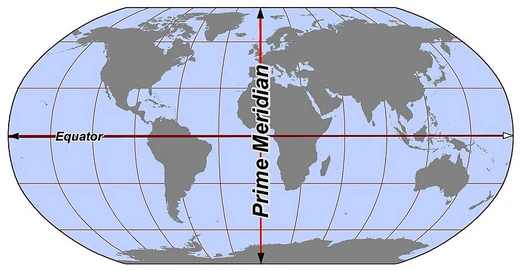
By convention, the top of a map points north. To navigate north with a compass, set a bearing or azimuth of 0° or 360°. Traveling directly north follows a meridian line upward. In Western culture, north is considered the fundamental direction: it is used (explicitly or implicitly) to define all other directions. The top edges of maps usually correspond to the northern edge of the area shown, unless stated otherwise or landmarks are more useful. For any rotating astronomical object, north often denotes the side that appears to rotate counterclockwise when viewed from afar along the axis of rotation. However, the International Astronomical Union defines the geographic north pole of a planet or satellite as the pole in the same celestial hemisphere as Earth's north pole, relative to the Solar System's invariable plane. This means some objects, like Uranus, rotate retrograde: when seen from the IAU north, the spin is clockwise.
Magnetic north is the direction a properly functioning magnetic compass points. The difference between magnetic north and true north is called magnetic declination. For many purposes, ignoring this difference is acceptable; in others, compensation based on known declination solves the problem. Simple generalizations on the subject are unsound and may reflect popular misconceptions about terrestrial magnetism. Maps for orienteering by compass clearly indicate local declination for easy correction. Maps may also show grid north, the direction northward along the map projection's grid lines.
The visible rotation of the night sky around the celestial pole provides a vivid metaphor for north as "up." Thus, choosing north as "up" in the Northern Hemisphere (or south in the Southern Hemisphere) was, before global communication, not arbitrary for nighttime astronomers. (The Southern Hemisphere lacks a prominent visible analog to the northern Pole Star.) Chinese and Islamic cultures considered south the proper "top" for maps. In Polynesian cultures, where navigation was vital, winds—prevailing local or ancestral—could define cardinal points. In Western culture, maps are typically drawn with true north or magnetic north at the top. Globes have the North Pole at the top, or in the top half if the axis is inclined. Maps are usually labeled to show which direction corresponds to a direction on Earth, often with a single arrow for true north, occasionally for magnetic north, or with two arrows for both. A compass rose may appear, but usually on a map with north at the top and with north more prominently decorated. "Up" is a metaphor for north. The convention that north should be "up" and east at the right was established by the Greek astronomer Ptolemy. Historian Daniel Boorstin suggested this may be because better-known places in his world were in the Northern Hemisphere, making them most convenient for study in the upper right-hand corner of a flat map. North is often associated with colder climates, as most of the world's populated high-latitude land is in the Northern Hemisphere. The Arctic Circle passes through the Arctic Ocean, Norway, Sweden, Finland, Russia, the United States (Alaska), Canada (Yukon, Northwest Territories, and Nunavut), Denmark (Greenland), and Iceland.
- Etymology
- From Old High German nord, Proto-Indo-European *ner- meaning 'left; below'
- Latin term
- borealis (from Greek boreas 'north wind')
- Abbreviation
- N
- Magnetic north
- Direction indicated as north on a properly functioning magnetic compass
- Prime direction
- Fundamental direction in Western culture
Lore & Background
The word north is related to the Old High German nord, both descending from the Proto-Indo-European unit *ner-, meaning 'left; below' as north is to left when facing the rising sun. Similarly, the other cardinal directions are also related to the sun's position. The Latin word borealis comes from the Greek boreas 'north wind, north' which, according to Ovid, was personified as the wind-god Boreas, the father of Calais and Zetes. Septentrionalis is from septentriones, 'the seven plow oxen', a name of Ursa Major. The Greek ἀρκτικός (arktikós) is named for the same constellation, and is the source of the English word Arctic. Other languages have other derivations. For example, in Lezgian, kefer can mean both 'disbelief' and 'north', since to the north of the Muslim Lezgian homeland there are areas formerly inhabited by non-Muslim Caucasian and Turkic peoples. In many languages of Mesoamerica, north also means 'up'. In Romanian the old word for north is mĭazănoapte, from Latin mediam noctem meaning midnight and in Hungarian is észak, which is derived from éjszaka ('night'), since between the Tropic of Cancer and the Arctic Circle the Sun never shines from the north. By convention, the top or upward-facing side of a map is north. Traveling directly north traces a meridian line upwards. North is specifically the direction that, in Western culture, is considered the fundamental direction: north is used (explicitly or implicitly) to define all other directions.
Reader's Guide
North's significance extends beyond simple navigation. As the prime direction in Western culture, it defines all other directions and is conventionally placed at the top of maps, a practice established by the Greek astronomer Ptolemy. The historian Daniel Boorstin suggests this may be because the better-known places in his world were in the northern hemisphere, and on a flat map these were most convenient for study if they were in the upper right-hand corner. The visible rotation of the night sky around the visible celestial pole provides a vivid metaphor of that direction corresponding to 'up', though Chinese and Islamic cultures considered south as the proper 'top' end for maps. Magnetic north differs from true north by an angle called magnetic declination. Maps intended for orienteering by compass clearly indicate the local declination for easy correction to true north. On any rotating astronomical object, north often denotes the side appearing to rotate counterclockwise when viewed from afar along the axis of rotation, though the International Astronomical Union defines the geographic north pole of a planet or any of its satellites in the Solar System as the planetary pole that is in the same celestial hemisphere, relative to the invariable plane of the Solar System, as Earth's north pole. North is quite often associated with colder climates because most of the world's populated land at high latitudes is located in the Northern Hemisphere.
Did You Know?
- The word north derives from the Proto-Indo-European *ner-, meaning 'left; below', as north is to the left when facing the rising sun.
- In many languages of Mesoamerica, north also means 'up'.
- The difference between magnetic north and true north is called magnetic declination.
- The Greek word ἀρκτικός (arktikós), source of 'Arctic', is named for the constellation Ursa Major.
Frequently Asked Questions
Who is North in the Lines & Hemispheres canon?
North is the prime cardinal direction, the fixed reference point that anchors the entire compass system. It sits directly opposite South and forms right angles with both East and West, making it the baseline against which every other bearing is defined.
What role or 'power' does North hold in the series?
North functions as the heading a properly functioning magnetic compass seeks, and it is the direction placed at the top of every standard map in Western tradition. Its role is structural: it provides the constant axis around which the other three cardinal points are positioned.
Where does the name 'North' come from?
The word descends from Old High German 'nord,' which in turn traces back to the Proto-Indo-European root *ner-, originally carrying the sense of 'left' or 'below.' In Latin scholarship the equivalent descriptor is 'borealis,' borrowed from the Greek name for the north wind, boreas.
How does North's arc resolve across the 24-part run?
Because North is the fixed, non-rotating reference point of the compass system, its 'story' concludes by simply remaining in place while the other three directions define themselves in relation to it. Its permanence is the structural anchor that holds the entire series together.
Why do fans argue North is more important than East, West, or South?
In Western cultural tradition North is treated as the default or prime direction, the one a compass needle actively seeks and the one mapped at the top of every standard chart. This gives it a foundational status the other three cardinal points do not share.
More in Lines & Hemispheres 1-24
Spotted an error? Know more?
This is a living reference — every entry is fact-audited, and reader corrections feed straight into our audit queue. Suggest an edit · See this site's audit record