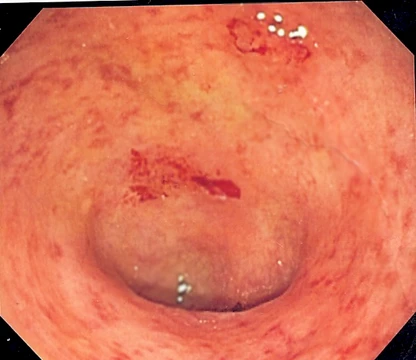
Ascending cholangitis
Life-threatening bile duct inflammation, usually from gallstone obstruction.
Last updated

Alaa Najjar · CC BY-SA 3.0
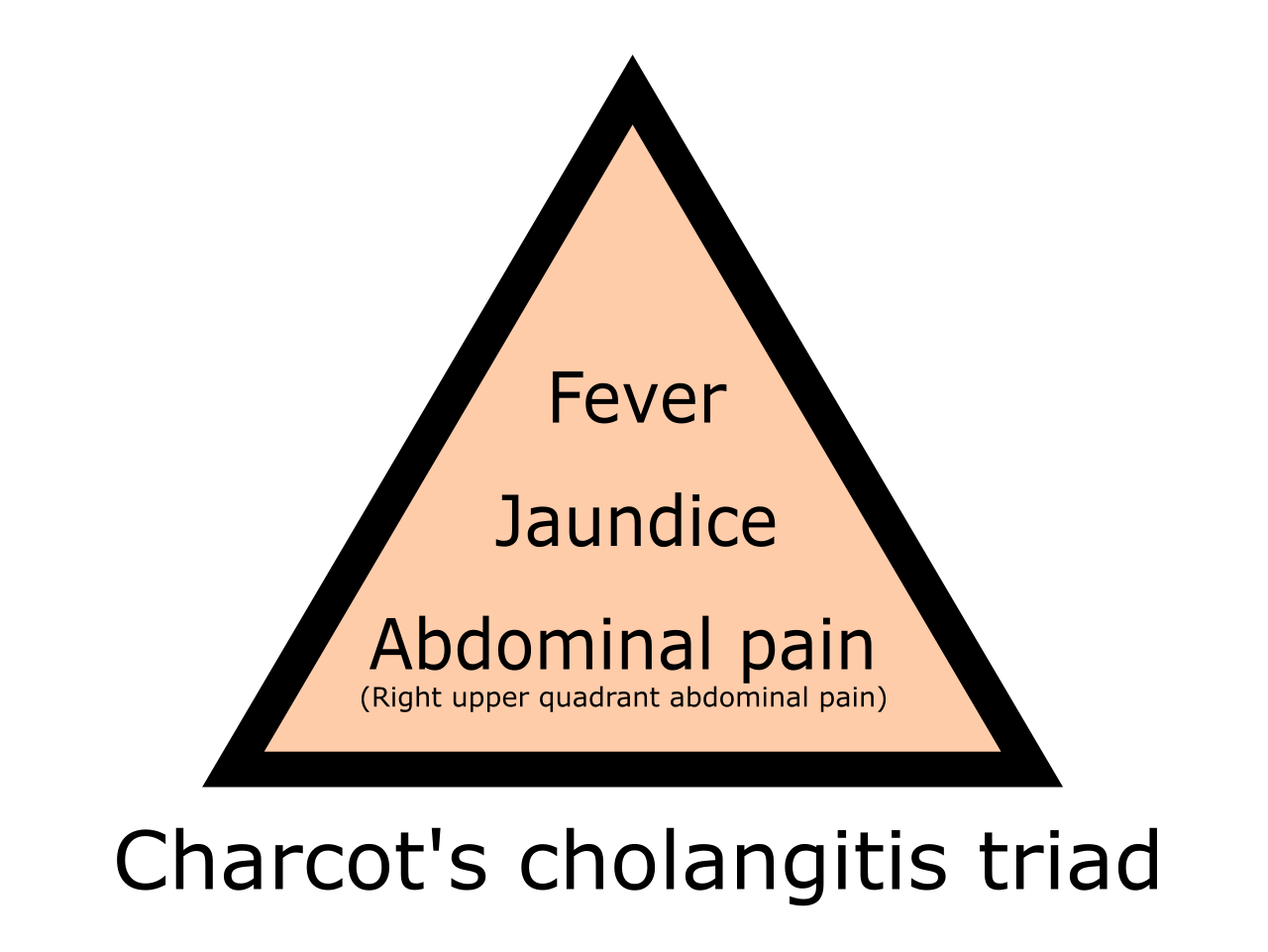
Ascending cholangitis is inflammation of the bile duct caused by bacteria ascending from the duodenum, often when the duct is partially obstructed by gallstones.[1] Fever, abdominal pain, and jaundice are characteristic symptoms of cholangitis, which is considered a medical emergency that can be life-threatening; severe cases may involve low blood pressure and confusion.[2]
Key facts and history
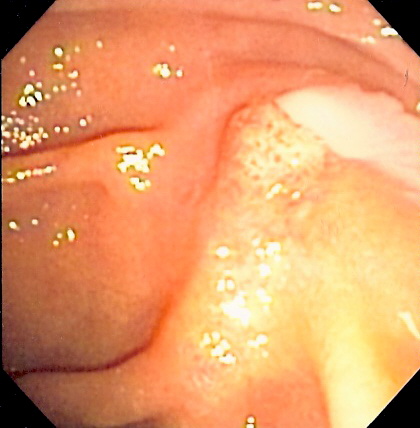
Dr Jean-Martin Charcot first reported the condition in 1877, calling it "hepatic fever" and describing the triad of abdominal pain, jaundice, and fever.[3] Dr Benedict M. Reynolds and Dr Everett L. Dargan formulated the pentad that includes Charcot's triad plus septic shock and mental confusion in 1959.[3] Cholangitis remained a surgically treated condition until the rise of ERCP in 1968.[3] Bile duct obstruction is usually due to gallstones, but 10–30% of cases have other causes like benign stricturing or tumors.[2]
Parasites such as Ascaris lumbricoides and liver flukes can also cause cholangitis.[4] Before 1980, mortality from acute cholangitis was greater than 50%, but after 1980 it fell to 10–30%.[5] The leading cause of death is irreversible shock with multiple organ failure.[5]
What the research sources say
It notes the sphincter of Oddi acts as a mechanical barrier and that biliary system pressure is normally low at 8 to 12 cmH2O.[6][7] The same source explains that increased biliary pressure above 20 cmH2O widens spaces between duct lining cells, allowing bacteria into the bloodstream.[8][9] Schwartz's Principles of Surgery also states that intravenous fluids and antibiotics are commenced, with empirical broad-spectrum treatment until the pathogen is known.[1][9] Schwartz's Principles of Surgery (2005) indicates that the presence of bacteria alone, without any blockage, does not typically lead to cholangitis.[8][9]
References
- Wikipedia, "Ascending cholangitis" (CC BY-SA 4.0), which cites: Kinney TP, "Management of ascending cholangitis", Gastrointest Endosc Clin N Am, April 2007, p. 289–306; "Schwartz's Principles of Surgery", McGraw-Hill, 2005, p. 1203 (we also read that source) en.wikipedia.org
- Wikipedia, "Ascending cholangitis" (CC BY-SA 4.0), which cites: Kinney TP, "Management of ascending cholangitis", Gastrointest Endosc Clin N Am, April 2007, p. 289–306 (original not read by us) en.wikipedia.org
- Wikipedia, "Ascending cholangitis" (CC BY-SA 4.0), which cites: Charcot JM, "Leçons sur les maladies du foie, des voies biliaires et des reins faites à la Faculté de médecine de Paris: Recueillies et publiées par Bourneville et Sevestre", Bureaux du Progrés Médical & Adrien Delahaye,; Charcot JM, "Leçons sur les maladies du foie, des voies biliaires et des reins faites à la Faculté de médecine de Paris: Recueillies et publiées par Bourneville et Sevestre", Bureaux du Progrés Médical & Adrien Delahaye,; "Definitions, pathophysiology, and epidemiology of acute cholangitis and cholecystitis: Toky en.wikipedia.org
- Wikipedia, "Ascending cholangitis" (CC BY-SA 4.0), which cites: Lim JH, "Liver flukes: the malady neglected", Korean J Radiol, 2011, p. 269–79; Kinney TP, "Management of ascending cholangitis", Gastrointest Endosc Clin N Am, April 2007, p. 289–306; "Definitions, pathophysiology, and epidemiology of acute cholangitis and cholecystitis: Tokyo Guidelines", J Hepatobiliary Pancreat Surg, 2007, p. 15–26; "Guidelines on the management of common bile duct stones", Gut, 2008, p. 1004–1021; Brand, "Antibiotic prophylaxis for patients undergoing elective endoscopic retrograde cholangiopancreatography.", en.wikipedia.org
- Wikipedia, "Ascending cholangitis" (CC BY-SA 4.0), which cites: "Definitions, pathophysiology, and epidemiology of acute cholangitis and cholecystitis: Tokyo Guidelines", J Hepatobiliary Pancreat Surg, 2007, p. 15–26; "Definitions, pathophysiology, and epidemiology of acute cholangitis and cholecystitis: Tokyo Guidelines", J Hepatobiliary Pancreat Surg, 2007, p. 15–26 (original not read by us) en.wikipedia.org
- Wikipedia, "Ascending cholangitis" (CC BY-SA 4.0), which cites: Dooley JS, "Oxford textbook of clinical hepatology", Oxford University Press, 1999, p. 1650 (we also read that source) en.wikipedia.org
- Open Library record, ISBN 9780192625151 ("Oxford textbook of clinical hepatology."). CC0 (metadata); book content not read. openlibrary.org
- Wikipedia, "Ascending cholangitis" (CC BY-SA 4.0), which cites: "Schwartz's Principles of Surgery", McGraw-Hill, 2005, p. 1203; "The significance of biliary pressure in cholangitis", Arch Surg, May 1969, p. 629–632 (we also read that source) en.wikipedia.org
- Open Library record, ISBN 9780071410908 ("Schwartz's Principles of Surgery, 8/e (Schwartz's Principles of Surgery)"). CC0 (metadata); book content not read. openlibrary.org
Each numbered sentence above was checked against the source it cites before publication. Sentences citing Wikipedia adapt text from the English Wikipedia article Ascending cholangitis (contributors), used under CC BY-SA 4.0; this entry is available under the same licence. Other sources were used for facts only; no text or images are copied from them.
More in Inflammatory diseases of the digestive system
Sources
Compiled from Wikipedia and the sources listed below. Text from Wikipedia is available under CC BY-SA 4.0; this entry is adapted from it.
- Wikipedia: Ascending cholangitis (CC BY-SA 4.0).
- Word definitions: the , each quoted from its Wikipedia article.
Spotted an error? Know more?
Reader corrections go straight into our review queue. Suggest an edit · How this site is sourced