Colitis
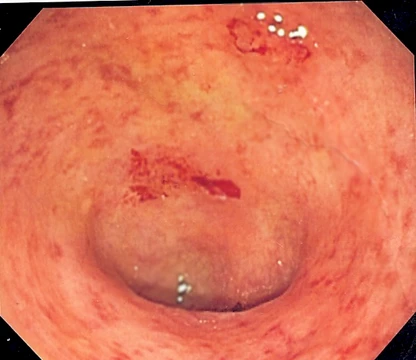
Inflammation of the colon with variable causes and symptoms.
Last updated

DataBase Center for Life Science (DBCLS) · CC BY 4.0
Symptoms can include abdominal pains, persistent hemorrhagic diarrhea, and fatigue.[1] The large intestine (colon) can become swollen or inflamed, a condition referred to as colitis.[2] Among the more severe signs of colitis are fever, a heartbeat that is fast or irregular, and experiencing shortness of breath.[1]
Quick Facts
- Field
- Gastroenterology
Facts from the source article.
Key facts and history
A subtype of infectious colitis is Clostridioides difficile colitis, informally called "C-diff colitis".[3] The National Institute of Diabetes and Digestive and Kidney Diseases states that doctors treat ulcerative colitis with medicines and surgery.[4] Doctors most often treat severe and fulminant ulcerative colitis in a hospital.[4] People with ulcerative colitis typically need lifelong treatment with medicines unless they have surgery to remove the colon and rectum.[4]
The NIDDK notes that doctors may recommend surgery for complications such as severe rectal bleeding or toxic megacolon.[4] The most common types of surgery for ulcerative colitis are ileoanal reservoir surgery.[4] People with ulcerative colitis should avoid taking NSAIDs for pain because these medicines can make symptoms worse.[4] Colitis can either be a short-term, self-resolving issue or a persistent, long-term condition.[2]
When colitis displays characteristics of both Crohn's disease and ulcerative colitis, it is categorized as indeterminate colitis.[5]
What the research sources say
The NIDDK explains that to diagnose ulcerative colitis, doctors review medical and family history, perform a physical exam, and order medical tests.[6] Doctors use blood tests to check for signs of ulcerative colitis and complications such as anemia.[6] Doctors order endoscopy of the large intestine with biopsies to diagnose ulcerative colitis and rule out other digestive conditions.[6] The NIDDK states that doctors prescribe aminosalicylates to treat mild or moderate ulcerative colitis or to help people stay in remission.[4]
Corticosteroids are prescribed to treat moderate to severe ulcerative colitis and for mild to moderate cases that do not respond to aminosalicylates.[4] The Crohn’s and Colitis Foundation recommends that people who have had ulcerative colitis symptoms for at least 8 years get a colonoscopy every 1 or 2 years.[7] According to a 2020 Cochrane review, there was no strong evidence that taking probiotics improves the chance of achieving remission for individuals with Crohn's disease.[8]
References
- Wikipedia, "Colitis" (CC BY-SA 4.0), which cites: NHS Choices, "Ulcerative colitis - Symptoms - NHS Choices", www.nhs.uk (original not read by us) en.wikipedia.org
- Wikipedia, "Colitis" (CC BY-SA 4.0), which cites: "Colitis", www.pennmedicine.org, July 1, 2021 (original not read by us) en.wikipedia.org
- Wikipedia, "Colitis" (CC BY-SA 4.0), which cites: "Clostridium Difficile Colitis – Overview", WebMD, LLC (original not read by us) en.wikipedia.org
- "Treatment for Ulcerative Colitis - NIDDK", National Institute of Diabetes and Digestive and Kidney Diseases. facts only, no text reused. niddk.nih.gov
- Wikipedia, "Colitis" (CC BY-SA 4.0), which cites: "Indeterminate colitis: a distinctive clinical pattern of inflammatory bowel disease in children", Pediatrics, December 2008, p. e1278–e1281; "Do preoperative factors predict subsequent diagnosis of Crohn's disease after ileal pouch-anal anastomosis for ulcerative or indeterminate colitis?", Colorectal Disease, October 2010, p. 1026–1032 (original not read by us) en.wikipedia.org
- "Diagnosis of Ulcerative Colitis NIDDK", National Institute of Diabetes and Digestive and Kidney Diseases. facts only, no text reused. niddk.nih.gov
- "Colonoscopy for ulcerative colitis: Why to get one, prep, and more", 30 July 2021. facts only, no text reused. medicalnewstoday.com
- Wikipedia, "Colitis" (CC BY-SA 4.0), which cites: Limketkai, "Probiotics for induction of remission in Crohn's disease", Cochrane Database of Systematic Reviews, 2020-07-17 (original not read by us) en.wikipedia.org
Each numbered sentence above was checked against the source it cites before publication. Sentences citing Wikipedia adapt text from the English Wikipedia article Colitis (contributors), used under CC BY-SA 4.0; this entry is available under the same licence. Other sources were used for facts only; no text or images are copied from them.
More in Inflammatory diseases of the digestive system
Sources
Compiled from Wikipedia and the sources listed below. Text from Wikipedia is available under CC BY-SA 4.0; this entry is adapted from it.
- Wikipedia: Colitis (CC BY-SA 4.0).
- Word definitions: the , each quoted from its Wikipedia article.
Spotted an error? Know more?
Reader corrections go straight into our review queue. Suggest an edit · How this site is sourced