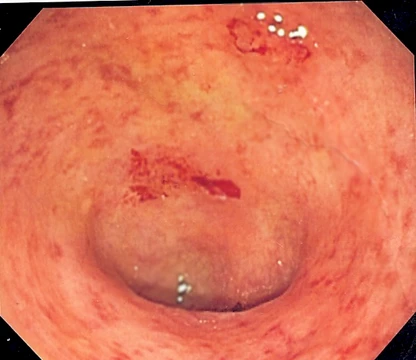
Epiploic appendagitis
Self-limiting colon fat inflammation mimicking surgical abdomen.
Last updated

Hellerhoff · CC BY-SA 3.0
The condition is commonly misdiagnosed, often as diverticulitis, due to its acute onset of pain in the left lower quadrant.[1] Anti-inflammatory drugs and pain medication (ranging from moderate to strong, depending on the case) are the typical treatment, and surgery is avoided in almost all instances.[2]
Quick Facts
- Typical age range
- 12 to 82 years, most common in 40s and 50s
- Sex predominance
- Men slightly more affected than women
- Common misdiagnosis
- Diverticulitis (left-sided pain) or appendicitis (right-sided pain)
- Age range
- 12 to 82 years
- Peak age
- 40s and 50s
- Number of epiploic appendages
- 50–100
- Appendage length
- 0.5 to 5 cm / 1.97 in
Facts from the source article.
Key facts and history
Epiploic appendages, also called appendices epiploicae, are 50–100 appendages oriented in two rows parallel to the taenia coli.[3] The colon has 50–100 epiploic appendages arranged in two rows, each measuring 0.5 to 5 cm in length and connected by one or two arterioles and a venule inside vascular stalks.[3] Twisting of these appendages can cut off blood supply, leading to pain that resembles diverticulitis or appendicitis, though such torsion is uncommon.[3] Patients in their 40s and 50s are most often affected, with a higher incidence in males.[1]
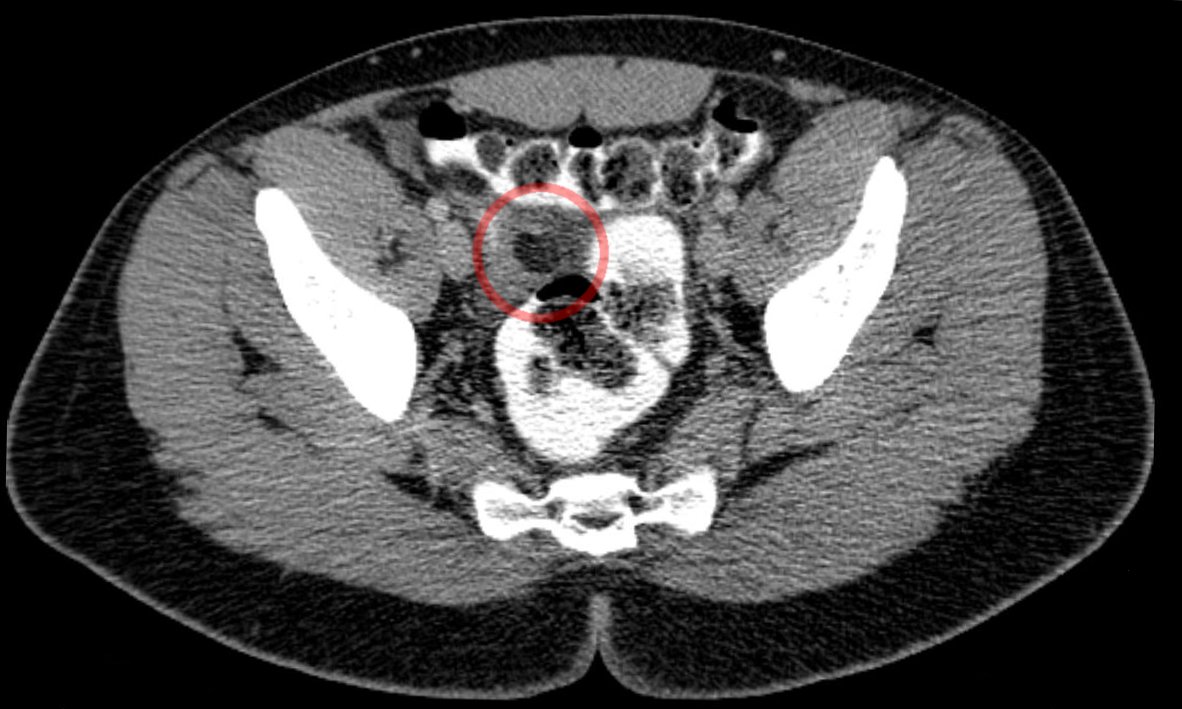
Documented patient ages span from 12 to 82 years, and the condition occurs slightly more often in men than in women.[1] Obesity, hernia, and unaccustomed exercise are common factors linked to acute epiploic appendagitis.[1] In the majority of patients, the inflammation clears up spontaneously, and with non-invasive care symptoms typically disappear within fourteen days.[1][4] Admission to a hospital is not required for managing this condition.[4]
What the research sources say
A positive diagnosis is typically made via ultrasound or CT; on ultrasound, the finding is an oval, non-compressible hyperechoic mass located directly beneath the point of greatest tenderness.[5] Because abdominal CT is now used more often to assess lower abdominal pain, epiploic appendagitis is being identified with greater frequency.[5] A peritoneal loose body—a calcified, free-floating mass of dead fibrous tissue—is an uncommon outcome of epiploic appendagitis.[6] When a peritoneal loose body grows sufficiently large, it may lead to urinary retention or blockages in the bowel.[6]
References
- Wikipedia, "Epiploic appendagitis" (CC BY-SA 4.0), which cites: Singh, "Acute Epiploic Appendagitis and Its Mimics", RadioGraphics, 2005-11-01, p. 1521–1534 (original not read by us) en.wikipedia.org
- Wikipedia, "Epiploic appendagitis" (CC BY-SA 4.0), which cites: Sand, M., et al. (2007). Epiploic appendagitis – clinical characteristics of an uncommon surgical diagnosis. BMC Surgery 7:11. (original not read by us) en.wikipedia.org
- Wikipedia, "Epiploic appendagitis" (CC BY-SA 4.0), which cites: Sand, "Epiploic appendagitis – clinical characteristics of an uncommon surgical diagnosis", BMC Surgery, 2007-01-01, p. 11 (original not read by us) en.wikipedia.org
- Wikipedia, "Epiploic appendagitis" (CC BY-SA 4.0), which cites: van Breda Vriesman, A. C. (2004). Infaction and Idiopathic Inflammation of Intraperitoneal Fat. Implications of Diagnostic Imaging of the Acute Abdomen. PhD the (original not read by us) en.wikipedia.org
- Wikipedia, "Epiploic appendagitis" (CC BY-SA 4.0), which cites: Sand, "Epiploic appendagitis – clinical characteristics of an uncommon surgical diagnosis", BMC Surgery, 2007-01-01, p. 11; Sand, "Epiploic appendagitis – clinical characteristics of an uncommon surgical diagnosis", BMC Surgery, 2007-01-01, p. 11 (original not read by us) en.wikipedia.org
- Wikipedia, "Epiploic appendagitis" (CC BY-SA 4.0), which cites: Sussman, "Peritoneal Loose Body", New England Journal of Medicine, 2015-04-02, p. 1359 (original not read by us) en.wikipedia.org
Each numbered sentence above was checked against the source it cites before publication. Sentences citing Wikipedia adapt text from the English Wikipedia article Epiploic appendagitis (contributors), used under CC BY-SA 4.0; this entry is available under the same licence. Other sources were used for facts only; no text or images are copied from them.
More in Inflammatory diseases of the digestive system
Sources
Compiled from Wikipedia and the sources listed below. Text from Wikipedia is available under CC BY-SA 4.0; this entry is adapted from it.
- Wikipedia: Epiploic appendagitis (CC BY-SA 4.0).
- Word definitions: the Codexery glossary, each quoted from its Wikipedia article.
Spotted an error? Know more?
Reader corrections go straight into our review queue. Suggest an edit · How this site is sourced