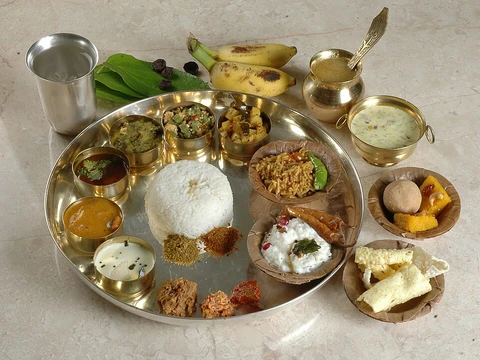
Rajasthani cuisine
Arid-region cuisine shaped by warlike lifestyles and temple traditions.
Last updated
Rajasthani cuisine is the traditional cooking of Rajasthan, a state in north-west India. Its character was shaped by the region's arid climate, the warlike lifestyles of its inhabitants, and Hindu temple traditions such as those of the Pushtimarg and Ramanandi sampradayas. The state is notable for having the highest percentage of vegetarians in India, at 74.9% according to a 2014 survey.
Quick Facts
- Vegetarian population
- 74.9%
Facts from the source article.
Breads
Wheat and millets form the staple diet in Rajasthan, as the state is largely arid. Breads made from wheat include tawa roti, angarki or tandoori roti, kinwani roti (made from naturally fermented flour), and khoba roti, which is patterned by pinching the dough. Large rotis called rotlas or bhakri are prepared from millets such as bajra (pearl millet), makai (maize), and jowar. Missi roti combines wheat flour with gram flour, while bejad roti is a multigrain flatbread of wheat, jowar, and besan.
Tikkad is a bread made from a blend of flours and vegetables, with variations like kanda tamatar tikkad and bajra mooli tikkad. Deep-fried breads include puris and kachauris, the latter stuffed with dal pithi, vegetables, or mawa; kanda kachauri (onion-stuffed) and mawa kachauri (sweet) are specialties.
Jhakolma puri, a large puri of flowing-consistency wheat dough, is a Mewari specialty served with chana dal and amchur chutney. Pan-cooked breads include stuffed parathas, cheelas, pudlas, and malpuas; korma paratha or dal churi paratha uses semi-crushed lentils. Baked breads include baatis, angarki roti, and kinwani roti.
Desserts and sweet dishes
Rajasthani sweets and desserts draw heavily on the Naivedhya tradition of Hindu temples, using milk products such as chhena, mawa, malai, makhan, ghee, and rabdi. Gram flour (besan) and lentils are also common due to the dry climate. Vaishnavite traditions like Pushtimarg, Nimabarka, and Ramanandi are known for their Chhapan Bhog temple offerings, where deities are presented with sweets rich in dry fruits and milk products, later distributed to devotees.
Ghevar is a honeycombed cake of deep-fried wheat flour batter soaked in sugar syrup, offered to Shiva and Parvati during Teej. Laapsi is a pudding of grain flour cooked in ghee with milk, dry fruits, and sugar; variations include daliya laapsi, suji laapsi (mohan bhog), maida laapsi (sohan bhog), besan laapsi, moong dal laapsi, and rajwaadi badam or suphal laapsi. Kusum laapsi (gulab laapsi) is rose-flavored and popular in Paali. Jhajhariya is a laapsi variety made from hara choliya or corn flour.
Panjeeri, derived from the Sanskrit panchjeerak (a blend of five herbal ingredients), is an Ayurvedic postpartum supplement that evolved into a sweet; it is prepared on Janamashtami as a naivedhya for Krishna's mothers Devaki and Yasodha.
Typical Rajasthani dishes
Lentils and pulses are central to Rajasthani cuisine, with dal and roti forming the staple diet. Panchratna dal combines five lentils: toor dal, urad dal, moong dal, chana dal, and moth dal; it is served with baati bread and churma as dal baati churma. Dal dhokli (or dal pithouri) is a dish of dal cooked with small wheat dough pasta pieces. Dal baakla refers to dry, gravy-less lentil preparations such as sukhi moong, sukhi moth, or sukhi urad dal.
Dal maharani or dal rajwadi uses whole urad dal in a rich gravy of dry fruits topped with ghee. Haveji is chana dal cooked with yogurt or buttermilk gravy. Lentils also appear as mangodi (moong dal fritters), pakodas, pittod, gatte, sev, and pappad. Mangodi ro saag is a vegetable preparation using these fritters, with variations like palak mangodi, methi mangodi, and aloo mangodi.
Pittod ro saag and pittod ro teewan use steamed besan slices (pittod or chakki) in a yogurt gravy. Govind gatte ro saag features besan dumplings stuffed with mawa or chhena and dry fruits, named after Govind Dev ji.
Papad ro saag cooks lentil crisps with spices and onions. Besan childa ro saag uses savory pancakes. Rajasthani kadhi pakoda is a yogurt-based gravy with besan, pakodas, and vegetables, served with rice or millet rotla.
Chutneys, launji, chhunda and athana pickles
Launji is a sweet and tangy relish served as an accompaniment, made from vegetables or fruits. Variations include kairi launji (raw mango), methi amchur launji (fenugreek seeds with dried dates or raisins and dry mango powder), karonda launji (Indian natal plum), and amla launji (Indian gooseberry). Chhunda refers to sweet fruit preserves, such as aam chhunda (mango), amla chhunda (gooseberry, common in winters), gajar chhunda (carrot), and bael chhunda (wood apple).
Athana or athano are pickles; varieties include mathania mirchi athana (using chillies from Mathania village), kairi athana (raw mango), kachri athana, gunda athana, ker sangri athana, and pachranga athana (a five-colored pickle of cauliflower, carrot, turnip, lemon, karonda, lotus stem, gooseberry, and dry mango powder). Mirchi tipore is an instant pickle of chopped green chillies, distinct from stuffed mirchi athana. Chutneys include Rajasthani lehsun chutney (garlic-based, with variations like lehsun ratto mirch chutney, dahi lehsun chutney, and bhuna lehsun pudina chutney), kachri chutney (wild melon seeds), kairi kanda chutney (raw mango and onion), and dhaniya pudina chutney (coriander and mint).
Did You Know?
- Clay ovens called bhatthi or tandoor originated in Rajasthan; the Indus Valley site of Kalibangan has the earliest archaeological evidence of clay ovens resembling present-day tandoors.
- Rajwaadi cuisine, also known as Raajsi cuisine, is characterized by high usage of dry fruits, milk products, and whole spices, and food items are often decorated with thin foils of gold or silver.
- Rajput cuisine traditionally includes game meat procured via the Jhatka method, with dishes such as ratto maans (meat in red gravy), dhaulo maans (meat in white gravy), and khadd khargosh (curried rabbit baked in a pit).
More in Indian Cuisine by State Or Union Territory
Sources
Compiled from Wikipedia and the sources listed below. Text from Wikipedia is available under CC BY-SA 4.0; this entry is adapted from it.
- Wikipedia: Rajasthani cuisine (CC BY-SA 4.0).
Spotted an error? Know more?
Reader corrections go straight into our review queue. Suggest an edit · How this site is sourced