Gujarati cuisine
Gujarati cuisine is known for its sweet, salty, and spicy balance.
Last updated
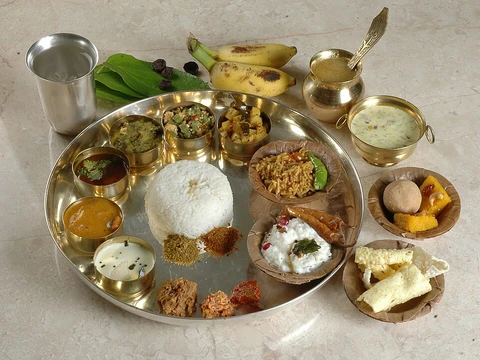
Gujarati cuisine is the cuisine of the Indian state of Gujarat. The typical Gujarati thali includes rotli, dal or curry, rice, and shaak, along with pulse preparations, a snack item like dhokla or fafda, and a sweet such as mohanthal or jalebi. Many Gujarati dishes are distinctively sweet, salty, and spicy, and the cuisine varies widely by family taste and region.
Quick Facts
- Major regions
- North Gujarat, Kathiawad, Kachchh, Central Gujarat, South Gujarat
- Common seafood
- pomfrets
- khandwas
- gedadas
- surmai
- prawns
- crabs
- lobster
- narsinga (calamari)
- Typical summer temperature
- 50 °C (122 °F) in the shade
- Staple grains for flatbreads
- bajra (pearl millet)
- wheat
- maize
- sorghum
Facts from the source article.
Staple foods
In Gujarat, the everyday meal often starts with homemade khichdi, a mix of rice and lentils or mung beans, alongside chaas, which is buttermilk, and pickles served on the side. The main dishes rely on vegetables that are steamed and then combined with various spices and dals, all added to a vaghar—a blend of spices heated in oil that changes based on what’s being cooked. Because summer temperatures can hit 50°C in the shade, salt, sugar, lemon, lime, and tomatoes are used often to help prevent dehydration.
A touch of sugar or jaggery is frequently stirred into vegetable dishes and dal, giving a sweet contrast to the usual savory and spicy flavors. What’s on the table shifts with the seasons: in summer, ripe mangoes appear as Keri no Ras, a fresh mango pulp, and spices like garam masala are used less. Fasting is common, with meals limited to milk, dried fruits, and nuts. In villages near Saurashtra during cold winters, thick rotis called rotla, made from bajra flour, and bhakri, from wheat flour, are served with garlic chutney, onion, and chaas.
Sweets in a thali are typically made from milk, sugar, and nuts; dry sweets like magas and ghooghra are reserved for celebrations such as weddings or Diwali. A standout feature of Gujarati cuisine is its wide range of farsan—side dishes that accompany the main meal or are eaten alone as snacks or light bites.
Sub-regional cuisines
Along the Gujarat coast, the Kharwa community built a food tradition around fresh and dried seafood, including pomfrets, khandwas, gedadas, surmai, prawns, crabs, lobster, and narsinga (calamari). Across the state, cuisine changes noticeably by region, with Surat, Kutch, Kathiawad, and North Gujarat offering the most distinct styles, and family preferences also shape flavors. A hallmark of many popular Gujarati dishes is sweetness, since sugar or jaggery is routinely added to vegetables and dal. Cooking methods vary too: some dishes are stir-fried, others steamed, while vegetables, spices, or dal are often boiled and then finished with vaghar, or fried spices, to boost taste.
List of Gujarati vegetarian dishes
Rotla is a thick millet flour flatbread usually grilled over coals in a clay pan. Makai no rotlo is a thick maize flour flatbread similarly grilled. Bhakri is made with whole wheat flour, thicker than rotli. Phulka rotli (also called rotli or chapati) is made with whole wheat flour, rolled thin.
Juvar no rotlo is a thick sorghum flatbread. Parotha is a shallow-fried whole wheat flatbread. Puri is made with whole wheat flour and deep-fried. Thepla or dhebra is made with a mixture of flours, pan-fried, mildly spiced, and usually contains shredded vegetables.
Staple foods
Poodla (sweet) is made with a mixture of flours and pan-fried. Rajgira ni puri is also prepared. Rice-based dishes include biranji (steamed rice flavoured with saffron, sugar, and dried fruit), khatta-mittha bhaat (sour and sweet rice with potatoes and spices), vagharelo bhaat (aromatic tempered rice), doodhpak (rice pudding with milk, sugar, cardamom, raisins, saffron, cashews, pistachios, or almonds), khichdi (rice and dal cooked like porridge with ghee, yogurt, and pickle), pulao (rice with vegetables), khichu (kneaded rice flour heated with water, salt, green chillies, and cumin), sabudana khichadi, fada ni khichdi, and kachori (deep-fried, crispy, round, often filled).
Vegetable dishes include bateta nu shaak (potato curry), bateta sukhi bhaji (dry potato), bateta dungri nu shaak (potato and onion curry), bateta ringan nu shaak (potato and eggplant curry), bateta guvar nu shaak (potato and cluster beans curry), bateta chawli nu shaak (potato and glossary long beans), lasaniya bateta (garlic-flavored potato curry), bharela ringan (stuffed dry eggplant), bharela bhinda (stuffed dry okra), bharela karela (stuffed dry karelu), bhinda nu shaak (dry okra), bhinda bateta nu shaak (dry okra and potato), vatana bateta nu shaak (potato and peas curry), cholaa nu shaak (black-eyed peas curry), chawli ringan bateta nu shaak (glossary long beans, brinjal, and potato curry), dhana capsicum nu shaak (dry coriander, capsicum, and chickpea flour curry), dudhi bateta nu shaak (bottle gourd and potato curry), ringan bateta nu shaak (eggplant and potato curry), and dudhi chana ni daal nu shaak (bottle gourd and split black chickpea curry).
More in Indian Cuisine by State Or Union Territory
Sources
Compiled from Wikipedia and the sources listed below. Text from Wikipedia is available under CC BY-SA 4.0; this entry is adapted from it.
- Wikipedia: Gujarati cuisine (CC BY-SA 4.0).
Spotted an error? Know more?
Reader corrections go straight into our review queue. Suggest an edit · How this site is sourced