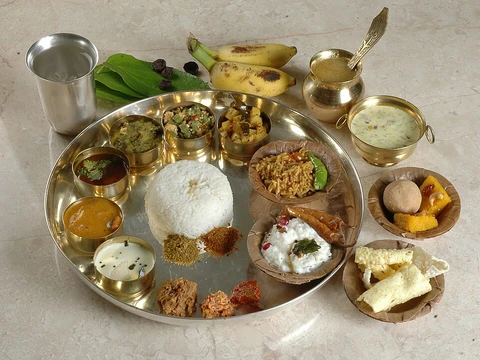
Kerala cuisine
A coastal cuisine rich in spices, coconut, and seafood.
Last updated
Hailing from the southwestern Malabar Coast, Kerala's cooking blends vegetarian and non-vegetarian dishes with fish, poultry, and red meat, always paired with rice. The region, called the "Land of Spices," uses coconut, curry leaves, mustard seeds, turmeric, tamarind, asafoetida, and chilies. Its ancient spice trade with Europe and the Sumerians dates back millennia.
Quick Facts
- State
- Kerala
- Region
- Southwestern Malabar Coast of India
- Earliest recorded spice trade
- 3000 BCE (Sumerian records)
- Staple starch
- Rice, tapioca
- Common cooking fat
- Coconut oil
- Typical ceremonial meal
- Sadya (with about 20 accompaniments)
Facts from the source article.
Overview
A traditional Kerala meal is the vegetarian sadya, a full-course meal of rice with about 20 accompaniments and desserts, served on a plantain leaf for celebrations like weddings, Onam, and Vishu. Coconuts grow abundantly, so grated coconut and coconut milk are used for thickening and flavouring.
The long coastline and rivers support a strong fishing industry, making seafood common. Rice and tapioca are main starches, and spices such as black pepper, cardamom, clove, ginger, and cinnamon are frequently used. Breakfast dishes include idli, dosa, appam, idiyappam, puttu, and pathiri.
Snacks
Well-known Kerala snacks include banana chips (thinly sliced raw bananas fried in coconut oil, flavored with salt or jaggery), achappam (crispy flower-shaped deep-fried snack from rice flour, coconut milk, and eggs), kuzhalappam (cylindrical snack with rice flour, coconut, cumin, and sesame seeds), unni appam (deep-fried rice cakes with jaggery, banana, and coconut), ela ada (steamed rice flour dough filled with jaggery and grated coconut, wrapped in banana leaves), pazham pori (slit bananas dipped in batter and deep-fried), neyyappam (sweet rice fritter fried in ghee), kozhukkatta (steamed rice dumplings with sweet coconut and jaggery), sukiyan (deep-fried mung bean fritter), and undampori (deep-fried round fritter from wheat flour, mashed bananas, and jaggery).
Breads
The breads of Kerala are made by baking or frying. Appam is a bowl-shaped pancake from fermented rice batter and coconut milk, often eaten with stew or egg curry. Parotta is a layered flatbread made with refined flour and oil.
Dosa is a thin, savory crepe from a fermented batter of black gram and rice. Pathiri, a thin rice flour flatbread, is popular among the Malabar Muslim community and served with coconut milk-based curries. Puttu is a steamed cylinder of ground rice layered with coconut shavings.
Vattayappam, an oil-free tea-time snack, uses rice flour, sugar, and coconut. Kalathappam is a soft, fermented rice pancake made with coconut milk and toddy or yeast. Idiyappam consists of thin, steamed rice noodles shaped like nests.
Religion-specific cuisines
Muslim cuisine, or Mappila cuisine, blends traditional Kerala, Persian, Arab, Portuguese, and Western food culture, with heavy use of black pepper, cardamom, and clove. Specialties include kallummakkaya (mussels) curry, irachi puttu (meat puttu), pathiri, ghee rice, kuzhi mandi (influenced from Yemen), and Thalassery biriyani (made with kaima rice as dum biriyani). Snacks include unnakkaya (deep-fried ripe banana paste with cashews, raisins, and sugar), pazham nirachathu (ripe banana filled with coconut and molasses), muttamala (made of eggs), chatti pathiri (layered chapati dessert), and arikkadukka.
Christians of Kerala, especially Nasranis (Saint Thomas Christians), have a cuisine blending Indian, Middle Eastern, Syrian, Jewish, and Western styles. A common dish is mappas or ishtu, where chicken or beef, potatoes, carrots, green peas, and onions are simmered in coconut milk with spices; in Central Kerala, this is made only with beef or lamb. Pidi is rice flour dumplings boiled in coconut milk, cumin, and garlic, made mainly by Syrian Christians.
Other dishes include piralen (chicken stir-fried), meat thoran/roast/ullathiyathu (dry curry with shredded coconut), seafood and duck roast, meen molee (spicy stewed fish) eaten with appam, pork vindaloo, and meen mulakittathu or meen vatichathu (fish in fiery red chilli sauce).
Did You Know?
- Some Hindus in Kerala do not consume beef and pork according to religious dietary restrictions.
- Most Muslims in Kerala do not eat pork and other food forbidden by Islamic law.
- Alcohol is available in Kerala in many hotels, bars and liquor stores.
More in Indian Cuisine by State Or Union Territory
Sources
Compiled from Wikipedia and the sources listed below. Text from Wikipedia is available under CC BY-SA 4.0; this entry is adapted from it.
- Wikipedia: Kerala cuisine (CC BY-SA 4.0).
Spotted an error? Know more?
Reader corrections go straight into our review queue. Suggest an edit · How this site is sourced