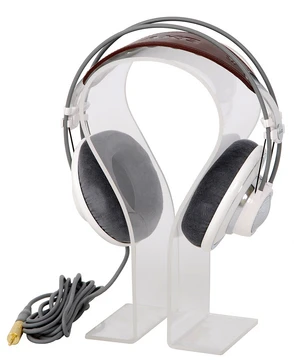
Stax Ltd.
Japanese maker of electrostatic earspeakers and high-end audio gear.

Stax Ltd. is a Japanese company specializing in high-end audio equipment, particularly known for its electrostatic and electret headphones, which it brands as "earspeakers." These headphones function similarly to electrostatic loudspeakers, but in a smaller form. In December 2011, the Chinese audio firm Edifier announced it had acquired full ownership of Stax.
Founded in 1938, Stax introduced its first electrostatic earspeaker, the SR-1, in 1960. Over the following decades, the company produced amplifiers, earspeakers, tonearms, CD players, DACs, phono cartridges, and loudspeakers. In 1995, after 57 years in business, Stax became insolvent but was revived the next year as a new company.
As of mid-2020, Stax’s lineup included seven electrostatic earspeakers, seven electrostatic amplifiers, and accessories like extension cords and a headphone stand. Four current earspeaker models—the SR-L300, SR-L300 Limited, SR-L500, and SR-L700—are based on the classic "Lambda" design. Five in-ear models were produced: the SR-001, SR-001mk2, SR-002, SR-003, and SR-003mk2. The SR-003 and SR-003mk2 use a standard "Pro-Bias" plug for standalone electrostatic amplifiers, while the SR-001, SR-001mk2, and SR-002 use a proprietary plug for a matching battery-powered portable amplifier. The SR-003 MK2 remains in production. The 4070 is a closed-back model aimed at studio and broadcast use. The flagship SR-009, part of the "Omega" series, had a U.S. MSRP of $4,450, with predecessors including the SR-007 and SR-007A. A new flagship, the SR-X9000, was introduced in December 2022.
Stax earspeakers use two bias voltages: an older 230-volt "Normal" bias and a later 580-volt "Pro" bias. Normal bias earspeakers have a six-pin vintage Amphenol microphone plug, while Pro bias models use a five-pin plug. Normal bias provides separate DC voltage for each side, which can cause temporary volume imbalance until the diaphragms charge fully. Pro bias earspeakers can be plugged into a Normal bias socket but should be used at low volume to avoid arcing that could burn the diaphragm coating. Normal bias earspeakers cannot physically connect to Pro bias sockets due to voltage mismatch. All current Stax earspeakers are Pro bias; the last Normal bias model was discontinued around 1992.
- Founded
- 1938
- First electrostatic earspeaker
- Stax SR-1 (1960)
- Insolvency
- 1995
- Revival
- 1996
- Acquisition
- December 2011 by Edifier
- Flagship model (as of june 2020)
- SR-009 (MSRP $4,450 in the United States)
- New flagship model
- Stax SR-X9000 (December 2022)
Lore & Background
Stax Ltd. was founded in 1938. Twenty-two years later, in 1960, it released its first electrostatic earspeaker, the Stax SR-1. Over the following thirty-six years, the company produced a variety of amplification, earspeaker, tonearm, CD player, DAC, phono cartridge, and loudspeaker products. In 1995, fifty-seven years after the company’s foundation, it became insolvent. The company was revived in 1996 as the new STAX company.
Stax earspeakers use two different bias voltages. The earlier 'Normal' bias earspeakers operate at 230 volts and use a six-pin vintage Amphenol microphone plug. The later 'Pro' bias earspeakers operate at 580 volts and use a five-pin plug, similar to the six-pin but with one pin absent. Normal bias provides a separate bias for each side, which can cause a temporary volume imbalance until the diaphragms are fully charged. Pro bias earspeakers can be plugged into a Normal bias socket and will work, but volume should be kept low to avoid arcing that could burn the conductive coating off the diaphragm. Normal bias earspeakers cannot be physically plugged into Pro bias sockets. All current Stax earspeakers are Pro bias, as the last Normal bias earspeaker went out of production around 1992.
As of June 2020, the current Stax product lineup consists of seven electrostatic earspeakers, seven electrostatic amplifiers, and accessories including extension cords and a headphone stand. Four current models are based on the classic 'Lambda' design: the SR-L300, SR-L300 Limited, SR-L500, and SR-L700. Five in-the-earspeaker (in-ear monitor) models were produced: SR-001, SR-001mk2, SR-002, SR-003, and SR-003mk2. The SR-003 and SR-003mk2 use a standard Pro-Bias plug for standalone electrostatic amplifiers, while the SR-001, SR-001mk2, and SR-002 use a proprietary plug for a matching battery-powered amplifier. One model, the 4070, is a closed-back electrostatic earspeaker targeted at studio and broadcast applications. Stax’s flagship earspeakers are the SR-009 (in the 'Omega' series), preceded by the SR-007 and SR-007A. A new flagship, the Stax SR-X9000, was introduced in December 2022.
Reader's Guide
Stax Ltd. holds a distinct position in audio history as a specialist in electrostatic headphones, a technology that differs fundamentally from conventional dynamic drivers. The company’s longevity—from its founding in 1938 through insolvency in 1995 and revival in 1996—reflects both the niche appeal and the engineering dedication behind its products. The acquisition by Edifier in December 2011 brought Stax under Chinese ownership while the brand continued to produce its signature earspeakers. The development of two bias standards (Normal and Pro) created a compatibility landscape that enthusiasts must navigate, with all current models using the Pro bias system. The Lambda series remains a cornerstone of the lineup, while the Omega series (including the SR-009 and the newer SR-X9000) represents the pinnacle of Stax’s electrostatic design. The company’s in-ear monitors, such as the SR-003 MK2, extend electrostatic technology to portable use, though some models require proprietary amplifiers. Stax’s legacy is tied to its unwavering commitment to electrostatic principles, offering an alternative listening experience that has cultivated a dedicated following among audiophiles and professionals alike.
Did You Know?
- Stax calls its electrostatic headphones 'earspeakers.'
- The first electrostatic earspeaker from Stax was the SR-1, released in 1960.
- Normal bias earspeakers use a six-pin Amphenol plug, while Pro bias uses a five-pin plug.
- The Stax SR-009 had an MSRP of $4,450 in the United States as of June 2020.
More in Headphones and Audio Gear 1-24
Spotted an error? Know more?
Reader corrections go straight into our review queue. Suggest an edit · How this site is sourced