Crystal earpiece
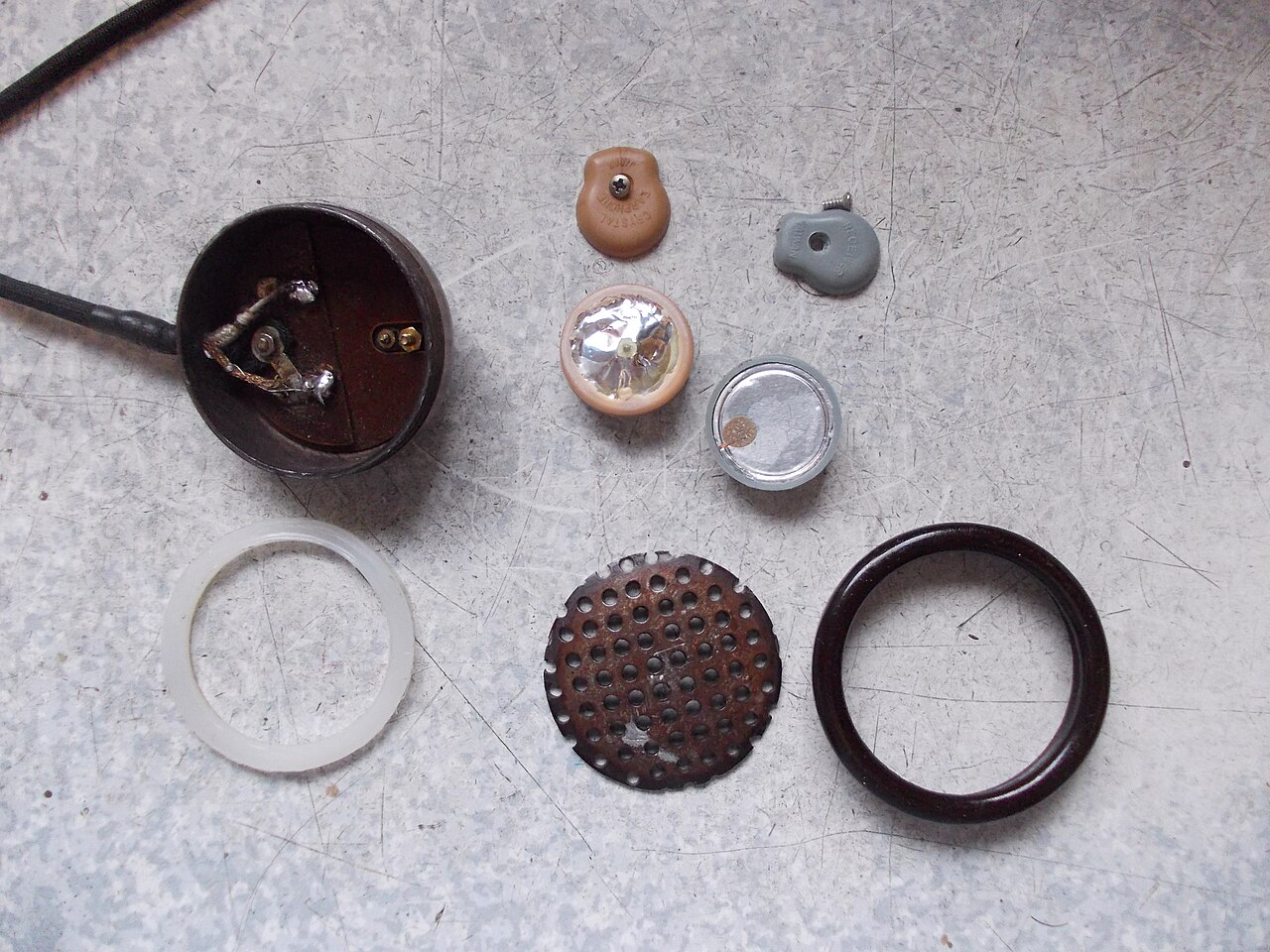
A high-impedance piezoelectric earphone used in early transistor radios and crystal sets.

Nvtj · CC BY-SA 3.0
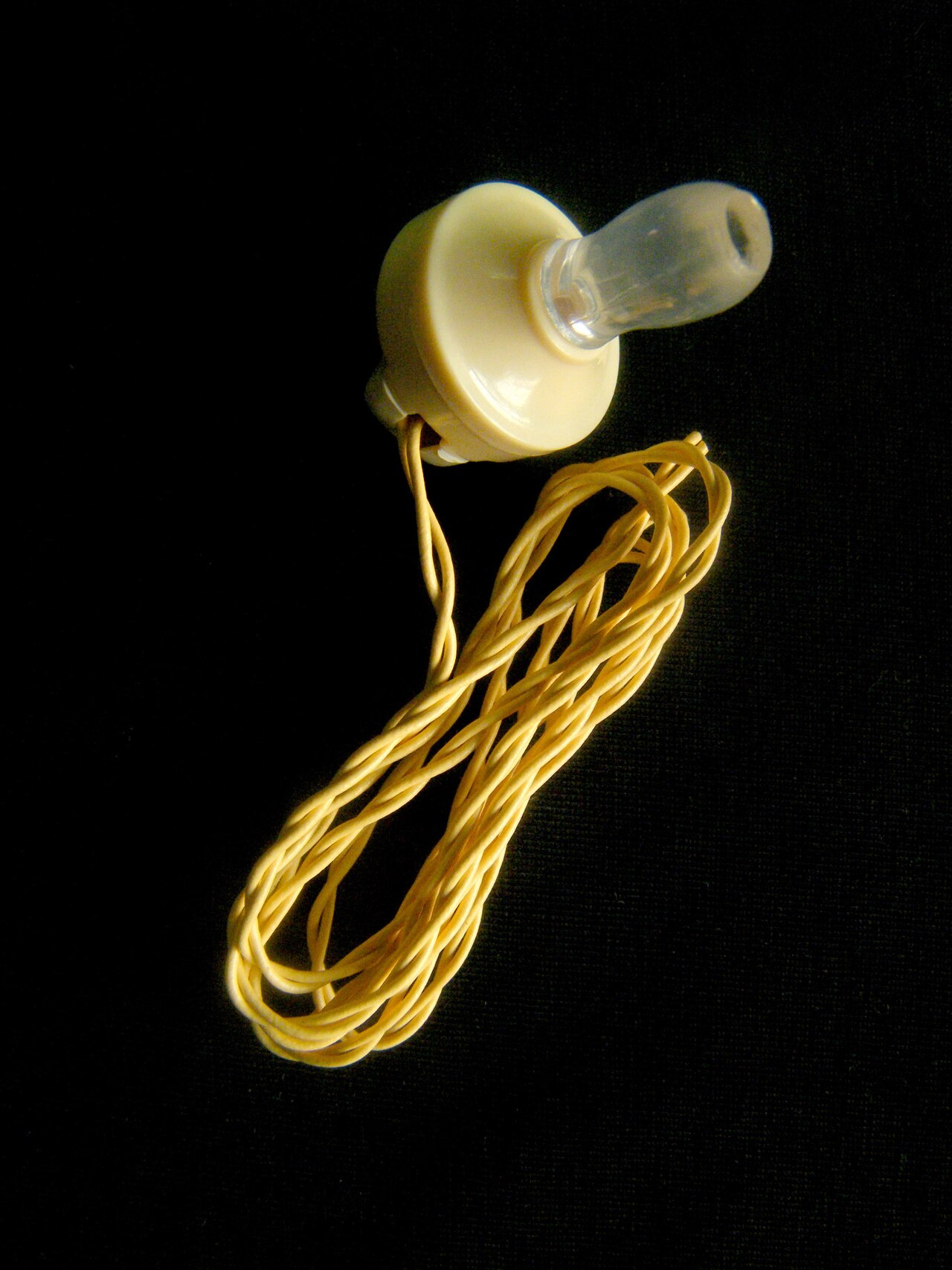
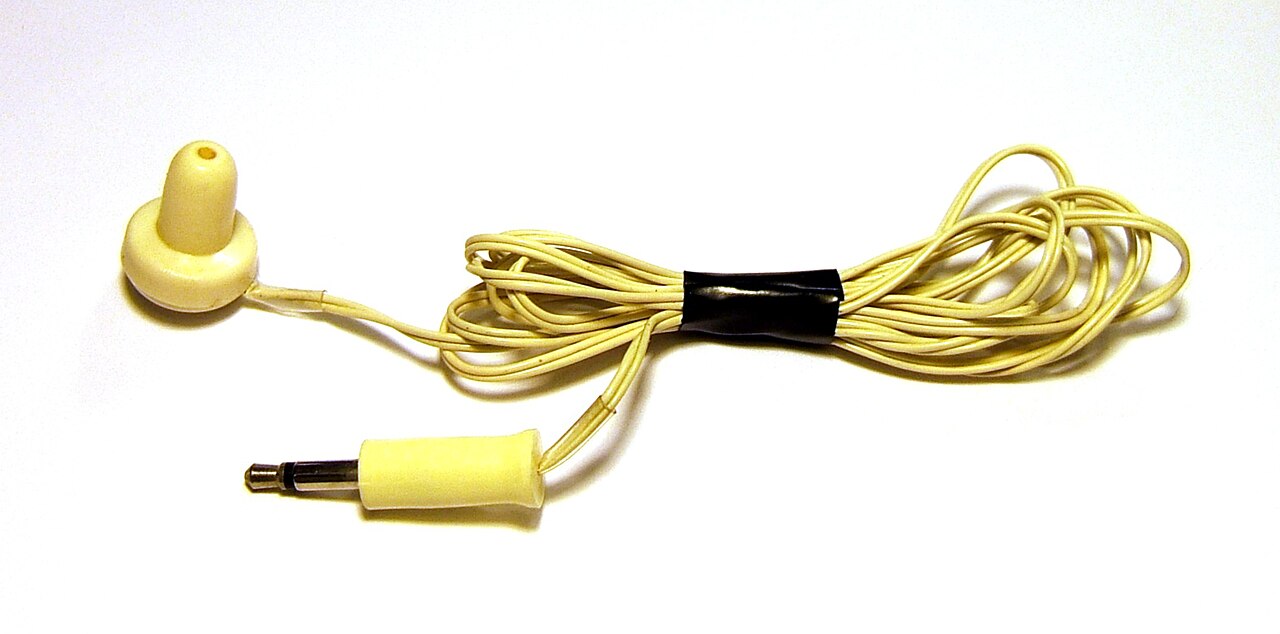
A crystal earpiece is a piezoelectric earphone that generates sound through a crystal that deforms when an electrical current passes through it. It is typically shaped to fit inside the ear canal. Inside the plastic casing, a piezoelectric crystal—with metal electrodes on both sides—is attached to a cone-shaped diaphragm made of plastic or metal foil. Early versions used Rochelle salt as the piezoelectric material, while modern ones use barium titanate or, less often, quartz. When an audio signal reaches the electrodes, the crystal flexes slightly in response, vibrating the diaphragm. This vibration pushes air, creating sound waves, and the plastic casing funnels those waves efficiently into the ear canal toward the eardrum. The diaphragm is fixed at its outer edge and operates by bending. The air path inside the earpiece is horn-shaped, with a narrowing column that increases air displacement at the eardrum to boost volume.
These earpieces are monaural devices with very low sound fidelity but high sensitivity and impedance. They were most widely used with transistor radios and hearing aids in the 1960s. They are not suitable for modern portable media players because of poor sound quality, which results from limited diaphragm movement, nonlinearity, resonances within the audible range, and the very short horn shape of the casing. The sound produced is thin and lacks bass. Modern headphones rely on electromagnetic drivers, such as moving coils or moving iron cores in a magnetic field, similar to speakers.
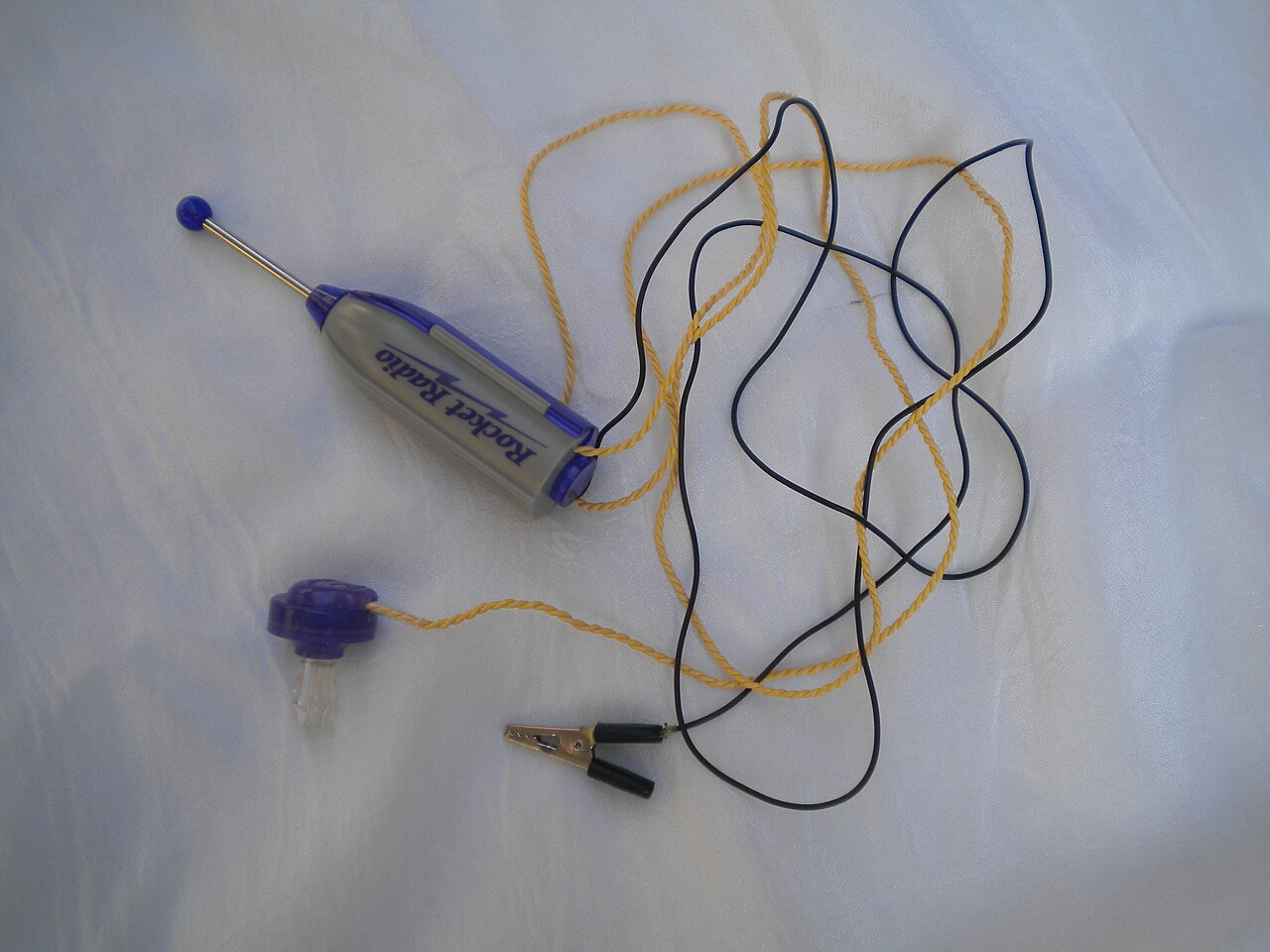
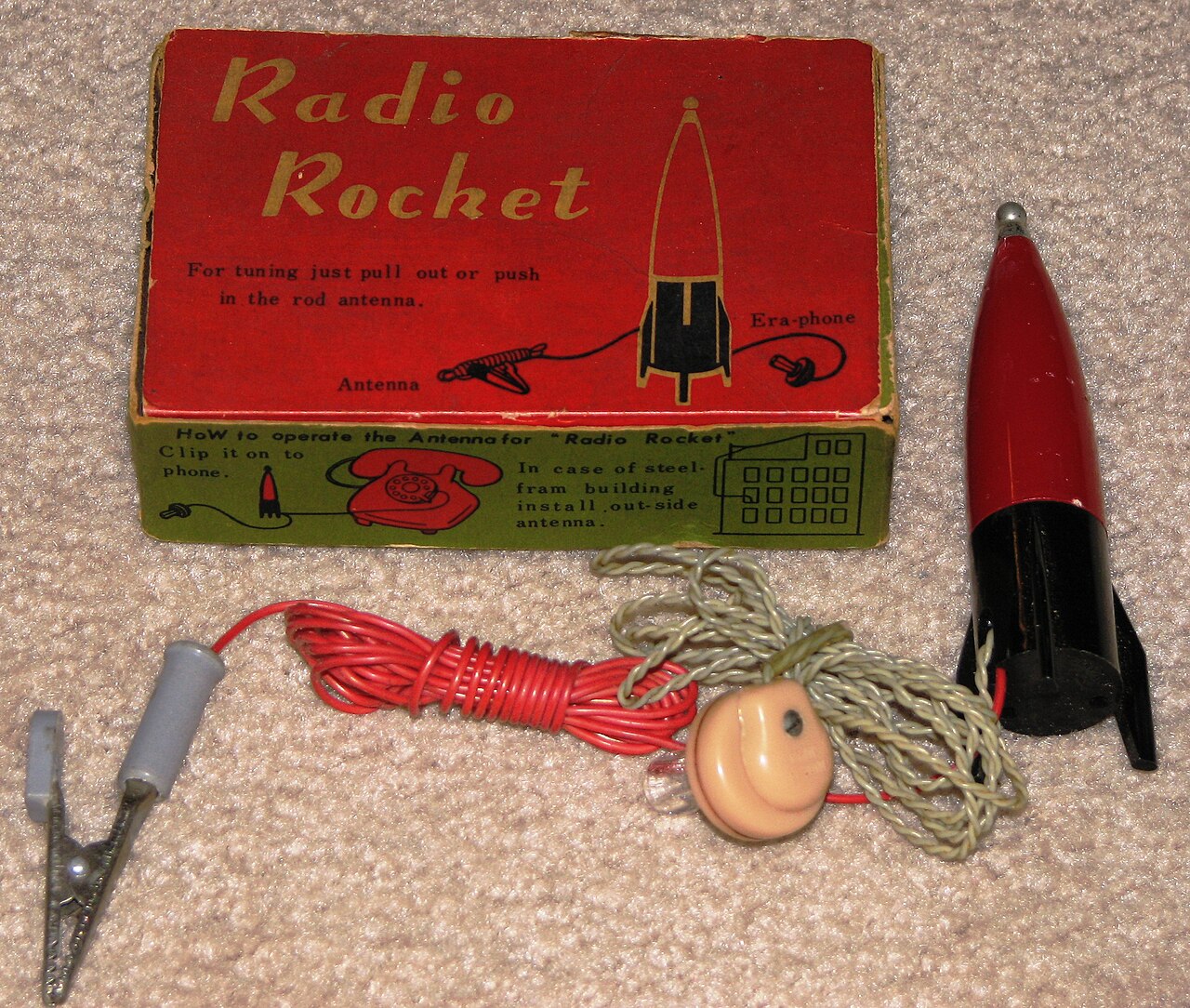
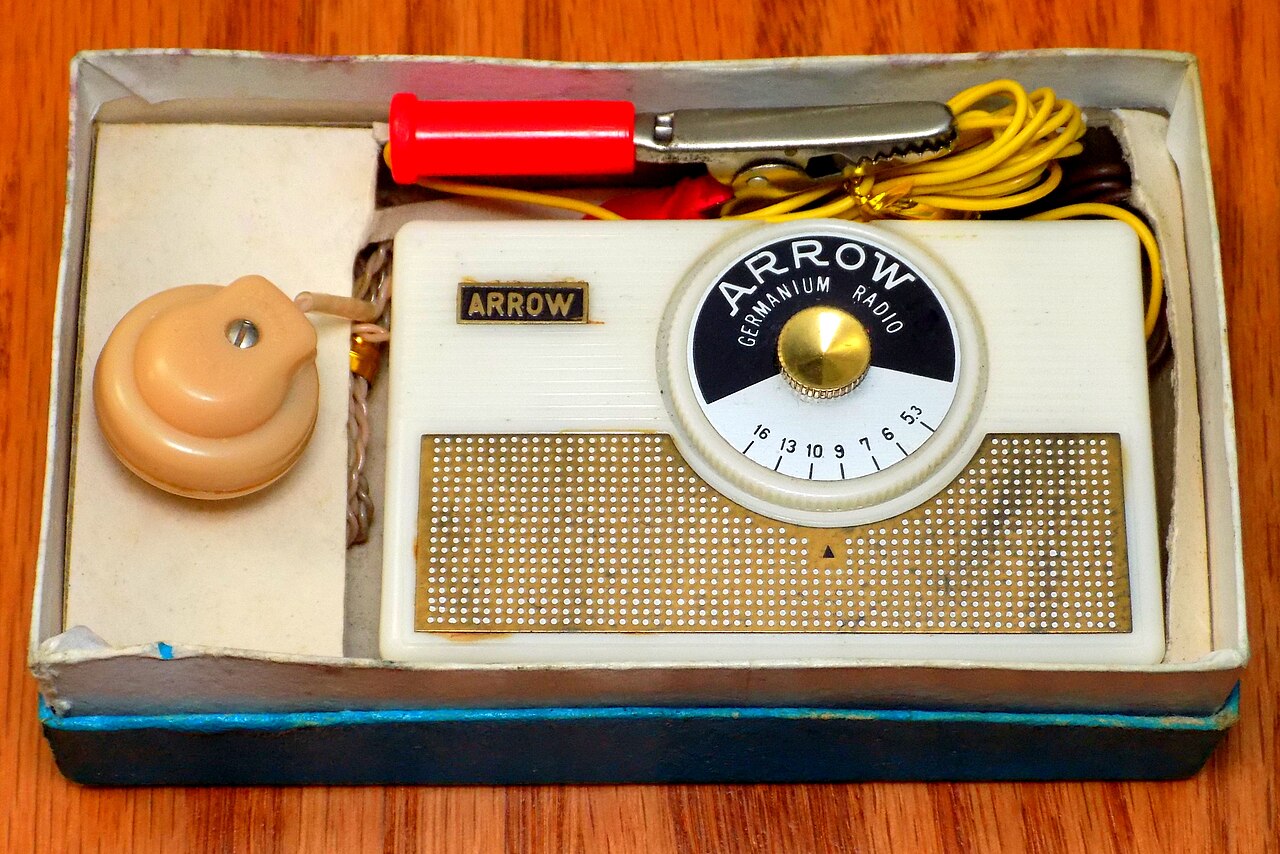
One remaining application is in crystal radios, where the earpiece’s high sensitivity lets it work with the very weak signals those radios produce, and its high impedance—around 20 kilohms—matches the radio’s output well. Crystal earpieces have also been used as microphones, as their high output requires less amplification. Additionally, they can serve as a basic, low-voltage tool for troubleshooting audio circuits: touching the tip of the earpiece’s audio connector to a test point while the sleeve connection is touched with a finger will make any audio-range signal at that point audible. This quick method can avoid the need for an oscilloscope or an amplifier for initial checks.
- Impedance
- on the order of 20 kilohms
- Typical piezoelectric materials
- Rochelle salt (early), barium titanate (modern), or less often quartz
- Peak use era
- 1960s era transistor radios and hearing aids
- Remaining use
- crystal radios
Lore & Background
Crystal earpieces are usually monaural devices with very low sound fidelity, but high sensitivity and impedance. Their peak use was probably with 1960s era transistor radios and hearing aids. They are not used with modern portable media players due to unacceptable sound quality. The main causes of poor performance with these earpieces are low diaphragm excursion, nonlinearity, in-band resonance and the very short horn shape of the earpiece casing, resulting in a very tinny sound lacking in bass.
One remaining use for crystal earpieces is in crystal radios. Their very high sensitivity enables them to use the very weak signals produced by crystal radios, and their high impedance (on the order of 20 kilohms) is a good match for the typical crystal radio. They have also been used as microphones, with their high output requiring less amplification.
Crystal earpieces can also be used as rudimentary, low voltage, audio circuit troubleshooting tools; it is sufficient to touch the tip of the earpiece's audio connector on a point of interest while simultaneously touching the other (sleeve) connection with one's finger. The high impedance of the earpiece means that any audio-range signal applied to the tip of the connector will be heard in the earpiece.
Reader's Guide
The crystal earpiece represents an early, simple approach to personal audio reproduction, relying on the piezoelectric effect rather than electromagnetic drivers. Its significance lies in its extreme sensitivity and very high impedance, which made it uniquely suited to the weak signals of crystal radios and early transistor radios. While its sound quality is poor—tinny and lacking bass due to low diaphragm excursion, nonlinearity, in-band resonance, and a short horn-shaped air path—its ability to produce audible sound from minimal electrical power was a practical advantage in battery-powered devices of the 1960s. The earpiece's high impedance (around 20 kilohms) also made it a natural match for crystal radio circuits, and its use as a microphone and as a quick troubleshooting probe for audio circuits demonstrates its versatility beyond simple listening. Modern headphones have largely replaced crystal earpieces with electromagnetic drivers using moving coils or moving iron cores, but the crystal earpiece remains a notable example of piezoelectric transducer application in consumer audio.
Did You Know?
- Crystal earpieces use a piezoelectric crystal that changes shape when electricity is applied, vibrating a diaphragm to produce sound.
- The earpiece's high impedance (about 20 kilohms) makes it a good match for the weak signals of crystal radios.
- A crystal earpiece can be used as a rudimentary audio circuit troubleshooting tool by touching its tip to a test point while holding the sleeve connection.
Origins in the Telephone Exchange
The story of the earpiece begins not in music or entertainment but in the practical demands of the telephone switchboard. By the 1880s, operators needed a way to keep both hands free while patching wires between callers. The solution was a simple clamp that held a single receiver against the ear, freeing the operator's fingers for the mechanical work of connecting lines. This singular device—just one earpiece, not a pair—was the original headphone. It was never designed for enjoying sound; it was a labor tool. Audio quality was, by any modern measure, poor, and the form was crude. Yet this humble clamp-and-receiver arrangement laid the groundwork for everything that followed, from the two-earpiece designs that emerged in the 1890s to the sophisticated electroacoustic transducers we wear today. The fundamental principle remained: convert an electrical signal into a corresponding sound for one listener, privately, without broadcasting into the surrounding air.
The Wireless Frontier and Crystal Sets
As wireless telegraphy took shape in the early 1900s, the humble telephone receiver found a second life as a detector for radio signals. By 1902, innovators such as Lee de Forest were strapping two head-mounted receivers together to catch the faint electrical whispers of receiving circuits. Terminology evolved rapidly: the plural 'head telephones' gave way to 'head phones' by 1908, and the single compound word 'headphones' appeared a year later. Holtzer-Cabot began manufacturing head receivers in 1909, and Nathaniel Baldwin, motivated by his inability to hear sermons on Sundays, offered a prototype headset to the U.S. Navy in 1910, which promptly ordered a hundred units. These early wireless earpieces were paired with crystal sets and triode receivers, and their impedance typically sat in the 1,000-to-2,000-ohm range, a specification chosen to match the sensitivity demands of those primitive radio circuits.
Driver Engineering and the Struggle for Fidelity
The internal mechanics of early earpieces were a study in compromise. Most relied on moving-iron drivers, where voice coils wound around the poles of a permanent magnet sat close to a flexible steel diaphragm. Audio current passing through the coils altered the magnetic field, pushing and pulling the diaphragm to generate sound waves. The central problem was sensitivity: to pick up weak signals, designers avoided any damping, which let the diaphragm ring freely. The result was a frequency response riddled with sharp resonant peaks, producing a thin, uneven tone. Padding was largely absent, so extended listening sessions were physically uncomfortable. Impedance varied by application—75 ohms for telegraph and telephone work, but the higher 1,000-to-2,000-ohm range for radio use, where finer wire with more turns boosted sensitivity. Some exceptionally sensitive models, such as those manufactured by Brandes around 1919, became staples of early radio experimentation.
From Private Listening to Public Culture
The cultural footprint of the earpiece expanded dramatically beginning in the 1980s, a shift often attributed to the Walkman effect. What had been a tool for switchboard operators, wireless operators, and professionals suddenly became a personal audio companion on sidewalks, in grocery stores, and aboard public transit. The technology kept diversifying: circumaural and supra-aural designs use a headband to position drivers around or over the ear, while earbuds and earpieces plug directly into the ear canal, with cordless wireless variants now available. Bone conduction models wrap behind the head and rest before the ear canal, leaving it open. Connectivity has broadened from simple quarter-inch or eighth-inch jacks to Bluetooth, DECT, and FM radio links. In professional settings the earpiece remains indispensable—audio engineers mix live sound, DJs cue tracks silently, and pilots and call-center agents rely on integrated headsets with built-in microphones.
Gallery
Frequently Asked Questions
What is a crystal earpiece?
A crystal earpiece is a high-impedance piezoelectric earphone shaped to sit inside the ear canal. It was a staple of 1960s-era transistor radios and hearing aids before being largely replaced by dynamic drivers.
How does a crystal earpiece actually produce sound?
An audio signal reaches metal electrodes on both faces of a piezoelectric crystal, causing the crystal to flex ever so slightly. That micro-flexion drives a cone-shaped plastic or metal-foil diaphragm to vibrate, pushing air and producing audible sound.
What materials are used as the piezoelectric element in crystal earpieces?
Early designs used Rochelle salt, while most modern units employ barium titanate. Quartz is a less common but still used alternative.
Why aren't crystal earpieces found in modern headphones?
Their roughly 20-kilohm impedance is far too high for standard audio sources to drive effectively, and dynamic or electrostatic drivers offer better sensitivity and bass response. They now survive mainly in crystal radio sets and niche low-power applications.
What is the typical impedance of a crystal earpiece and why does that matter?
A crystal earpiece typically presents on the order of 20 kilohms, orders of magnitude above a conventional dynamic driver. That extreme impedance means it requires a very different signal source to work, which is why it became impractical as consumer audio gear evolved.
More in Headphones and Audio Gear 1-24
Spotted an error? Know more?
Reader corrections go straight into our review queue. Suggest an edit · How this site is sourced