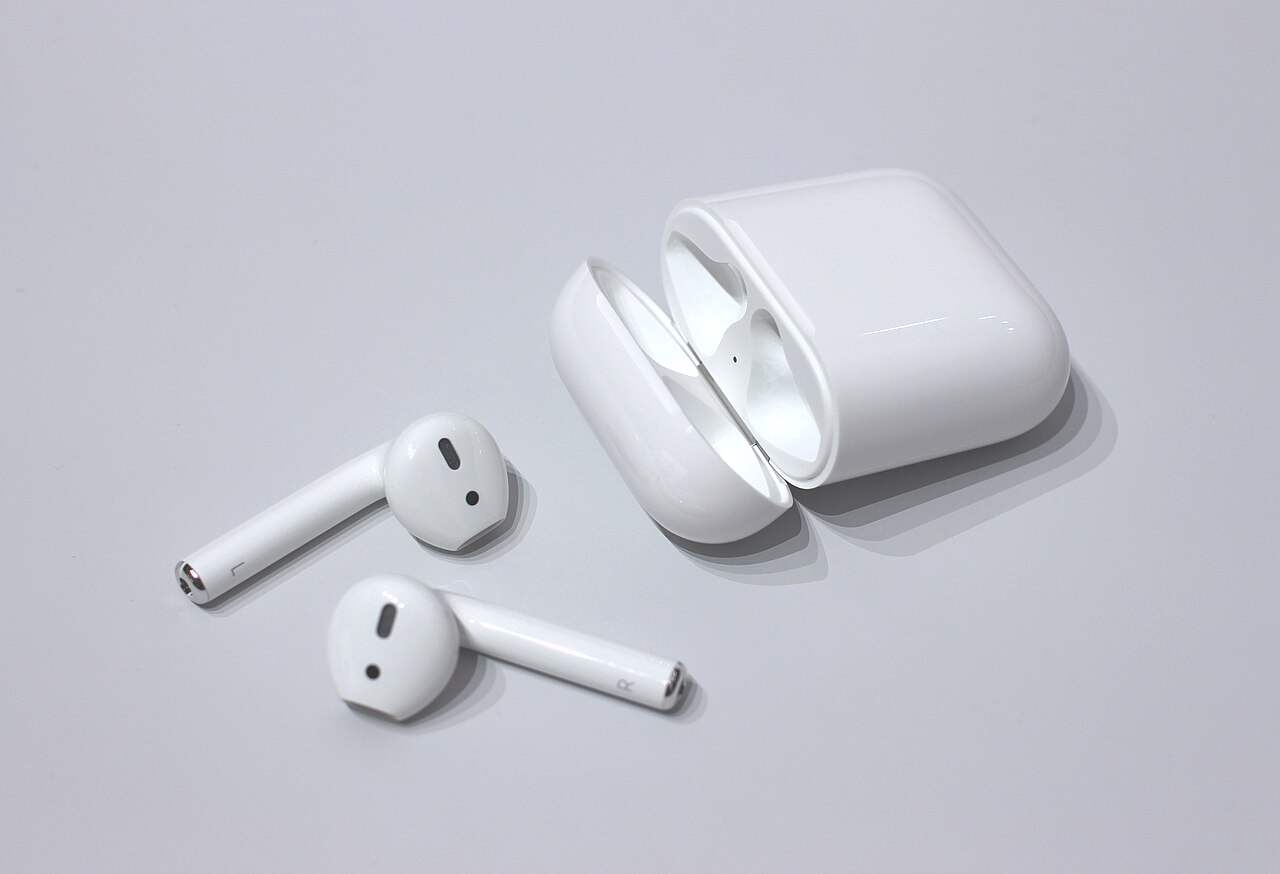
AirPods
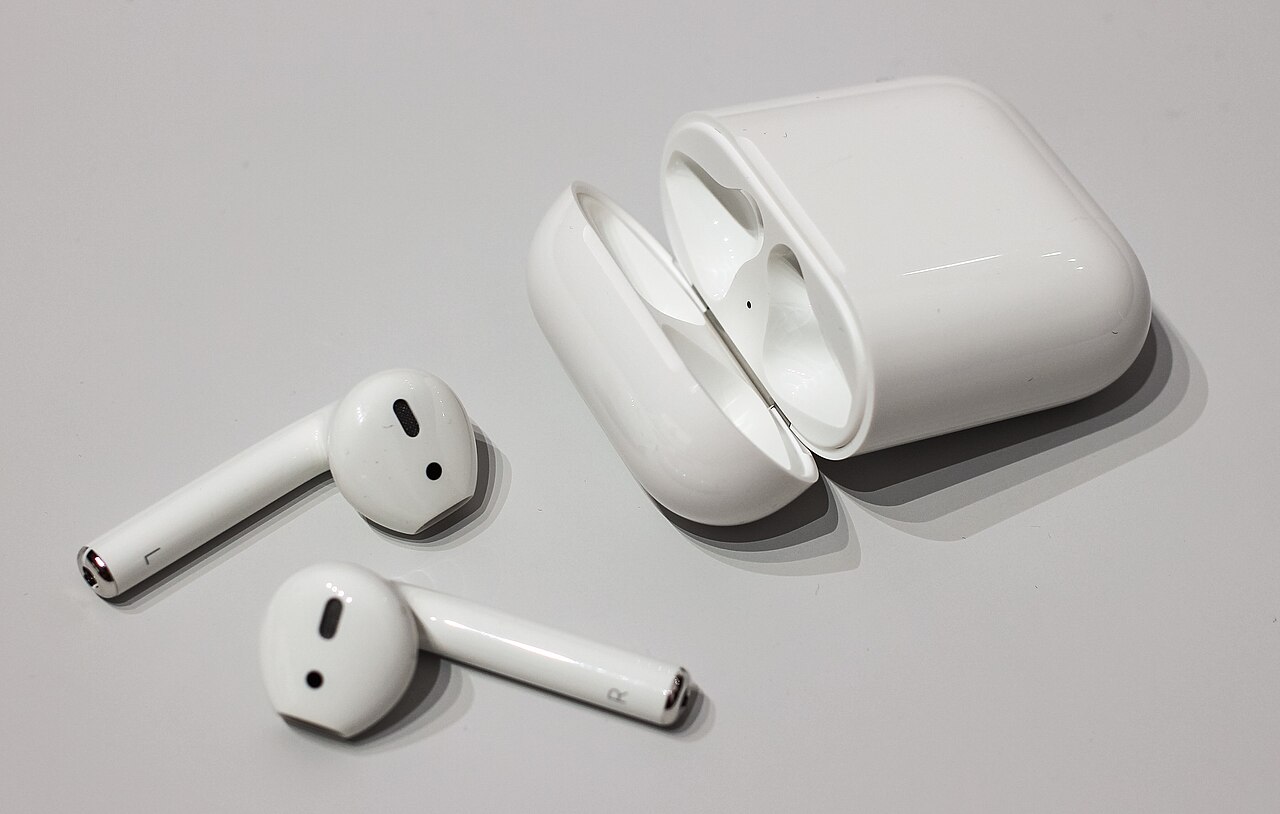
Apple's entry-level wireless earbuds, first announced in September 2016.

TimTom405 · CC BY-SA 4.0
AirPods are wireless Bluetooth earbuds made by Apple. They debuted on September 7, 2016, at the same event as the iPhone 7 and the 2016 MacBook Pro, and within two years they became Apple’s best-selling accessory. They sit as the company’s basic wireless headphones, alongside the pricier AirPods Pro and AirPods Max.
Beyond playing audio, each AirPod has a microphone that cuts background noise, plus accelerometers and optical sensors. These detect taps and pinches—like a double-tap or pinch to pause audio—and sense when they’re in the ear, so audio automatically pauses when removed.
The second generation arrived on March 20, 2019, with the H1 chip, longer talk time, and hands-free “Hey Siri.” A pricier version came with a Qi-compatible charging case.
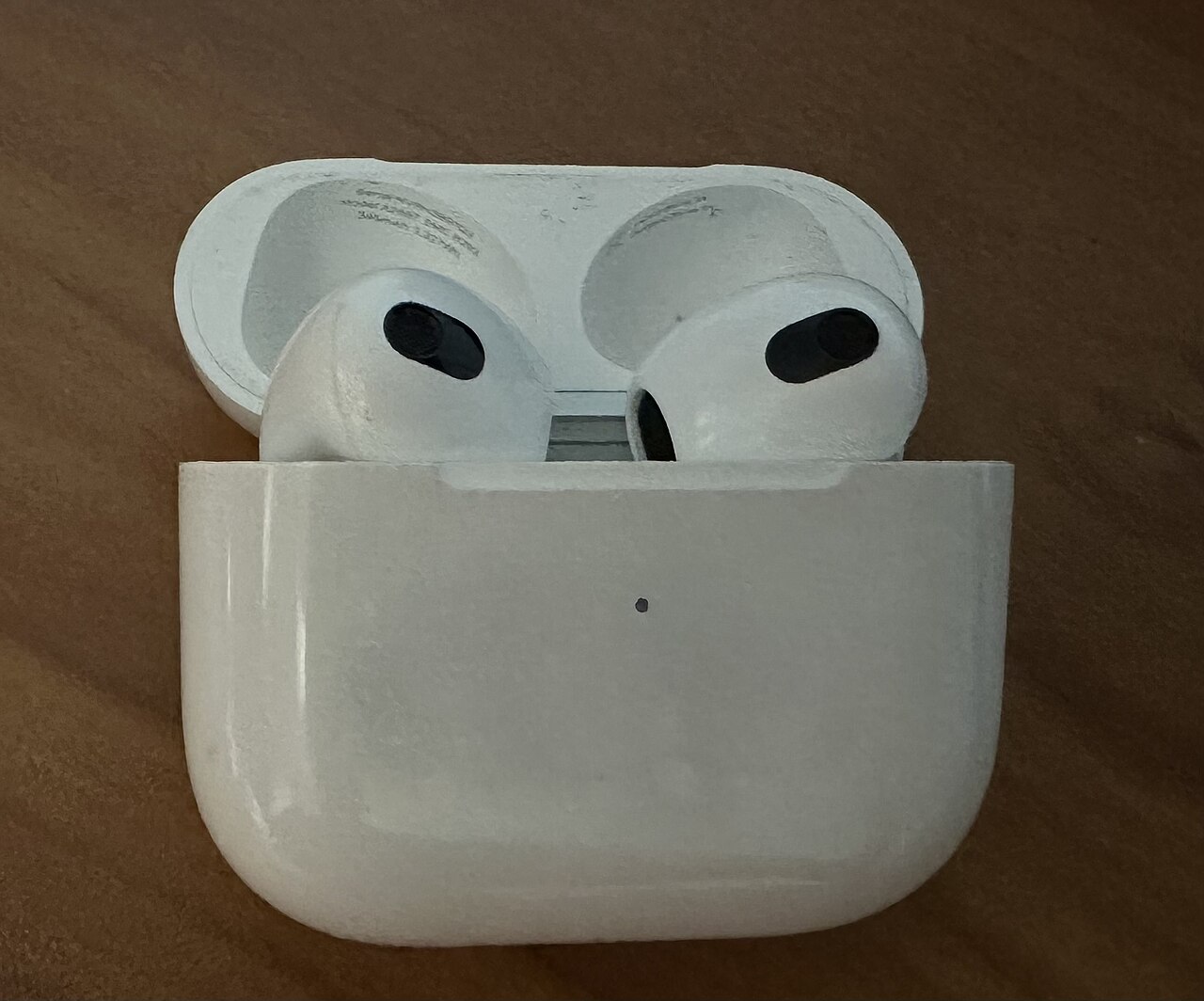
The third generation launched on October 26, 2021, with a redesigned look featuring shorter stems like the AirPods Pro, spatial audio, IPX4 water resistance, longer battery life, and MagSafe charging.
On September 9, 2024, Apple announced the AirPods 4, which include the H2 chip, Bluetooth 5.3, and a USB-C charging case. The higher-end model adds active noise cancellation and a case that works with Qi and Apple Watch chargers. After iOS 26, that model also enables real-time foreign language conversation through AI translation.
**Models**
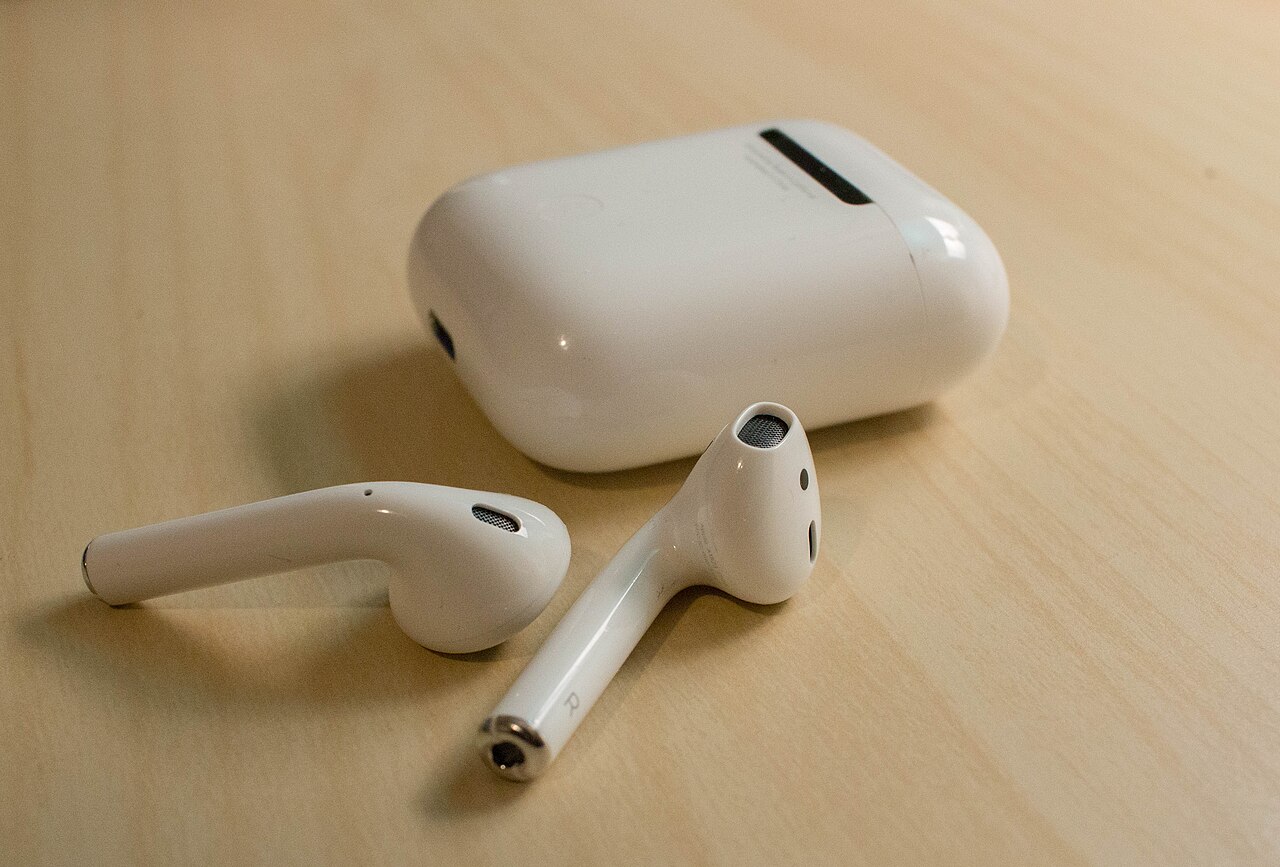
**1st generation** Announced on September 7, 2016, alongside the iPhone 7 and Apple Watch Series 2, the first-generation AirPods were originally set for late October but delayed. Online orders started December 13, 2016, and they hit stores and authorized resellers on December 20, 2016. They use Apple’s proprietary W1 chip, which optimizes battery and handles Bluetooth 4.2 and audio connections. The W1’s advanced features require iOS 10, macOS Sierra, watchOS 3, or later, but they work as standard Bluetooth headphones with any device supporting Bluetooth 4.0 or higher, including Windows and Android devices. Each AirPod has two microphones—one at ear level and one at the stem’s bottom. Each weighs 0.14 oz; the charging case weighs 1.34 oz. Battery life is about five hours, with fifteen minutes of charging providing three hours of listening. The case holds 24 hours total. Each AirPod contains a 93 milliwatt hour battery in its stem, and the case has a 1.52 watt hour (398 mAh at 3.81 V) battery. Model numbers are A1523 and A1722.
Quick Facts
- Developer
- Apple
- Manufacturer
- Luxshare (on contract) / GoerTek (on contract)
- Family
- AirPods
- Release Date
- 1st generation: 2016-12-13 / 2nd generation: 2019-03-20 / 3rd generation: 2021-10-26 / AirPods 4: 2024-09-20
- System On Chip
- 1st generation: Apple W1 / 2nd and 3rd generation: Apple H1 / AirPods 4: Apple H2
- Discontinued
- 1st generation: 2019-03-20 / 2nd and 3rd generation: 2024-09-09
- Input
- AirPods (each) / Dual beam-forming microphones, dual optical sensors
- Currentfw
- 1st gen: 6.8.8 (December 2019) / 2nd gen: 6F21 (October 22, 2024) / 3rd gen: 6F21 (October 22, 2024) / AirPods 4 and ANC: 8B39 (March 24, 2026. )
- Dimensions
- AirPods (each) / 0.65 x 0.71 x 1.59 in / (16.5 x 18.0 x 40.5 mm) / Charging case / 1.74 x 0.84 x 2.11 in / (44.3 x 21.3 x 53.5 mm)
- Weight
- AirPods (each) / 0.14 oz / Charging case / 1.34 oz
- Related
- AirPods Pro, AirPods Max
Facts from the source article.
Lore & Background
AirPods contain a proprietary Apple W1 SoC processor that optimizes battery use and manages Bluetooth 4.2 and audio connections. They include a microphone that filters out background noise, built-in accelerometers, and optical sensors capable of detecting taps and pinches as well as placement within the ear, enabling automatic pausing of audio when removed. The first-generation AirPods were announced on September 7, 2016, but their release was delayed; online orders began on December 13, 2016, and they were available at Apple Stores and select carriers on December 20, 2016. Production of the first generation was discontinued on March 20, 2019, upon the release of the second generation.
The second-generation AirPods, announced on March 20, 2019, feature the H1 chip, hands-free 'Hey Siri' support, Bluetooth 5 connectivity, and 50% more talk time. They can be purchased with the same charging case as the first generation or with a Wireless Charging Case that supports Qi chargers. The third-generation AirPods, announced on October 18, 2021, feature a redesigned shorter stem, spatial audio, IPX4 water resistance, and a case supporting MagSafe charging. The fourth-generation AirPods, announced on September 9, 2024, feature the H2 chip, Bluetooth 5.3, IP54 dust resistance, and a USB-C charging case; a higher-end model includes active noise cancellation and compatibility with Qi and Apple Watch chargers.
Reader's Guide
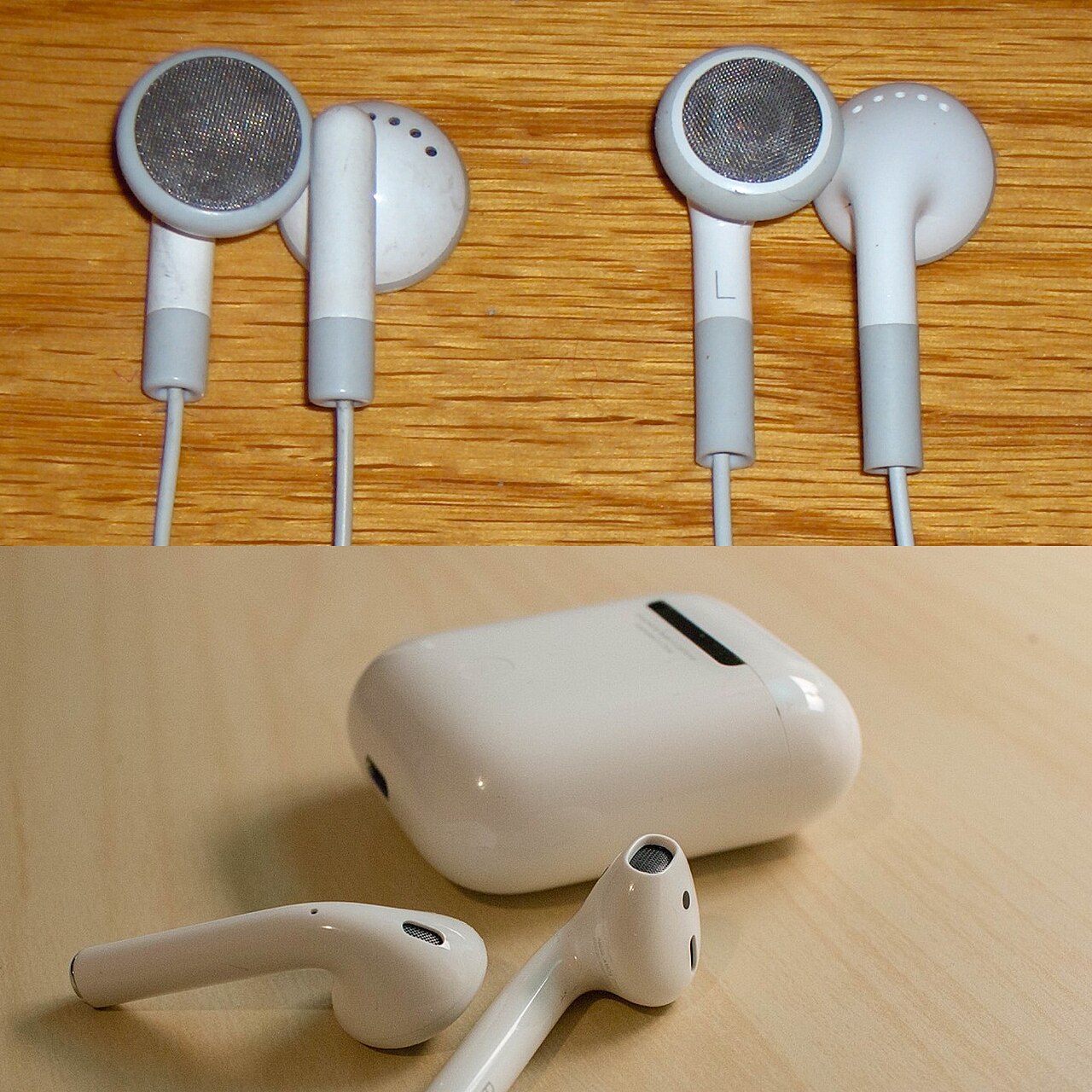
AirPods have had a significant cultural and market impact since their introduction. On announcement day, they were compared to Apple's existing EarPods, with observers noting they looked like the old EarPods with the wires cut off. Despite initial mockery, AirPods quickly became Apple's most popular accessory, with analysts estimating 14 to 16 million units sold in 2017, 35 million in 2018, and 60 million in 2019. By 2019, analysts estimated AirPods made up 60% of the global wireless headphone market, and Apple's entire Wearables category—including Apple Watch, AirPods, and AirPods Pro—was bigger than 60% of companies in the Fortune 500. An estimated 5–7% of Apple's revenue from AirPods comes from replacement earbuds and cases. Analysts estimated approximately 120 million pairs were sold in 2021. The lithium-ion batteries in AirPods can see significant degradation over time, with two-year-old sets lasting for less than half of the advertised five hours. Apple offers battery servicing and replacement of individual AirPods and charging cases, but iFixit gave AirPods 1, 2, and 4 a 0/10 repairability score because they cannot be repaired without destroying the outer case.
Did You Know?
- AirPods contain a 93 milliwatt hour battery in each stem, and the charging case contains a 1.52 watt hour battery.
- The second-generation AirPods added hands-free 'Hey Siri' support and Bluetooth 5 connectivity.
- The fourth-generation AirPods, announced in 2024, include an H2 chip, Bluetooth 5.3, and IP54 dust resistance.
- After iOS 26, the higher-end AirPods 4 enable real-time foreign language conversation through AI translation.
A Bold Debut and Rapid Ascent
Apple unveiled its first wireless earbuds on September 7, 2016, presenting them at the same special event as the iPhone 7. Although the company had initially targeted a late-October launch, shipping slipped, and online orders did not open until December 13, with in-store availability following on December 20. Each bud weighed just four grams and housed a proprietary W1 system-on-chip that managed Bluetooth 4.2 connectivity and optimized power draw. Two microphones per side—one facing outward at ear level, another at the stem's base—handled voice capture. A fifteen-minute top-up in the case yielded roughly three hours of playback, while the case itself stretched total usage to about twenty-four hours. The earbuds also carried accelerometers and optical sensors that recognized taps, pinches, and whether the bud sat in the ear, triggering automatic pause when removed. Despite the modest launch window, the product surged: within two years it had become Apple's best-selling accessory, a milestone that cemented the category and set the stage for every subsequent generation.
Five Generations of Iterative Redesign
The AirPods line has cycled through five distinct hardware generations, each building on the last. The first two generations shared an identical long-stem silhouette; the 2019 second generation swapped the W1 chip for an H1 processor, added Bluetooth 5, hands-free "Hey Siri" activation, and roughly fifty percent more talk time. The 2021 third generation marked the most visible design break, shortening the stems to echo the AirPods Pro profile, introducing force-touch controls, spatial audio with Dolby Atmos, IPX4 water resistance, and MagSafe-compatible charging that pushed total battery to six hours per charge and thirty hours with the case. The 2024 fourth generation moved to the H2 chip and Bluetooth 5.3, shrank the case to accept USB-C, dropped the MagSafe magnets, and added active noise cancellation to the premium tier. By 2026, the fifth generation brought enhanced noise cancellation and voice isolation to both models, raised water resistance to IP57, and introduced on-stem volume adjustment alongside wireless charging on the higher-end variant.
Sensing, Audio, and the Rise of AI
Beyond simple audio playback, each AirPod embeds a suite of sensors and processing that transforms how the user interacts with the device. Accelerometers and optical sensors track taps, double-taps, and pinches to control playback, while in-ear detection automatically pauses music the moment a bud is lifted out. Dual microphones on every side filter ambient noise during calls. As the lineup matured, the audio experience deepened: the third generation added spatial audio and Dolby Atmos, the fourth brought active noise cancellation to its premium model, and the fifth extended both noise cancellation and voice isolation across the entire range. Perhaps the most forward-looking addition arrived with the fourth generation's higher-end tier and iOS 26: real-time foreign-language conversation powered by Apple Intelligence's AI translation, requiring an iPhone equipped with the A17 Pro chip or newer. This feature turns the earbuds from passive listeners into active communication bridges, a capability no earlier generation offered.
A Tiered Ecosystem Built for Every Platform
Apple positions the standard AirPods as its entry-level wireless earbuds, sitting below the AirPods Pro and AirPods Max in the company's headphone hierarchy. That entry-level status does not mean limited compatibility. While the W1 and H1 chips deliver the tightest integration with iOS 10 and later, macOS Sierra and beyond, and watchOS 3 and newer, the earbuds also function as ordinary Bluetooth 4.0-or-higher headphones on Windows laptops and Android devices. The charging case has evolved alongside the buds: early generations used Lightning, the second generation offered an optional Qi wireless-charging case (originally teased in 2017 alongside AirPower, whose cancellation delayed its arrival), the fourth generation shifted to USB-C and added a built-in speaker for Find My tracking plus Apple Watch charger compatibility, and the fifth generation extended wireless charging to the premium model. Pricing has also flexed, with Apple introducing a $169 third-generation variant in 2022 that omitted Qi and MagSafe support, giving buyers a more affordable path into the ecosystem.
Gallery

Frequently Asked Questions
Who is AirPods?
AirPods are Apple's entry-level wireless Bluetooth earbuds, first revealed on September 7, 2016, at the same keynote as the iPhone 7. They hit retail on December 20, 2016, and within two years became the company's most popular accessory.
What are AirPods's powers/role?
Each bud packs a noise-reducing microphone, accelerometers, and optical sensors that let you control playback with simple taps and pinches. They also detect when they're in your ear and automatically pause audio the moment you pull them out.
Why is AirPods important?
Within roughly two years of launch, AirPods became Apple's best-selling accessory, proving that a simple cable-free earbud could reshape how millions of people listen to audio. They set the template for the entire Apple wireless-audio family.
What's AirPods's stat sheet?
Each bud weighs just 0.14 oz, the charging case tips the scale at 1.34 oz, and a single charge delivers about five hours of playback. The case extends total usable time to roughly 24 hours across multiple recharges.
More in Headphones and Audio Gear 1-24
Spotted an error? Know more?
Reader corrections go straight into our review queue. Suggest an edit · How this site is sourced