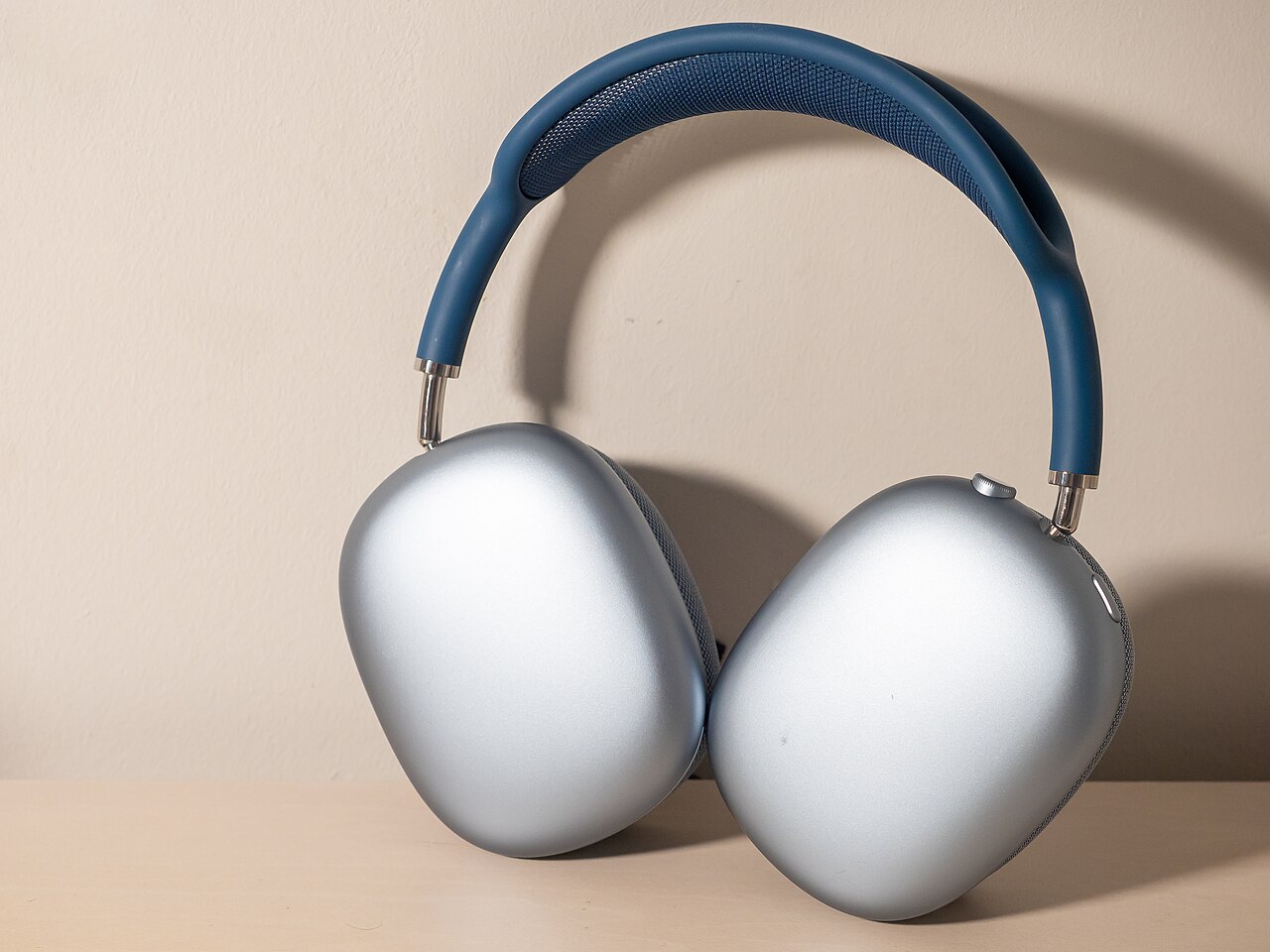
AirPods Max
Apple's over-ear wireless headphones with Digital Crown and noise cancellation.

Kyu3a · CC BY-SA 4.0
The AirPods Max are Apple's premium over-ear wireless headphones, released on December 15, 2020. They sit above the standard AirPods and AirPods Pro in the lineup. Compared to the AirPods Pro, the Max switch to an over-ear design with larger speakers, add a Digital Crown (borrowed from the Apple Watch and Vision Pro), offer more color choices, and deliver longer battery life. A USB-C version of this first-generation model arrived on September 20, 2024, and a second-generation model with the H2 chip launched in April 2026.
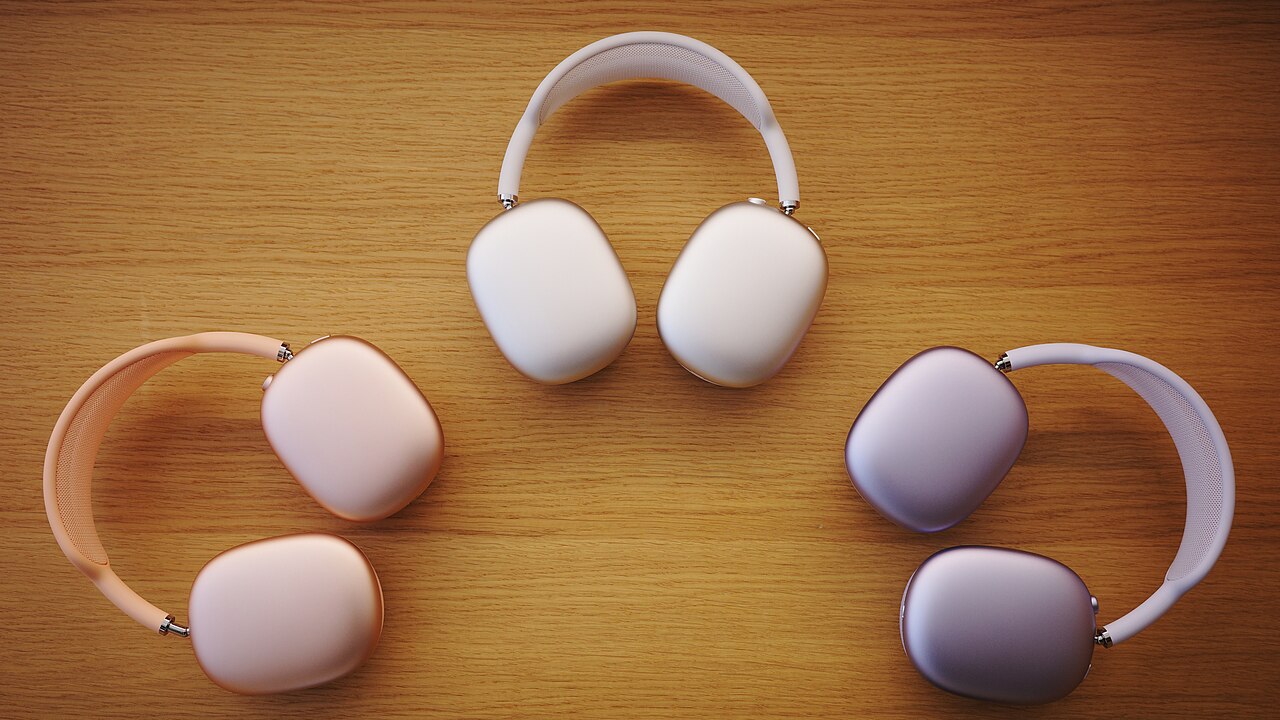
The first generation was announced via press release on December 8, 2020. Each ear cup contains an H1 chip, the same one used in second-generation AirPods and first-generation AirPods Pro. Active Noise Cancellation and Transparency mode are included. The Digital Crown controls playback, volume, track skipping, calls, and Siri. Proximity sensors automatically pause audio when the headphones are removed. Spatial audio uses gyroscopes and accelerometers to create a theater-like effect by tracking head movement. Apple rates battery life at 20 hours, with five minutes of charging providing 1.5 hours of listening. Charging is via Lightning, which also supports line-in audio through Apple’s USB-A, USB-C, or 3.5mm cables. A Smart Case with magnets puts the headphones into low-power mode. Five colors were available: Space Gray, Silver, Sky Blue, Green, and Pink, with matching ear cushions and chassis.
The USB-C update was announced on September 9, 2024, and released on September 20, 2024. It replaces Lightning with USB-C for charging and data, and introduces new colors: Midnight, Starlight, Blue, Purple, and Orange. With iOS/iPadOS 18.4 or macOS Sequoia 15.4, USB-C models support lossless audio up to 24-bit/48 kHz and ultra-low latency audio when connected via USB-C cable.
The second generation, announced March 16, 2026, and released April 1, 2026, adds the H2 chip and Bluetooth 5.3. It features improved sound quality and active noise cancellation, plus live translation, adaptive audio, audio recording, voice isolation, and Siri control via head gestures. Lossless audio over USB-C is also supported.
AirPods Max work with any Bluetooth device, including Android and Windows, but features like Siri require an Apple device running iOS 14.3, iPadOS 14.3, watchOS 7.2, tvOS 14, or macOS Big Sur.
Quick Facts
- Developer
- Apple Inc.
- Family
- AirPods
- Release Date
- 1st generation with Lightning: 2020-12-15 / 1st generation with USB-C: 2024-09-20 / 2nd generation: 2026-04-01
- Discontinued
- 1st generation with Lightning: 2024-09-09 / 1st generation with USB-C: 2026-03-16
- Price
- US$549.00
- System On Chip
- Apple H1 (1st generation) (each ear cup) / Apple H2 (2nd generation) (each ear cup)
- Input
- Nine microphones, optical sensor (each ear cup), position sensor (each ear cup), case-detect sensor (each ear cup), accelerometer (each ear cup), gyroscope (left ear cup)
- Currentfw
- AirPods Max Lightning: 6F25 / AirPods Max USB-C : 7E108 / AirPods Max 2 : 8E258
- Dimensions
- AirPods: / 6.64 x 3.28 x 7.37 in / (168.6 x 83.4 x 187.3 mm)
- Weight
- AirPods / 13.6 ounces (384.8 g) / Charging case / 4.74 ounces (134.5 g)
- Manufacturer
- Luxshare (on contract), Goertek (on contract)
- Related
- AirPods, AirPods Pro
Facts from the source article.
Lore & Background
The AirPods Max were announced on December 8, 2020, via a press release and released on December 15, 2020. They feature an over-ear headphone design introduced under the leadership of CEO Tim Cook and the company's product marketing team. Among those credited with their development were Apple's lead designers, along with Rayan Rechka, who was noted for his contributions to the color finishes. The headphones use an H1 chip in each ear cup, also found in the second-generation AirPods and first-generation AirPods Pro. They include Active Noise Cancellation and Transparency mode, and a Digital Crown similar to that of the Apple Watch for controlling playback, volume, calls, and Siri. Proximity sensors automatically detect when they are on a user's head. Spatial audio uses built-in gyroscopes and accelerometers to track head movement. Apple claims 20 hours of battery life, with five minutes of charging delivering 1.5 hours of listening time. The first generation charges via a Lightning port, which can also be used for line-in audio with Apple's cables. The headphones are bundled with a Smart Case that includes magnets to switch them to low-power mode. An updated USB-C version was announced on September 9, 2024, and released on September 20, 2024, adding support for lossless and ultra‑low latency audio up to 24-bit/48 kHz when connected via USB-C. A second-generation model with the H2 chip and Bluetooth 5.3 was announced on March 16, 2026, and released on April 1, 2026, adding improved sound quality, active noise cancellation, live translation, adaptive audio, audio recording, voice isolation, and Siri via head gestures.
Reader's Guide
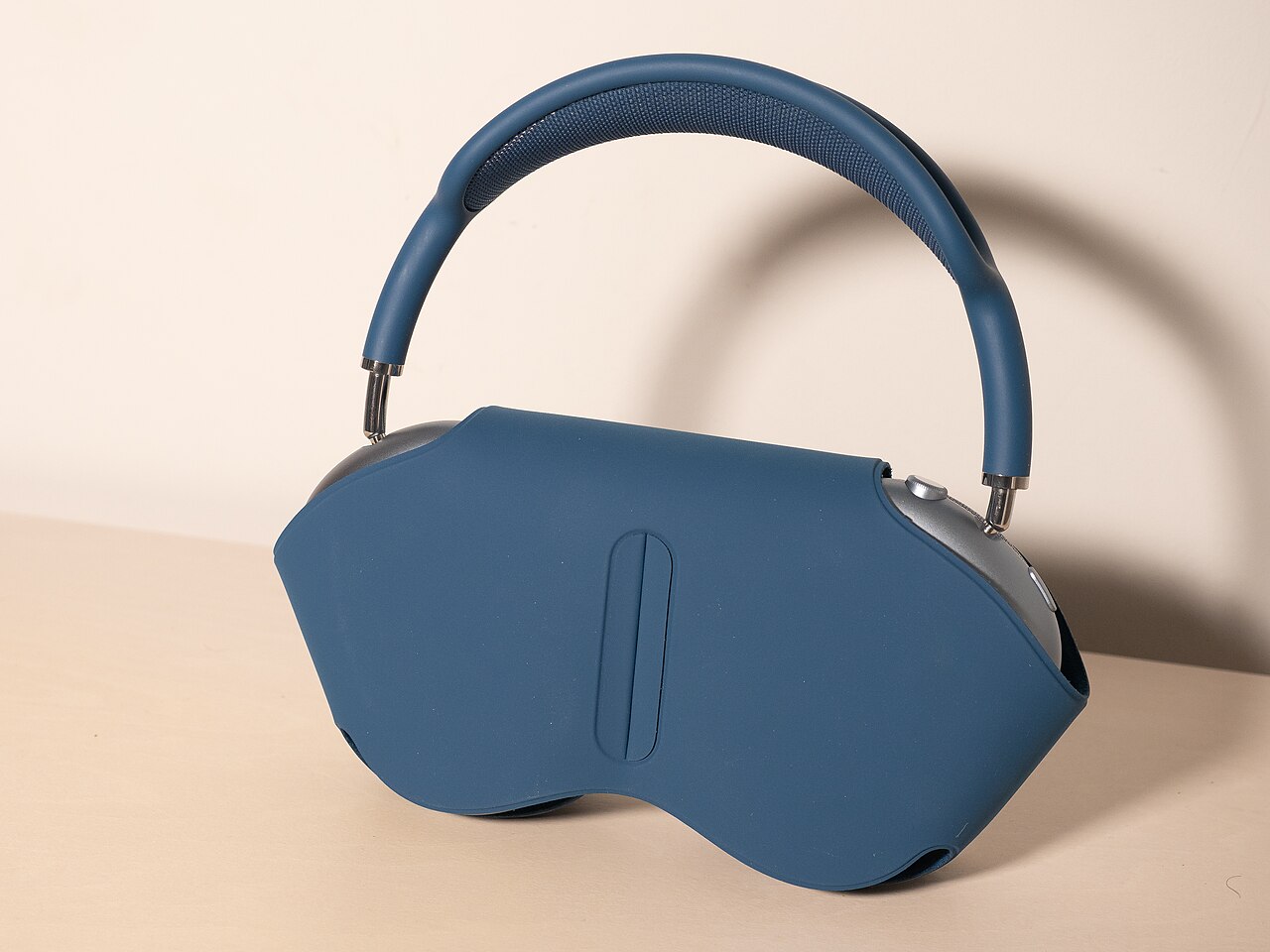
The AirPods Max represent Apple's entry into the over-ear headphone market, positioned as the premium option in the AirPods family. Their introduction marked a shift from Apple's earlier in-ear designs, bringing a full-size form factor with larger speakers and a Digital Crown borrowed from the Apple Watch. The first generation's Smart Case drew widespread mockery from technology reviewers and users on Twitter for its resemblance to a bra or purse, as noted by reporter Daniel Piper of Creative Bloq. Additionally, numerous people reported condensation buildup near the drivers after prolonged use under the removable ear cups, suspected to be caused by the full-metal body's thermal conductivity. The USB-C revision in 2024 added lossless audio support, addressing a key limitation of the original Lightning-based model. The second generation in 2026 introduced the H2 chip and Bluetooth 5.3, along with features like live translation and adaptive audio, further evolving the line. Compatibility extends to any Bluetooth device, though certain features such as Siri require an Apple device running iOS 14.3, iPadOS 14.3, watchOS 7.2, tvOS 14, or macOS Big Sur.
Did You Know?
- The AirPods Max were announced via a press release on December 8, 2020, and released on December 15, 2020.
- The Digital Crown on the AirPods Max is similar to that found on the Apple Watch and Apple Vision Pro.
- The Smart Case's design was widely mocked for resembling a bra or purse.
- The second-generation AirPods Max, released in April 2026, added live translation and Siri via head gestures.
Origins & Design Philosophy
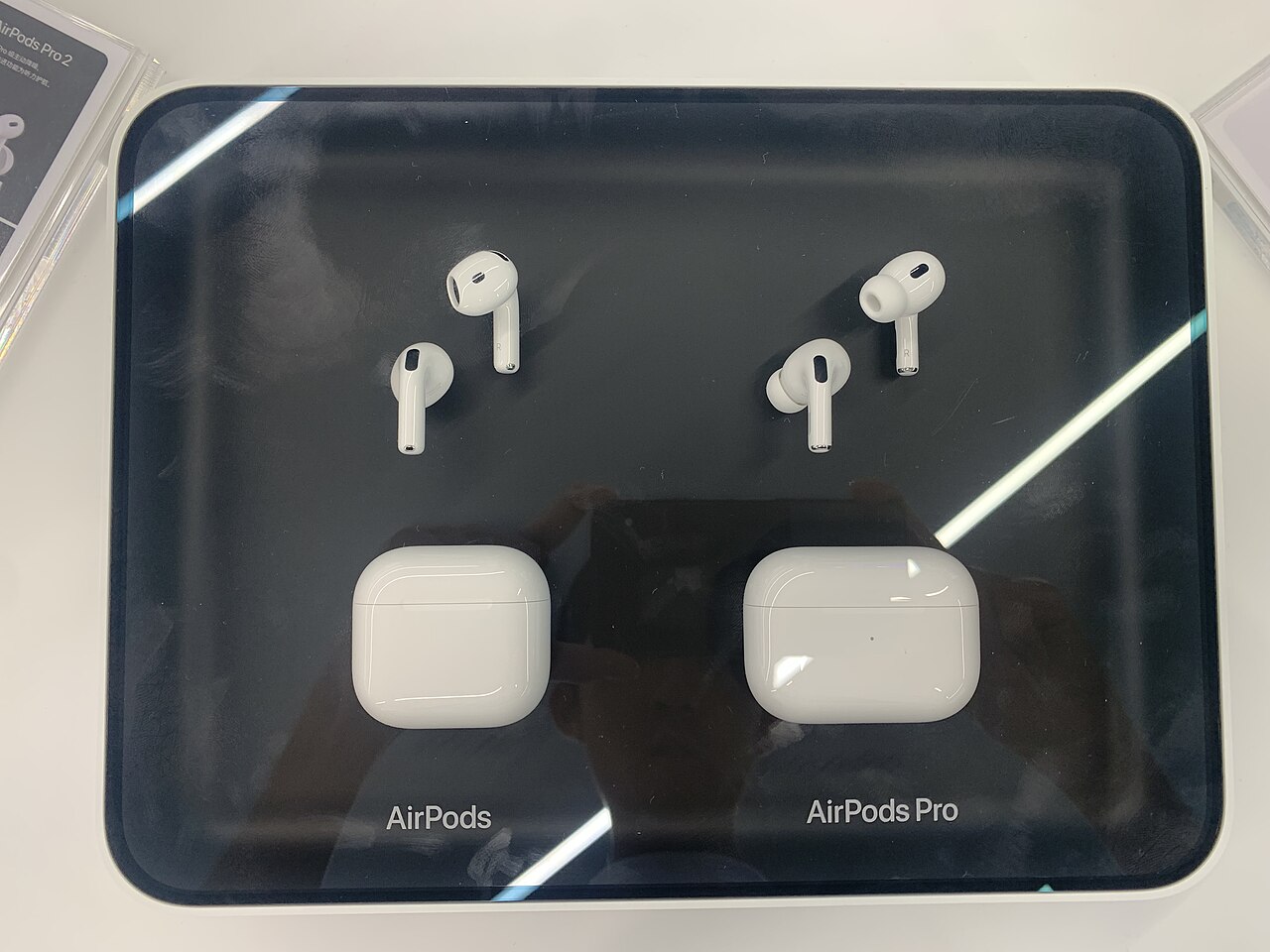
Apple unveiled its first true wireless earbuds on September 7, 2016, presenting them at the same special event where the iPhone 7 and MacBook Pro debuted. What began as a new entry-level option in Apple's headphone lineup—positioned below the AirPods Pro and AirPods Max—quickly became the company's most popular accessory within just two years. The original design was deceptively simple yet packed with sensing hardware: each earbud housed two microphones (one outward-facing at ear level, one at the stem base), accelerometers, and optical sensors that could interpret double-taps, pinches, and whether the bud was actually seated in the ear. That last feature enabled automatic pausing the moment a user pulled the earbud free. Under the hood, a proprietary W1 system-on-chip managed Bluetooth 4.2 connectivity and battery optimization, while the earbuds themselves weighed a mere 0.14 ounces against a 1.34-ounce charging case. After a brief delay from the planned late-October window, orders opened in mid-December 2016, and the product hit Apple Stores and carrier shelves on December 20.
Evolution Across Generations
From the H1 chip of the second generation in March 2019 through the H2-powered fourth generation in September 2024, each successive AirPods release brought meaningful hardware and software upgrades. The 2019 model added hands-free "Hey Siri" invocation and claimed fifty percent more talk time over its predecessor, while offering an optional Qi-compatible wireless charging case. The third generation, arriving in late October 2021, marked the first major external redesign: shorter stems echoing the AirPods Pro silhouette, force-touch controls, spatial audio with Dolby Atmos support, IPX4 water resistance, and a MagSafe-charging case that stretched total listening to thirty hours. By the fourth generation, Apple swapped the case to USB-C, introduced IP54 dust and water resistance, and offered active noise cancellation on the premium tier. The fifth generation, announced on September 9, 2026, pushed durability to IP57 and added on-stem volume adjustment alongside enhanced noise cancellation and voice isolation on both models.
Ecosystem Integration & Smart Features
AirPods have always been more than passive audio devices; their value lies in how deeply they weave into Apple's software stack. The original W1 chip required iOS 10, macOS Sierra, or watchOS 3 for its advanced pairing, though the earbuds still functioned as ordinary Bluetooth 4.0 headphones on Windows laptops and Android phones. The H1 generation unlocked hands-free Siri and, with iOS 13.2, the "Announce Messages with Siri" feature that let users dictate replies by voice. The third generation brought spatial audio and Dolby Atmos rendering, transforming the listening experience into something closer to a surround-sound environment. The fourth generation's premium tier added a speaker inside the charging case for Find My tracking and, after the iOS 26 update, real-time foreign-language conversation through AI translation on iPhones equipped with the A17 Pro or newer. Charging options evolved from Lightning to Qi, MagSafe, USB-C, and Apple Watch charger compatibility, reflecting Apple's broader hardware strategy.
Battery, Durability & Practical Engineering
Practical engineering choices define how AirPods feel in daily use. The first generation delivered roughly five hours of playback per charge, with a quick fifteen-minute top-up in the case yielding three additional hours; the case itself stored enough energy for twenty-four hours of total use. Teardowns revealed a 93-milliwatt-hour cell in each earbud stem and a 1.52-watt-hour (398 mAh at 3.81 V) battery in the case. The second generation's H1 chip improved talk time by fifty percent, and the third generation stretched earbud life to six hours with up to thirty hours from the case. Durability progressed steadily: IPX4 water resistance arrived with the third generation, IP54 dust and water protection with the fourth, and IP57 with the fifth. Weight remained remarkably light—0.14 ounces per earbud in the original—while the charging case shrank to a smaller form factor by the fourth generation. Each generation also refined the charging ecosystem, moving from Lightning through Qi and MagSafe to USB-C, ensuring the earbuds stayed compatible as Apple's broader hardware shifted toward universal connectors.
Gallery

Frequently Asked Questions
What are AirPods Max?
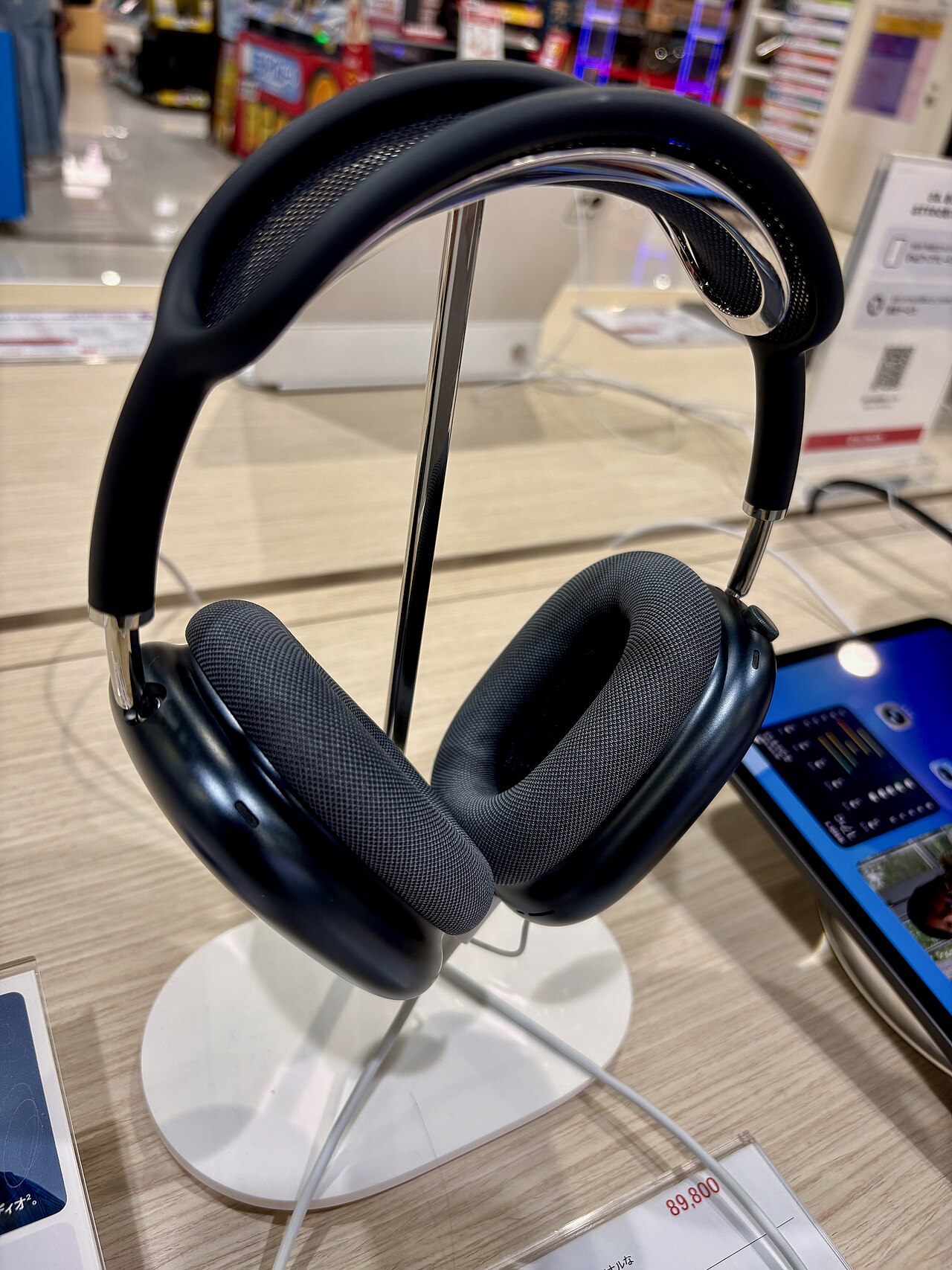
AirPods Max is Apple's flagship over-ear wireless headphone, sitting at the top of their audio lineup above the standard AirPods and AirPods Pro. They feature a stainless steel frame, a knit-mesh headband, and a Digital Crown on the right ear cup for tactile volume and playback control.
How long does the AirPods Max battery last?
A single charge gives you roughly 20 hours of continuous listening time. That is a major step up from the AirPods Pro and makes the Max a solid fit for long flights or full workdays without hunting for a top-up.
What chip powers the AirPods Max?
The first-generation model, including the 2024 USB-C refresh, runs an H1 chip in each ear cup to drive noise cancellation, spatial audio, and the rest of the computational audio features. The second-generation model that launched in April 2026 upgrades to the newer H2 chip.
What colors can you get AirPods Max in?
The original 2020 lineup shipped in Space Gray, Silver, Sky Blue, Green, and Pink. The 2024 USB-C revision swapped those for a new palette of Midnight, Starlight, Blue, Purple, and Orange.
How do AirPods Max differ from AirPods Pro?
The biggest jump is the shift from in-ear to over-ear design, which opens the door to larger drivers and a roomier soundstage. You also gain a Digital Crown for tactile volume control, more color options, and a 20-hour battery versus the Pro's roughly six hours.
More in Headphones and Audio Gear 1-24
Spotted an error? Know more?
Reader corrections go straight into our review queue. Suggest an edit · How this site is sourced