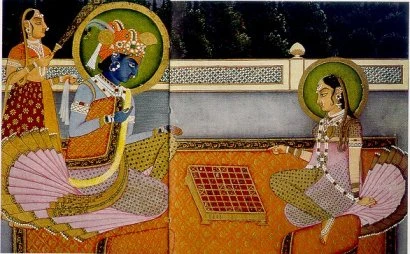
Senterej
Ethiopian chess variant, last popular survival of shatranj.

Senterej (Amharic: ሰንጠረዥ sänṭäräž), often called Ethiopian chess, is a regional variant of chess that was traditionally played in Ethiopia and Eritrea. It represents the last widely practiced form of shatranj. Historian Richard Pankhurst notes that the game was already in decline before the Italian invasion of Ethiopia in the 1930s, though it persisted in some areas into the 1940s or later.
The most unusual feature of Senterej is its opening phase. During this period, called the "mobilization" or "marshalling" phase (werera), both players move their pieces simultaneously, making as many moves as they like without regard for how many moves the opponent has made. They can even retract moves and substitute others. This free-for-all continues until the first capture occurs, after which players take turns normally. Because of this, memorizing opening lines is irrelevant.
The pieces move largely like those in shatranj, though local variations exist. The king (negus) stands on the d-file from White’s perspective, with the ferz on the e-file, as in shatranj. The king moves one step in any direction. The ferz moves one square diagonally. On the flanks of the king and ferz are the fil or alfil (saba), which leaps diagonally two squares. Beside them are the horsemen (feresenya), moving like chess knights. In the corners are the rooks (der), moving like chess rooks. The second rank is filled with pawns (medeq), which move one step forward and capture one square diagonally forward. There is no double-step first move, so no en passant. A pawn reaching the farthest rank is promoted to ferz (one source says it can be promoted to any piece already lost).
The objective is to checkmate the opponent. However, a king left with only pawns cannot be mated—the game is drawn. If a king has just one supporting piece (again, excluding pawns), checkmate is only possible before that piece has moved seven times; otherwise, the game is drawn.
Traditionally, the board is not checkered but merely marked into squares, often on a red cloth with black or blue strips. Play is more social than in Western chess: bystanders, even slaves in the past, are free to call out suggestions and move pieces around to demonstrate ideas. Customs around checkmate are elaborate. Delivering the final blow with a rook or knight is considered inartistic.
- Also known as
- Ethiopian chess
- Region
- Ethiopia and Eritrea
- Type
- Chess variant
- Distinctive feature
- Werera (mobilization phase) with simultaneous moves until first capture
- Extinction
- Already in decline before the Italian invasion of Ethiopia in the 1930s, persisting in some areas into the 1940s or later
- Board
- Red cloth marked into squares, not checkered
Lore & Background
Traditionally, the board is a red cloth marked by strips of black or blue, not checkered. Play is sociable, with bystanders calling out suggestions and moving pieces. Customs around checkmate are numerous: delivering checkmate with a rook or knight is considered inartistic; with a ferz or fil is more respectable; with a combination of pawns is even more praiseworthy.
Reader's Guide
Senterej represents the last known popular survival of shatranj, the medieval form of chess from which modern chess evolved. Its distinctive werera phase, where players move simultaneously without turn order until the first capture, sets it apart from all other chess variants and eliminates memorized opening lines. The game's extinction after the Italian invasion of Ethiopia in the 1930s, as noted by Richard Pankhurst, marks the end of a centuries-old tradition. The rules show regional variations, particularly in the movement of the ferz and promotion rules, reflecting the game's organic development. The social customs—uncheckered board, bystander participation, and aesthetic judgments on checkmate methods—highlight a communal approach to play distinct from Western chess. Senterej offers insight into how chess was adapted and enjoyed in the Horn of Africa before its disappearance.
Did You Know?
- During the werera phase, both players move their pieces simultaneously without waiting for turns.
- A king denuded of all pieces except pawns cannot be mated; the game is drawn.
- Delivering checkmate with a rook or knight was considered inartistic, while checkmate with a ferz or fil was more respectable.
Etymology and Military Roots
The name chaturanga is a Sanskrit bahuvrihi compound that literally translates to "having four limbs or parts," a phrase that in epic poetry frequently carried the broader meaning of "army." The term traces back to a specific battle formation referenced in the Mahabharata, one of India's great epics. In that context, chaturanga designated the four divisions of a classical Indian army: elephantry, chariotry, cavalry, and infantry. This military heritage is preserved in the game's very structure, where the initial board setup mirrors the ancient akshauhini formation. The pieces themselves—king, minister, chariot, and elephant—directly echo those four branches of warfare, embedding centuries of Indian military tradition into what would become the world's most widely played strategy game. The connection between the battlefield and the board is not merely symbolic; it is structural, with each piece representing a distinct arm of the army.
The Ancestor of a Global Family
Chess historians broadly agree that chaturanga stands as the common ancestor from which an entire constellation of strategy board games descended. This family includes modern Western chess, the Chinese xiangqi, Korean janggi, Japanese shogi, Burmese sittuyin, Thai makruk, Cambodian ouk chatrang, and the contemporary Indian version of the game. The transmission path is well documented: the game crossed into Sassanid Persia, where it was known as chatrang or shatranj, and from there it reached late-medieval Europe in the form that would evolve into the chess we know today. The linguistic fingerprints remain visible—Arabic chess terminology is drawn directly from chaturanga, the modern game is still called shatranj in Arabic, and the bishop retains the name "elephant." The game's introduction to Western scholarly audiences came through Thomas Hyde's 1694 publication, followed by Sir William Jones's translations of Sanskrit accounts.
Pieces, Board, and the Elephant Mystery
Chaturanga was played on an eight-by-eight uncheckered board called ashtāpada, which sometimes bore special markings of unknown purpose. Chess historian H. J. R. Murray speculated these marks may have served a different, older race-type dice game, perhaps resembling chowka bhara. The objective was to checkmate the opponent's raja or reduce them to a bare king, with a draw if both sides could achieve bare-king status on consecutive moves. The raja moved one step in any direction, the mantri one step diagonally, and the ratha like a modern rook without castling. The most enigmatic piece was the gaja, or elephant, whose exact movement remains uncertain. Ancient sources describe at least two possibilities: a two-square diagonal leap (the alfil move seen in shatranj, Ethiopian senterej, and Tamerlane chess), or a one-step forward or diagonal advance (shared with Thai makruk's khon, Burmese sittuyin's sin, and shogi's silver general).
Tracing the Earliest Evidence
Pinpointing chaturanga's true origin has occupied scholars for centuries. The earliest unambiguous literary reference appears in Banabhatta's Harsha Charitha, composed around 625 CE in north India during the Gupta Empire's era, where the text mentions learning to draw up a chaturanga from Ashtāpada. Stewart Culin also pointed to the Bhavishya Purana as an early source, though that text is known to contain later interpolations, even references to British rule. A passage sometimes attributed to Subandhu's Vasavadatta, dated between the fifth and seventh centuries, describes frogs leaping on black field squares, though the colors described refer to the frogs themselves rather than opposing camps. More controversially, some have pointed to archaeological finds at Lothal from the Indus Valley Civilisation showing pieces on a board, and to the chariot's outsized power on the board despite its military obsolescence for centuries. Counterarguments note that chariots persisted in literature, transport, processions, and racing well beyond their battlefield retirement.
Frequently Asked Questions
What is Senterej?
Senterej, often called Ethiopian chess, is a regional chess variant that was traditionally played across Ethiopia and Eritrea. It is regarded as the last widely practiced surviving form of shatranj, the medieval ancestor of modern chess.
What makes Senterej different from standard chess?
Its standout feature is the opening stage called the werera (mobilization) phase, during which both players move their pieces at the same time rather than taking turns. This simultaneous-movement period continues until the very first capture is made on the board.
Where was Senterej traditionally played?
The game was a regional pastime in Ethiopia and Eritrea, where it was commonly referred to simply as Ethiopian chess. It did not spread as a formal variant beyond those areas.
Why isn't Senterej still widely played today?
Historian Richard Pankhurst notes the game was already in decline before the Italian invasion of Ethiopia in the 1930s. Some communities kept playing it into the 1940s or later, but it eventually faded from common practice.
What does a Senterej board look like?
Instead of a conventional checkered board, Senterej was played on a red cloth that had been marked into squares. This simple, cloth-based setup distinguished it visually from the wooden or board-game-style chess sets most people know.
More in Games related to chaturanga 1-18
Spotted an error? Know more?
Reader corrections go straight into our review queue. Suggest an edit · How this site is sourced