Chadarangam
Telugu chess variant reflecting medieval Indian warfare.

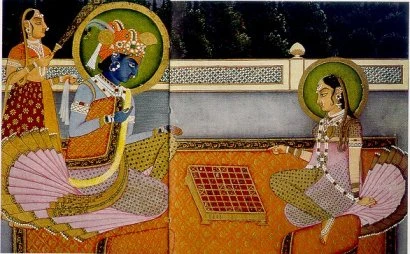
Chadarangam is a Telugu version of Indian chess, derived from Chaturanga. It became very famous among kings and courtesans, with pieces and movements reflecting Indian warfare.
- Pieces
- Rāju (king), Mantri (queen), Śakaṭam (rook), Gurram (knight), Enugu (bishop), Banṭu (pawn)
Lore & Background
Chadarangam is a Telugu version of Indian chess, Chaturanga. Its name may derive from the Sanskrit word Chaturanga or Persian word Chatrang. In a military context, Chaturanga means 'an entire army (comprising elephants, chariots, cavalry, and infantry)'. The game became very famous among kings and courtesans. The rook is known as Śakaṭam (chariot), while the bishop is called Enugu (elephant), reflecting the traditional Indian chess piece roles.
Reader's Guide
Chadarangam is significant as a regional adaptation of Chaturanga, preserving the four-limbed army concept while updating piece names to reflect medieval Indian warfare, such as replacing chariots with camels for the bishop. The game's rules and terminology are documented in Telugu, including unique valuations and the rule that the white king must be on a black square and the black king on a white square. Both checkmate and stalemate (Rāja digbhandanam) are considered wins. The game's legacy lies in its detailed correspondence between piece movements and historical military roles, as described in the source article, and its preservation of a distinct Telugu chess tradition.
Did You Know?
- The rook is called Śakaṭam (chariot), not the bishop.
- The knight is the only piece that can jump over other pieces.
- Stalemate is not universally considered a win in Chadarangam; it may be a draw or loss depending on local rules.
- Piece values in Chadarangam are not standardized; historical valuations vary.
Etymological Roots and the Shifting Battlefield
The name Chadarangam traces back to either the Sanskrit Chaturanga—literally 'having four limbs,' which in a military register denotes a full army composed of elephants, chariots, cavalry, and infantry—or to the Persian Chatrang. The game's vocabulary also records a real technological shift in Indian warfare: ancient armies relied on chariots (Ratha), but by the medieval era those had been supplanted by camels (Oṣṭra). This transition is fossilised in the bishop's name, which was once Ratha or Śakaṭa (chariot) before becoming Oṣṭra. Chadarangam enjoyed particular popularity among kings and courtesans, embedding the four-branch military structure of classical Indian armies into a board game that became a staple of Telugu courtly culture. Every piece on the board thus carries the memory of a specific arm of war, making the sixty-four squares a compressed replica of the subcontinent's martial history.
Six Pieces as Military Archetypes
Each Telugu piece name maps onto a distinct role in Indian warfare. The Rāju (king) is the supreme authority yet seldom enters the fray; his single-square L-shaped escape mirrors a sovereign's retreat at the most critical moment. The Mantri (queen, literally Prime Minister) wields the greatest operational power, devising strategy while the king merely issues decrees. The Śakaṭam (bishop, from Sanskrit for chariot) strikes in zig-zag patterns, often overlooked until it lands a devastating blow. The Gurram (knight, Telugu for horse) jumps irregularly, generating momentary confusion and offering the most available moves of any piece. The Enugu (rook, Telugu for elephant) advances in straight, unstoppable lines that scatter enemy formations. The Banṭu (pawn, also Bhaṭuḍu), though individually the least significant, numbers the most; upon reaching the far end it earns promotion to any rank except king, echoing a king honouring a soldier for exceptional service in battle.
Rules, Honour, and the Dignity of the Sovereign
Chadarangam imposes distinctive positional and ethical rules that set it apart from Western chess. The white king (Tella Rāju) must always occupy a black square (Nalla Gaḍi), while the black king (Nalla Rāju) must sit on a white square (Tella Gaḍi)—a fixed requirement with no parallel in the international game. Although defeating the opponent is the primary aim, the rules also demand that the adversary's king be honoured; carelessly wiping out all of a king's 'four limbs' (the Chatur+Anga) without sound strategy is regarded as poor play. Both checkmate (Āṭakaṭṭu) and stalemate (Āṭataṭṭu, or Rāja digbhandanam) count as victories, while every other ending is a draw. This framework reveals a cultural value system in which the manner of victory matters as much as the outcome, and the dignity of the opposing sovereign is preserved even in defeat.
Terminology and the Valuation Economy
The Telugu lexicon of Chadarangam is compact and evocative: a move is an Ettu, a square a Gaḍi, a piece a Pikka, check is simply Rāju, and the two colours are Tella (white) and Nalla (black). Beneath this vocabulary lies a rich internal valuation system that governs strategic trade-offs. A Mantri equals two Enugulu plus one Banṭu. An Enugu trades for one Śagaṭu and three Banṭlu, or alternatively one Gurramu and three Banṭlu. A Śagaṭu or Gurramu each equals three Banṭlu. Crucially, Banṭlu positioned in front of the Rāju carry extra weight, and a Śagaṭu or Gurramu may be sacrificed for two such pawns. This hierarchy mirrors the social and military stratification of a Telugu kingdom, where a single soldier's placement near the sovereign can outweigh the value of a mounted warrior.
Frequently Asked Questions
What is Chadarangam?
Chadarangam is a Telugu-language chess variant that evolved directly from the ancient Indian game Chaturanga. It represents the Indian chess tradition rendered in Telugu, with every piece name drawn from that language.
What pieces does Chadarangam use?
The board features six distinct pieces: Rāju (king), Mantri (queen), Śakaṭam (rook), Gurram (knight), Enugu (bishop), and Banṭu (pawn). Each Telugu name mirrors a role or unit found in medieval Indian warfare.
How does Chadarangam differ from modern Western chess?
While the movement logic is closely related, Chadarangam replaces European titles with Telugu terms rooted in Indian military hierarchy. Its overall design and terminology reflect the tactics and ranks of medieval Indian armies rather than a European court.
Who historically played Chadarangam?
The game became especially popular in royal Telugu courts, where kings and courtesans were noted as its most devoted players. Its strategic depth made it a favored pastime among the elite.
Why is Chadarangam significant in chess history?
It preserves the Chaturanga lineage within a South Indian linguistic and cultural context, showing how the game adapted to local traditions. Its warfare-inspired piece names and design make it a key link between ancient Indian strategy games and the chess we know today.
More in Games related to chaturanga 1-18
Spotted an error? Know more?
Reader corrections go straight into our review queue. Suggest an edit · How this site is sourced