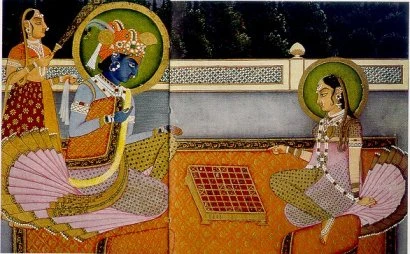
Chaturanga
Ancient Indian board game, ancestor of chess and many variants.

Chaturanga is an ancient Indian strategy board game, first known from India around the seventh century CE. It is widely considered by chess historians to be the common ancestor of numerous chess variants, including modern chess, xiangqi, shogi, and makruk.
- Origin
- India (Gupta Empire, 6th century CE)
- First known reference
- Banabhatta's Harsha Charitha (c. 625 CE)
- Etymology
- Sanskrit caturaṅga, meaning 'having four limbs or parts'
- Board
- 8×8 uncheckered board called ashtāpada
- Known for
- Common ancestor of chess and related board games
Lore & Background
The name chaturanga comes from a battle formation mentioned in the Indian epic Mahabharata, referring to four divisions of an army: elephantry, chariotry, cavalry, and infantry. The earliest clear reference to the game is from Banabhatta's Harsha Charitha, dating to around 625 CE. Some scholars argue for much older roots, citing archaeological remains from Lothal (2000–3000 BCE) that resemble chess pieces, though this is uncertain.
Not all rules of chaturanga are known with certainty. Chess historians suppose it had rules similar to its successor, shatranj. The moves of the gaja (elephant) are particularly uncertain, with three different moves described in ancient literature: two squares diagonally (jumping), one step forward or diagonally, or two squares orthogonally (jumping). The game was played on an 8×8 uncheckered board called ashtāpada, which sometimes had special markings of unknown meaning.
Chaturanga spread outside India as chatrang (shatranj) in Sassanid Persia, which later reached late-medieval Europe. It is also the common ancestor of Chinese xiangqi, Korean janggi, Japanese shogi, Burmese sittuyin, Thai makruk, Cambodian ouk chatrang, and modern Indian chess. The game was first introduced to the West in Thomas Hyde's De ludis orientalibus libri duo (1694).
Reader's Guide
Chaturanga holds immense significance as the foundational game from which a vast family of strategy board games descended. Its name, meaning 'having four limbs,' reflects its military theme, with pieces representing elephantry, chariotry, cavalry, and infantry. The prevailing view among chess historians is that chaturanga is the common ancestor of chess, xiangqi, janggi, shogi, sittuyin, makruk, ouk chatrang, and modern Indian chess. This makes it a pivotal link in the history of board games, influencing cultures from Persia to Europe and East Asia.
The uncertainty surrounding its exact rules, particularly the elephant's move, highlights the challenges in reconstructing ancient games. The game's spread to Persia as chatrang (shatranj) and later to Europe demonstrates its enduring appeal and adaptability. Chaturanga's legacy is not only in the games it inspired but also in its reflection of ancient Indian military organization and culture. Its study continues to inform historians about the evolution of strategic play and cultural exchange across continents.
Did You Know?
- The name chaturanga is a Sanskrit bahuvrihi compound meaning 'having four limbs or parts,' often referring to an army in epic poetry.
- The board used for chaturanga, called ashtāpada, was 8×8 and uncheckered, sometimes with special markings of unknown meaning.
- In chaturanga, a player could win by reducing the opponent to a bare king, unless the opponent could do the same on the next move.
Etymology & Military Roots
The Sanskrit name caturaṅga is a bahuvrihi compound that literally translates to "having four limbs or parts," a phrase that in epic poetry carried the broader connotation of "army." The term traces back to a battle formation described in the Mahabharata, where chaturanga denoted the four divisions of a military force: elephantry, chariotry, cavalry, and infantry. This martial imagery is not merely decorative; the ancient formation known as akshauhini mirrors the initial setup of the board game itself. The very pieces on the board—elephant, chariot, cavalry, and foot soldier—echo the four arms of a classical Indian army, embedding the game in a world of warfare and strategy long before it became a pastime. The name thus carries the weight of military tradition, linking a parlor game to the grandeur of ancient Indian combat.
Origins & Early Evidence
Pinpointing where and when chaturanga first appeared has long puzzled scholars. The earliest unambiguous reference to the game by name comes from Banabhatta's Harsha Charitha, composed around 625 CE in north India during the Gupta period, where the text mentions learning to draw up a chaturanga from Ashtāpada. Stewart Culin also pointed to the Bhavishya Purana as an early source, though that text is complicated by later interpolations, including references to British colonial rule. A passage sometimes attributed to Subandhu's Vasavadatta (5th–7th century) describes frogs leaping on black field squares, hinting at a board-game context, though the colors described are the frogs' mottled yellow and green rather than team colors. Some researchers push the timeline much further back, citing archaeological fragments from Lothal (2000–3000 BCE, Indus Valley Civilization) that resemble pieces on a board. Another argument for great antiquity is the chariot's status as the strongest piece, even though chariots had been militarily obsolete for centuries. Critics counter that chariots persisted in processions, travel, and racing.
Global Legacy & Descent
The prevailing consensus among chess historians is that chaturanga stands as the common ancestor of an entire family of strategy board games spanning Asia and beyond. From India, the game traveled to Sassanid Persia, where it was adopted as chatrang or shatranj, and from there it reached late-medieval Europe, eventually evolving into the chess known today. The same lineage produced xiangqi in China, janggi in Korea, shogi in Japan, sittuyin in Burma, makruk in Thailand, ouk chatrang in Cambodia, and the modern Indian chess tradition. The linguistic footprint is equally telling: in Arabic, the word for chess itself is shatranj, and the bishop is still called the elephant, a direct inheritance from the gaja. The game's introduction to Western scholarship came through Thomas Hyde's 1694 treatise De ludis orientalibus libri duo, followed by Sir William Jones's translations of Sanskrit accounts, which opened the door for European understanding of the game's Indian roots.
The Board, Pieces & Rules
Chaturanga was played on an 8×8 uncheckered board called ashtāpada, a name that also referred to the game itself. The board sometimes bore special markings whose purpose remains a mystery; these marks correspond to squares that no starting gaja can ever reach given its movement rules. Chess historian H. J. R. Murray speculated that the ashtāpada may have doubled as a board for an older race-type dice game, perhaps akin to chowka bhara, where those marks would have served a functional purpose. White always moved first, and the objective was to checkmate the opponent's raja or reduce the enemy to a bare king—though if the opponent could then do the same on the next move, the result was a draw. The raja moved one step in any direction, with no castling. The mantri stepped one square diagonally, the ratha slid like a modern rook, and the gaja's exact move remains the most debated: ancient sources describe it variously as a two-square diagonal leaper, like the alfil, or as a one-step forward-or-diagonal mover, a question that echoes through every descendant game from xiangqi to shogi.
Frequently Asked Questions
What is Chaturanga?
Chaturanga is an ancient Indian strategy board game that emerged during the Gupta Empire period, roughly the sixth to seventh century CE. Chess historians regard it as the shared root from which a broad family of chess-like games—including modern chess, shogi, xiangqi, and makruk—eventually branched out.
Where and when did Chaturanga first appear?
The game originated in India during the Gupta Empire era, around the sixth century CE. The earliest surviving written mention comes from Banabhatta's Harsha Charitha, a text composed near 625 CE.
What does the name 'Chaturanga' actually mean?
It derives from the Sanskrit compound caturaṅga, which literally translates to 'having four limbs or parts.' The name reflects the game's original design, in which the pieces represented the four divisions of an ancient Indian army.
What does a Chaturanga board look like?
Play takes place on an 8×8 grid of plain, uncheckered squares called ashtāpada. This square count and layout are the direct structural predecessor of the checkered 8×8 board familiar in modern chess.
Why do board-game historians consider Chaturanga so significant?
It is the documented common ancestor linking virtually every major chess variant across South and East Asia into a single lineage. Without Chaturanga as the starting point, the evolutionary thread connecting games like shogi, xiangqi, and Western chess would lack a traceable origin.
More in Games related to chaturanga 1-18
Spotted an error? Know more?
Reader corrections go straight into our review queue. Suggest an edit · How this site is sourced