Courier chess
A medieval chess variant played on an 8×12 board for 600 years.

Courier chess, also called the courier game and known in German as *Läufer-spiel*, is a chess variant likely originating in the 12th century. It remained popular for at least six centuries and played a role in the gradual transition from medieval chess to the modern game. The name comes from the courier (or runner), a powerful piece that moved like today’s bishop—an innovation at the time.
The game is played on an 8×12 board (eight ranks, twelve files). Historical art and writing show the board was always checkered, but the coloring of squares was inconsistent; the most common pattern placed a light square at the bottom right, as in modern chess. The goal is the same as Western chess: checkmate the opponent’s king. The stalemate rule is unknown, and the matter remained unresolved in Germany until late in the 19th century.
**Setup and piece movements (medieval rules):** - **King:** Starts on f1 and f8. In the known medieval tradition, if the board uses modern alternating coloring, the king begins on a dark square for both sides. Moves one square in any direction, cannot move into check. No castling. - **Sage (mann):** Next to the king, on e1 and e8. Moves like a king (one square any direction) but can be captured normally. - **Queen (ferz):** On g1 and g8. Moves one square diagonally. - **Schleich (fool, thief, jester, smuggler, spy, or trull):** On h1 and h8. Moves one square orthogonally (like a wazir). - **Courier (läufer):** On d1, i1, d8, and i8. Moves any number of squares diagonally (like a modern bishop). - **Bishop (archer):** On c1, j1, c8, and j8. Moves two squares diagonally, leaping over the first square (like an alfil). - **Knight:** On b1, k1, b8, and k8. Moves one square orthogonally then one diagonally, leaping over intervening squares (same as modern knight). - **Rook:** In corners a1, l1, a8, and l8. Moves any number of squares orthogonally (same as modern rook). - **Pawns:** Fill the second rank for each player. Move one square forward, capture one square diagonally forward. No double advance on the first move, so no en passant. - **Promotion:** A pawn reaching the farthest rank becomes a queen (ferz). It is unclear if promotion is immediate or follows a more complex process used in other contemporary variants. One described method: the pawn reaches the 8th rank and becomes immune to capture while staying there.
- Earliest known mention
- 1202–1205 (in Wirnt von Gravenberg's poem Wigalois)
- Board size
- 8×12 (8 ranks by 12 files)
- Notable piece
- Courier (läufer), moves like modern bishop
- Region of historical play
- Germany, especially Ströbeck near Halberstadt
- Modern revival attempts
- H. G. Albers (1821), Paul Byway (1971), Clément Begnis (2011)
Lore & Background
Courier chess was played on an 8×12 board with a checkered pattern, though there was no consistency as to which squares were light or dark. The winning objective was checkmate, as in Western chess, but the stalemate rule was unsettled in Germany late into the 19th century. The starting setup included a king, sage (mann), queen (ferz), schleich (fool), courier, bishop (archer), knight, rook, and pawns. The courier moved like the modern bishop, while the bishop moved as the alfil (two squares diagonally, leaping). Pawns advanced one square forward and captured diagonally, with no double advance or en passant. Promotion to queen (ferz) occurred upon reaching the farthest rank, though a more complex process involving backward leaps was also described.
Reader's Guide
Courier chess is significant as a key transitional variant between medieval chess and modern chess. Its introduction of the courier (bishop) with diagonal sliding movement was a major innovation, eventually replacing the weaker alfil on the standard chessboard after about 1475. The game was mentioned in early 13th-century literature by Wirnt von Gravenberg and later by Heinrich von Beringen and Kunrat von Ammenhausen. It was still played in the village of Ströbeck, Germany, into the 19th century, where H. G. Albers attempted to popularize it with updated rules in 1821. The game's legacy includes influencing the modern bishop and queen, and it remains a subject of historical and variant chess interest. Modern adaptations by Paul Byway (1971) and Clément Begnis (2011) have sought to update the rules for contemporary play.
Did You Know?
- The courier piece moved like the modern bishop, which was a unique move at the time of the game's introduction.
- In the medieval rules, pawns could not double advance on their first move, so en passant did not apply.
- A painting by Lucas van Leyden, The Chess Players, appears to show a woman beating a man at courier chess.
Origins & The Puzzle of Antiquity
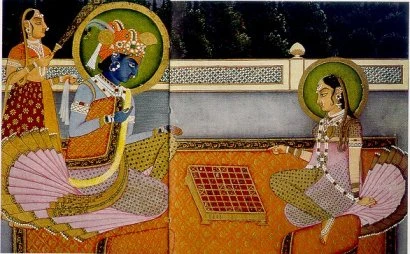
The origins of chaturanga remain one of the great unsolved mysteries in the history of board games. The earliest unambiguous mention traces back to north India during the Gupta Empire era, with Banabhatta's Harsha Charitha (circa 625 CE) providing the first clear reference to the name. Stewart Culin pointed to the Bhavishya Purana as an early description, though that text is known to contain later interpolations, even references to British colonial rule. An even earlier possible allusion appears in Subandhu's Vasavadatta (5th–7th century), where frogs leap across black squares in a game called nayadyutai. Some scholars push the timeline much further back, citing archaeological finds from Lothal (2000–3000 BCE) in the Indus Valley Civilization showing pieces arranged on a grid. Another intriguing clue is the chariot's status as the most powerful piece, despite chariots having been militarily obsolete for centuries by the time the game crystallized. The counterargument notes that chariots persisted in literature, transport, and ceremonial processions, keeping the symbol alive long after the battlefield.
Etymology & the Four-Army Formation
The name chaturanga is a Sanskrit bahuvrihi compound meaning 'having four limbs or parts,' a phrase that in epic poetry frequently evokes an army. The term draws directly from a battle formation described in the Mahabharata, referring to the four divisions of a classical Indian military force: elephantry, chariotry, cavalry, and infantry. This military origin is not merely nominal; the ancient formation known as akshauhini mirrors the initial setup of the chaturanga board. The game's pieces—raja (king), mantri (minister), ratha (chariot), and gaja (elephant)—each correspond to a functional role in that four-part army. The word itself, pronounced roughly 'chah-tuh-ruhn-gah,' carries the weight of centuries of Sanskrit literary and military tradition. What began as a metaphor for organized warfare on a battlefield became a structured abstract strategy game played on an 8×8 grid, transforming the chaos of combat into a disciplined contest of logic and foresight.
The Board, the Pieces, and the Elephant's Enigma
Chaturanga was played on an 8×8 uncheckered board called the ashtāpada, a name that also referred to a separate game. The board sometimes bore special markings whose purpose remains unknown; chess historian H. J. R. Murray speculated these marks related to an older race-type dice game, perhaps akin to chowka bhara, rather than to chaturanga itself. The objective was to checkmate the opponent's raja or reduce them to a bare king, with a mutual-bare-king scenario resulting in a draw. White moved first. The raja stepped one square in any direction, the mantri moved one diagonal step, and the ratha slid along ranks and files like a modern rook, minus castling. The gaja, however, remains the most contested piece. Ancient sources describe at least three distinct moves: a two-square diagonal leap (a (2,2)-leaper, like the alfil in shatranj), a one-step forward or diagonal advance, and variations in descendant games where the piece cannot jump over intervening pieces. This uncertainty persists because the exact rules were never fully codified in a single authoritative text.
A Game That Became the World's
The prevailing view among chess historians is that chaturanga stands as the common ancestor of an entire family of strategy games spanning Asia: chess, xiangqi in China, janggi in Korea, shogi in Japan, sittuyin in Burma, makruk in Thailand, and ouk chatrang in Cambodia, alongside modern Indian chess. The game traveled westward into Sassanid Persia, where it was adopted as chatrang (shatranj), and from there into late-medieval Europe. The linguistic footprint is enormous: in Arabic, the game itself is called shatranj, and the bishop is still known as the elephant, a direct inheritance from the gaja. The game's formal introduction to Western scholarship came through Thomas Hyde's De ludis orientalibus libri duo in 1694, followed by Sir William Jones's translations of Sanskrit accounts. Tamerlane chess later reached Iran as well. What began as an Indian military abstraction thus became the root of a global tradition, its pieces and terminology embedded in cultures thousands of miles from the Gupta courts where it first took shape.
Frequently Asked Questions
What is Courier chess?
Courier chess is a medieval chess variant played on an 8×12 board that enjoyed roughly six centuries of popularity. It is also known as the courier game or, in German, Läufer-spiel.
What makes the courier piece unique?
The courier, or läufer, was the game's signature innovation because it traveled diagonally across the board in the same way a modern bishop does. At the time of its introduction, this diagonal movement was a new concept in chess-like games.
When was Courier chess first mentioned in a written source?
The earliest known reference to the game appears in Wirnt von Gravenberg's epic poem Wigalois, composed between 1202 and 1205.
Where was Courier chess historically popular?
The variant was played mainly in Germany, with the small town of Ströbeck near Halberstadt standing out as a particular center of activity.
Why is Courier chess significant in chess history?
It occupied a key transitional role between medieval chess and the modern game, helping to establish the diagonal-moving bishop as a standard piece. Modern players have attempted revivals, with notable efforts by H. G. Albers in 1821, Paul Byway in 1971, and Clément Begnis in 2011.
More in Games related to chaturanga 1-18
Spotted an error? Know more?
Reader corrections go straight into our review queue. Suggest an edit · How this site is sourced