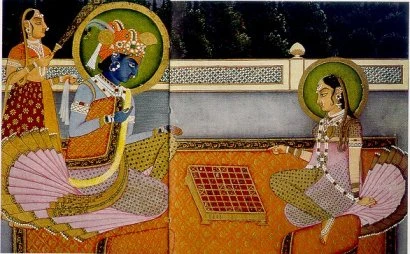
Makruk
A chess variant descended from chaturanga, played in Thailand and Cambodia.

Makruk, also known as Thai chess, is a strategy board game descended from the 6th-century Indian game of chaturanga or a close relative thereof, and is therefore related to chess. It is part of the family of chess variants. In Cambodia, where basically the same game is played, it is known as ouk or ouk chatrang.
Quick Facts
- Italic Title
- no
- Title
- Makruk
- Years
- Unknown, predates sittuyin
- Genre
- Board game · Abstract strategy game
- Players
- 2
- Setup Time
- < 1 minute
- Playing Time
- From 20 mins to several hours
- Random Chance
- None
- Skills
- Strategy, tactics
- Aka
- Thai chess
Facts from the source article.
Lore & Background
Makruk is a strategy board game that is descended from the 6th-century Indian game of chaturanga or a close relative thereof, and is therefore related to chess. It is part of the family of chess variants. In Cambodia, where basically the same game is played, it is known as ouk or ouk chatrang. The Persian traders came to the Ayutthaya kingdom around the 14th century to spread their culture and to trade with the Thai kingdom. It is therefore possible that the Siamese makruk, in its present form, was directly derived from the Persian game of shatranj via the cultural exchange between the two peoples in this period. This is because the movement of makruk's queen, or the 'seed', is essentially the same as the ferz in shatranj. It is more likely, however, that the game came more directly from India given the name similarities between chaturanga and the Cambodian name, ouk chaktrang, and the way the 'nobleman' moves. In his History of Chess, Murray suggests it may have followed the expansion of Buddhism in the area.
Reader's Guide
Makruk is significant as a living link to ancient chess traditions, preserving rules and piece movements from chaturanga and shatranj that have been lost in Western chess. Its pieces include the cowrie (pawn), seed (ferz), nobleman (silver general), horse (knight), boat (rook), and lord (king). The game features unique counting rules when neither side has any cowries, ensuring a draw if checkmate is not achieved within a set number of moves. Variants called sutras exist, such as Sut Khun (king sutra), Sut Met (queen sutra), and Sut Ma (knight sutra), which allow special first moves. In Cambodia, ouk has been played since at least the 12th century, as evidenced by bas-reliefs on temples. The first nationwide ouk tournament was held on 3–4 April 2008, upon the completion of a standardized rule set by the Olympic Committee of Cambodia and the Cambodian Chess Association. Ouk was one of three traditional sports introduced by Cambodia at the 2023 SEA Games.
Did You Know?
- In Cambodia, the same game is known as ouk or ouk chatrang.
- The cowrie shell pawn cannot advance two spaces on its first move, so there is no en passant capture.
Lineage & Ancestry
Makruk occupies a distinguished place in the family tree of strategy board games. The prevailing view among chess historians is that the ancient Indian game Chaturanga—first documented in the Gupta Empire around the sixth or seventh century CE—serves as the common ancestor of a remarkable constellation of games, including Thai Makruk. This means that every fundamental element of Makruk's structure, from its board dimensions to the logic of its pieces, carries echoes of a game played on an 8×8 uncheckered board called ashtāpada in ancient India. The name Chaturanga itself, a Sanskrit compound meaning 'having four limbs or parts,' references the four divisions of an army described in the Mahabharata: elephantry, chariotry, cavalry, and infantry. For players of Makruk, this lineage is not merely academic; it connects their game to one of the oldest strategic traditions in human history, a tradition that also gave rise to chess, shogi, xiangqi, and numerous other variants across Asia.
The Khon: A Piece with Ancient Roots
One of the most distinctive pieces in Makruk is the khon, or nobleman, whose movement preserves a direct thread to the gaja (elephant) of ancient Chaturanga. In the Indian ancestor game, the gaja's movement was described in several ways across ancient literature, but one variant—moving one step straight forward or one step in any diagonal direction—survives intact in the khon of Thai Makruk. This same movement pattern is also found in the sin (elephant) of Burmese sittuyin and the silver general of Japanese shogi, creating a small cluster of games that retained this particular piece behavior. What makes this noteworthy is that other descendants of Chaturanga took different paths: the elephant in Chinese xiangqi moves two squares diagonally but cannot jump over intervening pieces, while the elephant in Korean janggi uses a similar two-square diagonal leap but from an initial orthogonal step. The khon's simpler, single-step diagonal movement thus represents one of the more conservative survivals from the original Indian game, a living fossil of Chaturanga's piece design.
A Family of Sibling Games
Makruk does not exist in isolation; it is one member of a broad family of games that all trace their origins to Chaturanga. According to the prevailing view among chess historians, this ancestral game gave rise to chess (as it evolved through Sassanid Persian shatranj into late-medieval European forms), xiangqi in China, janggi in Korea, shogi in Japan, sittuyin in Burma, ouk chatrang in Cambodia, and modern Indian chess. Each of these games adapted the core Chaturanga framework to its own cultural context, modifying piece movements, board conventions, and winning conditions. For instance, while Makruk's khon moves one step forward or diagonally, the equivalent piece in xiangqi leaps two squares diagonally, and in janggi the elephant moves outward from an initial orthogonal step. The Burmese sittuyin, geographically and culturally close to Thai Makruk, shares the khon's exact movement for its sin piece, suggesting a particularly tight kinship between the two. This web of related games, all springing from a single Indian source, represents one of the most remarkable examples of cultural transmission in the history of board games.
The Long Journey from India
The path from ancient India to the courts of Siam was neither direct nor instantaneous. Chaturanga first appears in clear textual references from the Gupta Empire, with Banabhatta's Harsha Charitha (circa 625 CE) offering the earliest known mention of the game's name. From India, the game traveled to Sassanid Persia, where it was adopted as chatrang (later known in Arabic as shatranj), and from there eventually reached late-medieval Europe. Simultaneously, the game spread eastward and southward across Asia, taking root in Thailand as Makruk, in Burma as sittuyin, in Cambodia as ouk chatrang, and in Japan as shogi. The Arabic chess terminology still bears the imprint of this Indian origin: the word 'shatranj' itself derives from chaturanga, and the bishop in Arabic chess is called the elephant, a direct reference to the gaja piece. The game was formally introduced to Western scholarship through Thomas Hyde's De ludis orientalibus libri duo in 1694, and later through Sir William Jones's translations of Sanskrit accounts. For Makruk players, this long migratory history means their game carries within it the accumulated memory of a journey that spanned continents and centuries.
Frequently Asked Questions
What is Makruk?
Makruk is a strategy board game native to Thailand, commonly called Thai chess. It belongs to the chess-variant family and shares its deep roots with other post-chaturanga games.
Where did Makruk come from?
Makruk is generally understood to descend from the 6th-century Indian game chaturanga, though some scholars trace the lineage through the Persian intermediary shatranj. Either way, it arrived in Southeast Asia as part of the broader spread of chaturanga-derived games.
How is Makruk related to chess?
Makruk is a direct cousin of modern chess, both inheriting their structure from the same ancient Indian ancestor, chaturanga. The two share the core concept of opposing armies on a grid, but differ in piece movement, board size, and scoring conventions.
When is the earliest evidence of Makruk?
The oldest surviving record of the game comes from 12th-century bas-reliefs on Cambodian temple walls, showing figures seated across a board. This makes it one of the earliest visually documented chess variants in the region.
What is Makruk called in Cambodia?
In Cambodia, where virtually the same rules and board are used, the game is known as ouk or ouk chatrang. The near-identical gameplay across the two countries reflects their shared cultural and historical ties.
More in Games related to chaturanga 1-18
Spotted an error? Know more?
Reader corrections go straight into our review queue. Suggest an edit · How this site is sourced