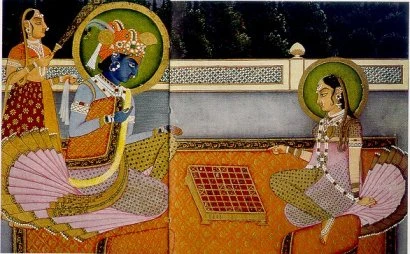
Chaturaji
Four-player chess-like game with dice and unique victory conditions.

Chaturaji (meaning 'four kings') is a four-player chess-like game first described in detail c. 1030 by Al-Biruni in his book India. Originally a game of chance where pieces to be moved were decided by rolling two dice, a diceless variant was still played in India at the close of the 19th century. The game is notable for its unique rules, including boat triumphs and sinhasana, and for its disputed role in the history of chess.
- First described
- c. 1030 by Al-Biruni
- Meaning
- four kings
- Number of players
- four
- Original mechanic
- dice-based movement
- Diceless variant
- still played in India at the close of the 19th century
- Related theory
- Cox–Forbes theory (disputed)
Lore & Background
Chaturaji is a four-player chess-like game first described in detail c. 1030 by Al-Biruni in his book India. The ancient Indian epic Mahabharata contains a reference that some have interpreted as chaturaji, but the critical edition of the epic omits this passage, indicating it is a later interpolation and not part of the original text. There is no certainty whether the mentioned game is really a chess-like game like chaturaji or a race game like Pachisi.
At the end of the 18th century, Hiram Cox put forth a theory (later known as the Cox–Forbes theory) that chaturaji is a predecessor of chaturanga and hence the ancestor of modern chess. The theory was developed by Duncan Forbes in the late 19th century and endorsed in an even stronger version by Stewart Culin. This theory was rejected by H. J. R. Murray in 1913, and modern scholars have sided with Murray. According to Forbes, this game is properly called chaturanga, which is also the name of a two-player game; the term chaturaji refers to a position in the game comparable to checkmate in chess.
The game is played with pieces of four different colours. Each player has four pieces on the back rank with four pawns in front. The four pieces are king, elephant, horse, and boat. The king moves like the chess king, the elephant like the chess rook, the horse like the chess knight, and the boat moves two squares diagonally in any direction, jumping over the intervening square. Player turns pass clockwise around the board. Pawns move and capture in different directions, and promotion requires the piece to have been previously captured.
Reader's Guide
Chaturaji's significance lies in its role in the historical debate over the origins of chess. The Cox–Forbes theory, which posited chaturaji as a predecessor of chaturanga and thus the ancestor of modern chess, was influential in the 19th century but was rejected by H. J. R. Murray in 1913 and is not accepted by modern scholars. The game itself is notable for its four-player format, use of dice to determine moves, and unique rules such as boat triumph (vrihannauka), where moving a boat to form a 2×2 square captures all three other boats, and sinhasana, where moving a king to the original square of another king grants control of that army. Scoring is based on capturing opponents' pieces, with a special 54-point award for capturing all three opponents' kings while one's own king remains. The game's legacy includes its documentation by Al-Biruni and its mention in the Mahabharata, though the latter is uncertain. The diceless variant played in India at the close of the 19th century shows the game's endurance, but its exact relationship to other chess-like games remains disputed.
Did You Know?
- The game originally used dice to decide which pieces to move; a diceless variant was still played in India at the close of the 19th century.
- The Cox–Forbes theory, which claimed chaturaji was a predecessor of modern chess, was rejected by H. J. R. Murray in 1913.
- A boat triumph (vrihannauka) occurs when a boat moves to form a 2×2 square of boats, capturing all three other boats.
Etymology & Military Roots
The name Chaturanga is a Sanskrit bahuvrihi compound that literally translates to "possessing four limbs or parts," a phrase that in classical epic poetry carried the broader connotation of a full army. The term traces back to a battle formation described in the Mahabharata, where an army was divided into four distinct branches: elephantry, chariotry, cavalry, and infantry. This ancient military structure, known as the akshauhini, mirrors the initial arrangement of pieces on the chaturanga board. The game thus emerged not as a mere pastime but as a strategic simulation of real warfare, encoding the roles of each military division into distinct game pieces. The very naming convention reflects how deeply Indian martial culture and Sanskrit literary tradition were intertwined with the intellectual pursuit of strategy games.
Origins & Earliest Evidence
Pinpointing the exact birth of chaturanga has long stymied scholars. The earliest unambiguous textual reference originates in north India during the Gupta period, around the sixth century. Banabhatta's Harsha Charitha, composed circa 625 CE, contains the first known mention of the name itself, set against a courtly backdrop where the game appears as a mark of refined leisure. Stewart Culin also pointed to the Bhavishya Purana as an early source, though that text is complicated by later interpolations, including references to British colonial rule. A passage sometimes credited to Subandhu's Vasavadatta (fifth to seventh century) evokes a board game with colored pieces on dark squares, though the description's exact connection to chaturanga remains debated. Some researchers have even suggested a far older lineage, citing Indus Valley artifacts from Lothal dating to 2000–3000 BCE that resemble board-game pieces. The prominence of the chariot as the board's most powerful piece has fueled speculation that the game predates the military obsolescence of chariots by several centuries, though counterarguments note that chariots persisted in ceremonial, literary, and transport contexts well into later periods.
Global Legacy & Transmission
The prevailing consensus among chess historians positions chaturanga as the single common ancestor from which the entire family of chess-like games descended. This lineage spans xiangqi in China, janggi in Korea, shogi in Japan, sittuyin in Burma, makruk in Thailand, ouk chatrang in Cambodia, and the modern Indian variant. The game crossed into Sassanid Persia, where it was renamed chatrang (later shatranj), and from there it traveled into late-medieval Europe, eventually becoming the chess familiar to the Western world. The linguistic fingerprints are unmistakable: in Arabic, the game itself is still called shatranj, and the bishop retains the name "elephant," a direct echo of the gaja piece. The game's formal introduction to Western scholarship came through Thomas Hyde's De ludis orientalibus libri duo in 1694, followed by Sir William Jones's translations of Sanskrit accounts. This extraordinary diffusion—from Gupta-era India to courts across Asia and Europe—makes chaturanga one of the most widely transmitted intellectual inventions in human history.
The Board, Pieces & Unresolved Questions
Chaturanga was played on an 8×8 grid called the ashtāpada, an uncheckered surface that sometimes bore mysterious markings whose purpose has been lost to time. Chess historian H. J. R. Murray speculated these marks may have served a separate race-type dice game, perhaps akin to chowka bhara. The objective was to checkmate the opponent's raja (king) or reduce the enemy to a bare king, with a draw possible if both sides could simultaneously reach that state. The four piece types—the raja moving one step in any direction, the mantri (minister) stepping one square diagonally, the ratha (chariot) sliding along ranks and files like a modern rook, and the gaja (elephant)—each mapped onto a military role. No castling existed. The elephant's movement remains the most contested question: ancient sources describe it as a two-square diagonal leaper (like the alfil), as a one-step forward-or-diagonal mover (like the silver general in shogi), or as a restricted version of the leaper seen in xiangqi and janggi. This ambiguity underscores how much of the original ruleset still eludes definitive reconstruction.
Frequently Asked Questions
What is Chaturaji?
Chaturaji, a name meaning 'four kings,' is a four-player chess-like game first documented in detail around 1030 CE by the scholar Al-Biruni in his book India. It is set apart from standard chess by its multi-player format and a set of distinctive winning conditions.
How did Chaturaji originally decide which piece a player could move?
In the earliest known form, a player rolled two dice and the result determined which of their pieces was to be moved that turn. A diceless variant of the game, however, was still being played in India as late as the close of the 19th century.
What are 'boat triumphs' and 'sinhasana' in Chaturaji?
These are two of the game's signature victory conditions that go beyond simply capturing an opponent's king. They give Chaturaji a set of unique winning rules not found in ordinary chess.
Who first described Chaturaji in writing?
The Persian polymath Al-Biruni provided the earliest detailed account of the game in his work India, composed around 1030 CE. His description remains the principal historical source from which modern scholars reconstruct the rules.
What is the Cox–Forbes theory and how does it involve Chaturaji?
The Cox–Forbes theory is a disputed hypothesis that places Chaturaji in the historical lineage leading to modern chess. Its exact role in that development is still debated among game historians.
More in Games related to chaturanga 1-18
Spotted an error? Know more?
Reader corrections go straight into our review queue. Suggest an edit · How this site is sourced