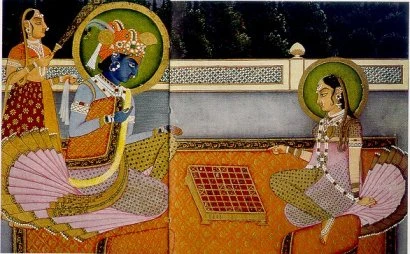
Indian chess
Regional chess variants from 18th–19th century India.

Indian chess refers to regional variations of chess played in India during the 18th and 19th centuries. These variations are distinct from the earlier chaturanga and share many similarities with modern rules, though they differ in aspects such as castling, pawn promotion, and piece movement. Historical sources describe pieces in various color pairs, such as red and black, with no single standard for which color moves first.
- Field
- Board game variations
- Region
- India
- Era
- 18th and 19th centuries
- Known for
- Regional chess variants with distinct rules for castling, pawn promotion, and piece movement
Lore & Background
In Indian chess, the starting position places each king facing the opposing queen, with the king to the right of the queen from each player's perspective. The pawn's two-step initial move is absent, and thus en passant is also absent. Normal castling is replaced by a king's leap, where the unchecked king can make a knight's move once in a game, jumping into a protected wall of pawns or pieces.
Reader's Guide
Indian chess represents a significant regional development in the history of chess, preserving older movement patterns for the queen (limited to a single-step diagonal) and bishop (jumping two squares diagonally) in traditional play, though European influence later standardized these pieces. The rules for pawn promotion are notably complex: a pawn reaching the opposite end is promoted to the piece type that began on that square, but if that piece type is still fully present on the board, the pawn becomes frozen until a corresponding piece is lost, at which point it instantly resurrects that piece. This system of material conservation, along with rules such as the prohibition on capturing the last piece (other than kings) and restrictions on giving check when only kings and pawns remain, highlights the unique strategic considerations of Indian chess. The variations also include regional differences, such as the king not being allowed to move until at least one check has been given.
Did You Know?
- In Indian chess, the king can make a knight's move once in a game as a form of castling, called Indian castling or king's leap.
- Promotion rules varied across Indian chess variants; there is no widely attested rule that a pawn promoted on the king's initial square becomes a queen.
- The concept of 'frozen pawns' resurrecting lost pieces is not found in mainstream descriptions of Indian chess variants from the 18th–19th centuries.
Origins & the Puzzle of Antiquity
The true origins of chaturanga remain one of the great puzzles in the history of board games. The earliest clear textual reference traces back to north India during the Gupta Empire, around the sixth century CE. The most celebrated mention appears in Banabhatta's Harsha Charitha, composed around 625 CE, where the text references learning to draw up a chaturanga from the Ashtāpada. Stewart Culin also pointed to the Bhavishya Purana as an early description, though scholars note this text contains later interpolations, even referencing British colonial rule. An even earlier possible reference comes from Subandhu's Vasavadatta, dated between the fifth and seventh centuries, which describes a board game with frogs as pieces leaping on black field squares. Some researchers push the timeline further back, citing archaeological finds from Lothal—dating to 2000–3000 BCE from the Indus Valley Civilisation—that appear to show pieces arranged on a board. Another intriguing clue is the prominence of the chariot as the most powerful piece, despite chariots having been militarily obsolete for centuries by the time the game crystallized, suggesting a very ancient military origin.
A Global Family Tree
The prevailing view among chess historians is that chaturanga stands as the common ancestor of an extraordinary family of strategy games spanning the entire Asian continent. From its Indian roots, the game evolved into xiangqi in China, janggi in Korea, shogi in Japan, sittuyin in Burma, makruk in Thailand, and ouk chatrang in Cambodia, alongside modern Indian chess. Its most consequential migration was westward: adopted in Sassanid Persia as chatrang (shatranj), it became the form of the game that eventually reached late-medieval Europe, where it transformed into the chess we know today. The linguistic footprint is equally remarkable. In Arabic, the word for chess itself—shatranj—derives directly from chaturanga, and the bishop is still called the elephant, a direct echo of the gaja piece. The game's introduction to Western scholarship came through Thomas Hyde's De ludis orientalibus libri duo in 1694, followed by Sir William Jones's translations of Sanskrit accounts, which helped cement chaturanga's place in the global chess narrative.
Board, Pieces & the Rules of War
Chaturanga was played on an 8×8 uncheckered board called the ashtāpada, a name that also refers to a separate game. The board sometimes bore special markings whose original purpose remains unknown; chess historian H. J. R. Murray speculated these marks may have belonged to an older race-type dice game, perhaps similar to chowka bhara, rather than to chaturanga itself. The objective was to checkmate the opponent's raja (king) or reduce them to a bare king, though if the opponent could reciprocate on the following move, the result was a draw. The piece set included the raja, moving one step in any direction like the modern king but with no castling; the mantri (minister), stepping one square diagonally like the shatranj ferz; the ratha (chariot), sliding along ranks and files like a rook; and the gaja (elephant), whose exact movement remains the most debated element. Ancient sources describe at least two possible moves: a two-square diagonal leap, the alfil, or a one-step forward or diagonal advance. This uncertainty persists because the rules were never fully codified in surviving texts.
Etymology & the Architecture of the Army
The name chaturanga is a Sanskrit bahuvrihi compound meaning having four limbs or parts, a phrase that in epic poetry commonly signified an army. The term draws directly from a battle formation described in the Mahabharata, one of India's great epics. Chaturanga embodied the four classical divisions of an Indian army: elephantry, chariotry, cavalry, and infantry. This military heritage is mirrored in the game's piece set, where the gaja (elephant), ratha (chariot), and the cavalry and infantry pieces each represent a branch of ancient Indian warfare. The formation known as the akshauhini, an ancient Indian battle array, closely resembles the initial setup of chaturanga on the board. The very structure of the game—four distinct piece types arranged in a symmetrical opening—reflects the organizational logic of a battlefield command. Even the board's name, ashtāpada, meaning eight-footed or eight steps, evokes the measured, deliberate nature of military deployment. In this way, chaturanga was not merely a pastime but a codified representation of how Indian civilization understood the architecture of war.
Frequently Asked Questions
What is Indian chess?
Indian chess refers to a family of regional board-game variants played across India during the 1700s and 1800s. They sit between the ancient chaturanga and modern chess, sharing much of the latter's structure while introducing their own distinctive rule twists.
How does Indian chess differ from chaturanga?
Although chaturanga is the older ancestor, the 18th- and 19th-century Indian variants already resemble modern chess in overall board and piece layout. The main departures show up in how castling is executed, what a pawn can promote into, and certain movement rules for individual pieces.
When and where did Indian chess originate?
These variants were played in India primarily during the 18th and 19th centuries, making them a regional branch of the broader chess family. Historical records describe them as distinct local versions rather than one single standardized game.
What are the key rule differences in Indian chess?
The most commonly noted variations involve castling mechanics, the options available when a pawn reaches the far rank, and specific movement restrictions or allowances for certain pieces. Sources also describe pieces in color pairs such as red and black, with no universal agreement on which side moves first.
Why is Indian chess significant in the history of chess?
It represents a transitional stage between ancient chaturanga and the globally standardized modern game, showing how rules evolved regionally before formal codification. Studying these variants helps trace how castling, promotion, and piece movement settled into their current forms.
More in Games related to chaturanga 1-18
Spotted an error? Know more?
Reader corrections go straight into our review queue. Suggest an edit · How this site is sourced