Shower
A bathing device using a spray of water for hygiene.

Kritzolina · CC BY-SA 4.0
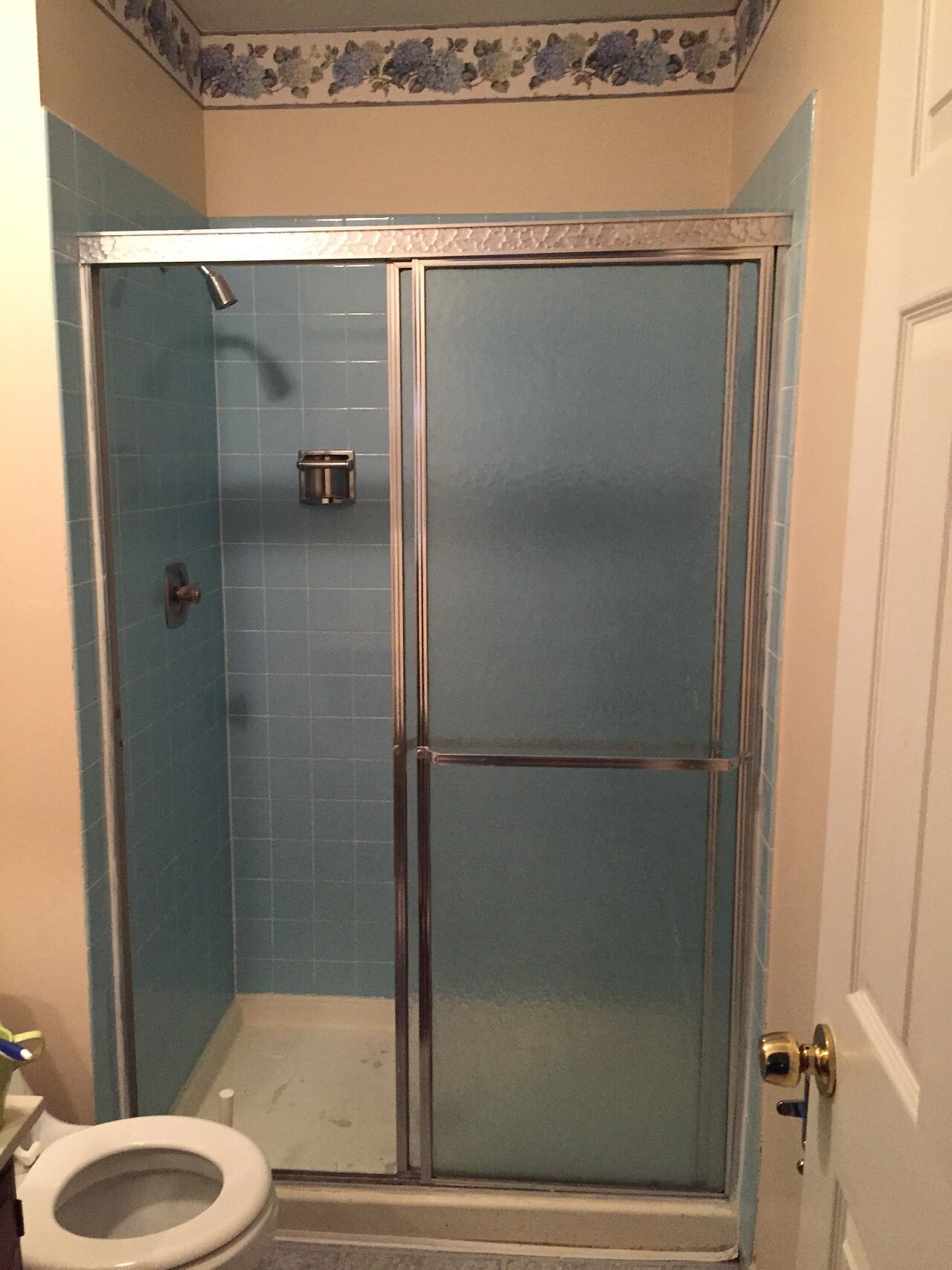
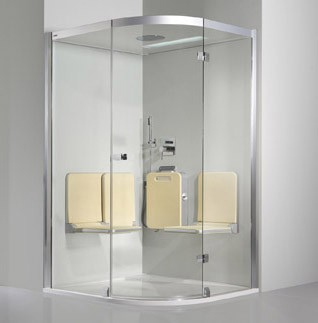
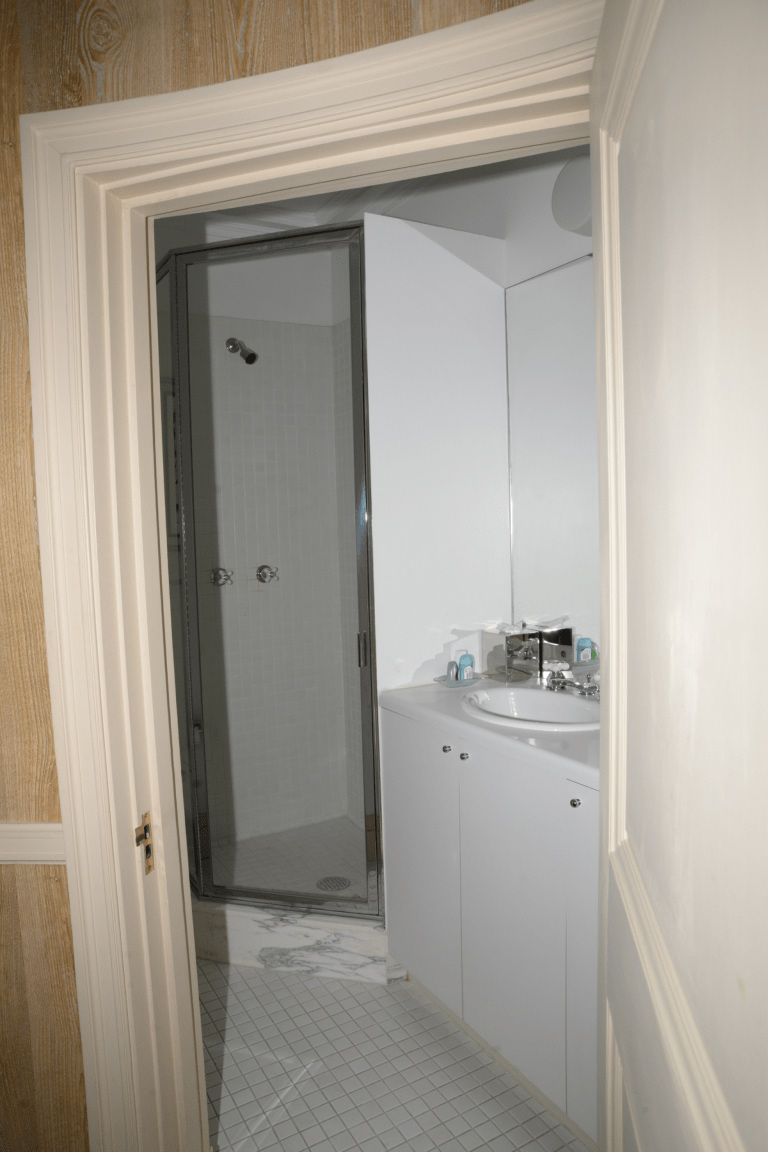
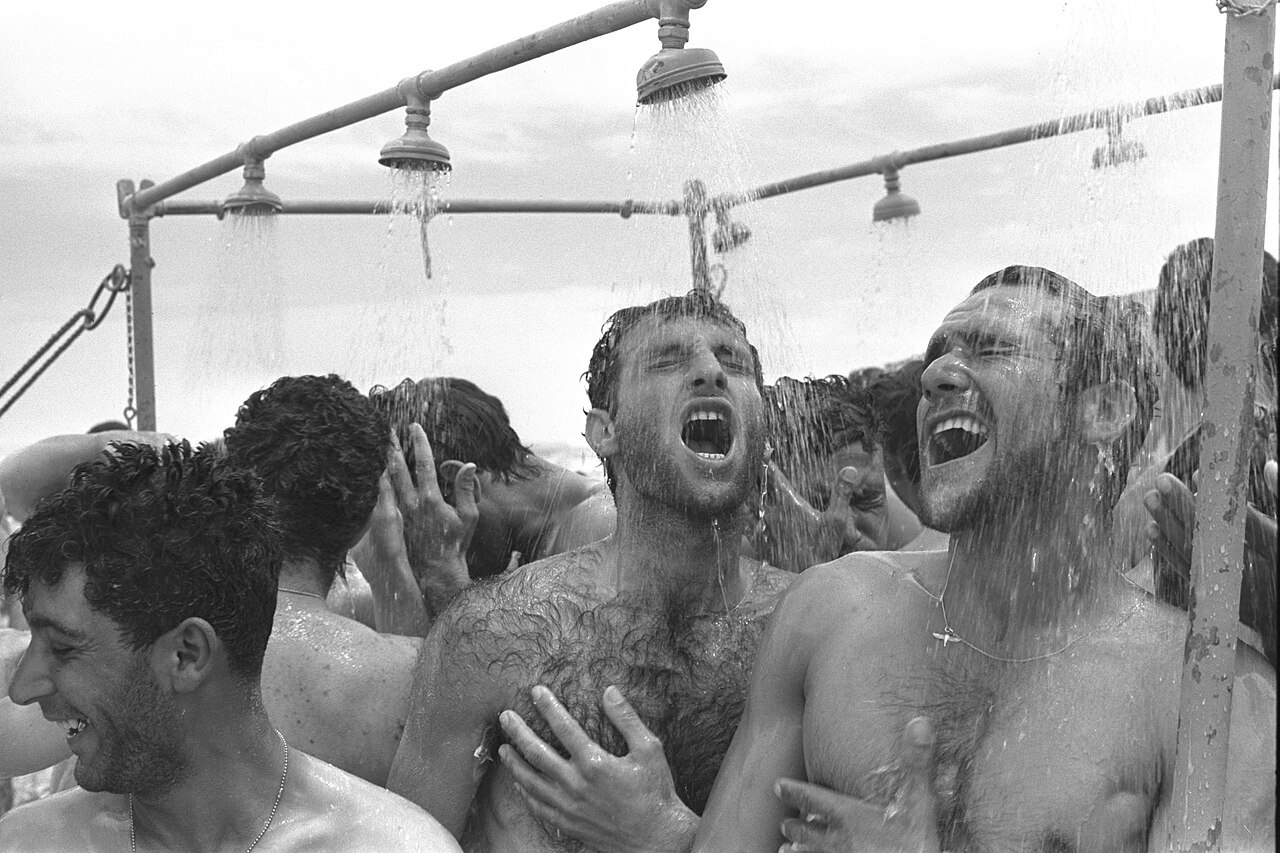
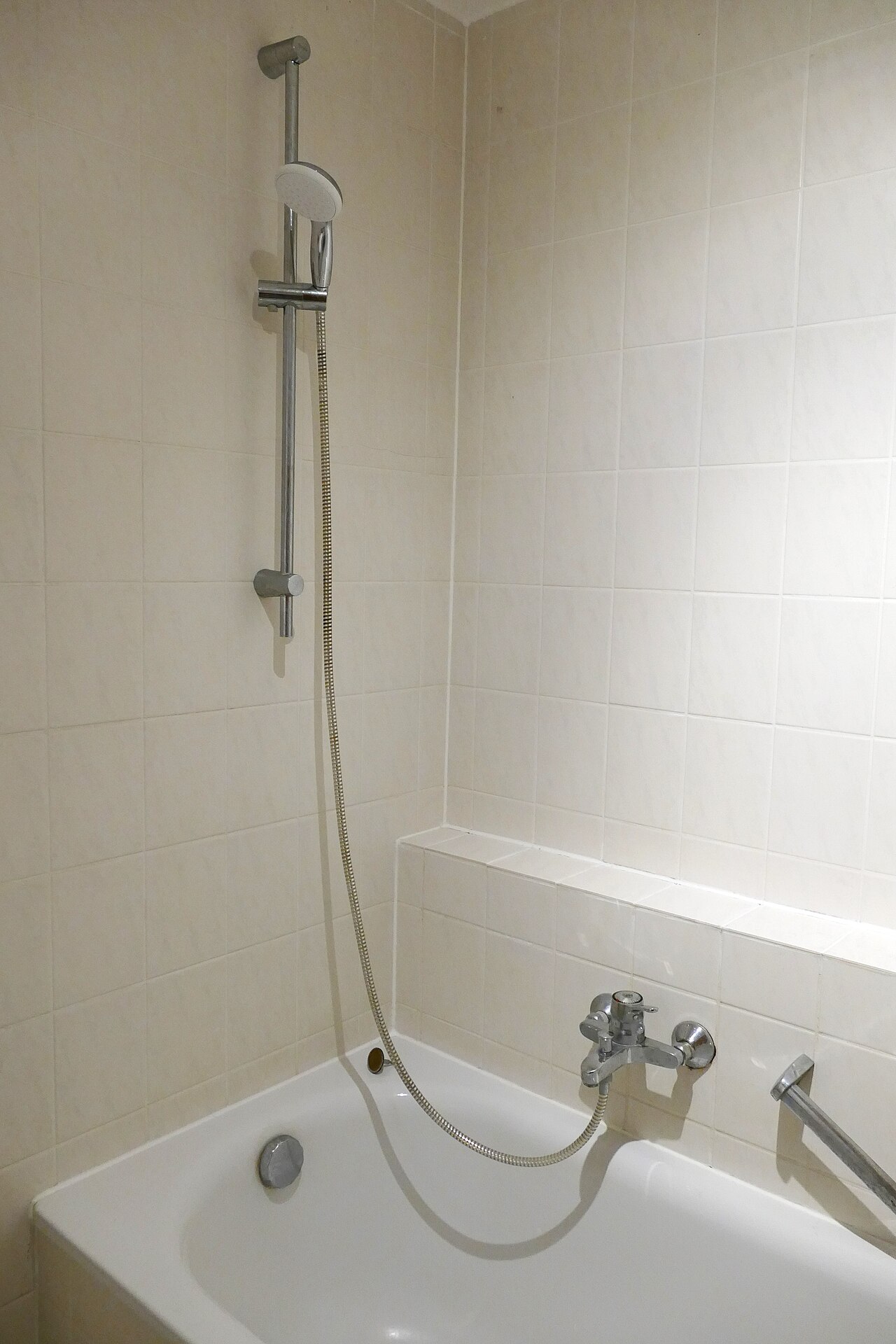
A shower is an area where someone bathes beneath a spray of water, usually warm or hot. When indoors, the floor includes a drain. Most showers allow the user to adjust the water temperature, spray pressure, and the angle of the showerhead nozzle. The simplest models feature a swivelling nozzle that points downward, while more complex ones have a showerhead attached to a hose with a mounting bracket, letting the person hold it by hand to direct water to different parts of the body. A showerhead can be placed in a small shower stall or inside a bathtub, with a plastic curtain or door to contain the spray. Showering is popular because it is more efficient than using a bathtub, so it is a common hygiene practice.
Historically, natural waterfalls served as primitive showers, rinsing bathers completely and being more efficient than basin bathing, which required carrying fresh and waste water by hand. Ancient people imitated this by pouring jugs of cold water over themselves after washing. Evidence shows that upper-class Egyptians and Mesopotamians had indoor shower rooms where servants bathed them in private, though these were primitive, with basic drainage and water carried in rather than pumped. The ancient Greeks built showers with aqueducts and lead pipes that pumped water into and out of large communal rooms used by both elites and common citizens. Such rooms have been found at Pergamum and appear in pottery, resembling modern locker-room showers with hooks for clothing. The Romans followed this practice, with their famous bathhouses across the Mediterranean and as far as England. They bathed several times a week or daily, but their water and sewage systems collapsed after the Roman Empire fell.
The first known mechanical shower, using a hand pump, was patented in England in 1767 by William Feetham, a stove maker. It pumped water into a vessel above the user’s head, released by pulling a chain. This eliminated the need for servants to carry water, but it failed to catch on with the wealthy because there was no way to pipe hot water, and the system recycled the same dirty water. Around 1810, an anonymous English Regency design improved on this. Over 10 feet tall, it was made of metal pipes painted to look like bamboo, with a basin above feeding a nozzle that sprayed water over the user’s shoulders. The water drained and was pumped back through the pipes to r
- first_mechanical_shower_patented
- 1767
- patent_holder
- William Feetham
- location_of_patent
- England
- inventor_of_shower_cabin
- Aleksander Edward Kierzkowski
- year_of_shower_cabin_invention
- 1839
- early_communal_showers_introduced_by
- François Merry Delabost
- year_of_French_army_showers
- 1870s
Lore & Background
Waterfalls have historically been used as primitive forms of showers. Ancient people began to reproduce these natural phenomena by pouring jugs of water over themselves after washing. Evidence exists of early upper-class Egyptian and Mesopotamians having indoor shower rooms where servants would bathe them. Ancient Greeks had showers with aqueducts and lead pipes, discovered at the site of Pergamum and depicted in pottery. The ancient Romans also followed this convention, with bathhouses found around the Mediterranean and as far as modern-day England. The water and sewage systems developed by the Greeks and Romans broke down after the fall of the Roman Empire.
The first known mechanical shower, operated by a hand pump, was pate
Reader's Guide
The shower represents a significant evolution in personal hygiene, moving from natural waterfalls to sophisticated indoor plumbing. Its development reflects broader technological and social changes, from ancient communal systems to modern private installations. The efficiency of showering compared to bathing in a tub made it a common practice, especially as water and sewage systems improved. The introduction of mechanical showers in the 18th century, though initially limited by the lack of hot water piping and water recycling, paved the way for later innovations. The 19th century saw key advances: the shower cabin, reliable indoor plumbing, and the adoption of communal showers in military and prison settings for economic and hygienic reasons. These institutional uses demonstrated the shower's practicality and helped spread its acceptance. The shower's legacy is its ubiquity in modern life, found in domestic bathrooms, public facilities, and specialized settings like emergency showers in laboratories. Its design continues to vary, from simple stall showers to complex digital systems, but the core principle of a directed spray of water for efficient cleaning remains unchanged. The historical arc from ancient Greek and Roman communal showers to modern private stalls illustrates a shift in bathing culture, yet the fundamental need for efficient water-based cleansing endures.
Did You Know?
- The first known mechanical shower was patented in England in 1767 by William Feetham, a stove maker.
- Ancient Greeks had communal shower rooms with lead pipes, discovered at the site of Pergamum.
- The shower cabin was invented in 1839 by Polish-Canadian engineer Aleksander Edward Kierzkowski.
- The first shower in a public bathhouse was in 1887 in Vienna.
Origins and Naming
Hollywood Regency, also referred to as Regency Moderne, is a design philosophy that spans interior design, architecture, and landscape architecture. The style draws its identity from the film industry of southern California, specifically evoking the lavish residences and estates built for the stars of Hollywood's Golden Era, a period stretching roughly from the 1920s through the 1950s. The very name is attributed to Dorothy Draper, who is credited with coining the phrase in the 1920s, making her both a foundational practitioner and the originator of the terminology. Alongside Draper, figures such as Billy Haines helped define the aesthetic vocabulary that would come to characterize the movement. The style is fundamentally about bold color, strong contrast, and the strategic use of metallic and glass elements, all working together to communicate a dual message of opulence and genuine comfort. Though rooted in a specific time and place, the design language has never been confined to its origins, continuing to influence creative work both within and beyond California's borders.
Aesthetic Philosophy and Emotional Tone
At its core, Hollywood Regency is a maximalist and eclectic approach that deliberately pushes beyond the restraint of Art Deco. Where Deco tends toward geometric precision, this style embraces ornamental excess, favoring a feeling of glitz and glamour wrapped in lacquer, chrome, and mirrored surfaces. Every single detail is calibrated to project luxury, and the design implicitly invites the viewer to imagine themselves looking spectacular within the space—perhaps draped in a satin bathrobe, holding a cocktail. The overall effect is intentionally frivolously overdone and pleasantly, extravagantly unbalanced, yet it retains a sleek modernity. The style has been compared to Rococo rather than Baroque, since it avoids the strict, repetitive ornamentation of the latter in favor of a more playful, asymmetric exuberance. High ceilings and large windows frame the composition, while blocks of contrasting color—particularly vivid pinks, a full range of turquoises from deep near-blue to pale seafoam, bright yellows, and black-and-white checkerboard patterns—create visual energy. These palettes may appear in orderly but asymmetric repetition or through varied textures of soft furnishings, ensuring the space feels dynamic rather than static.
Signature Materials and Decorative Motifs
The material vocabulary of Hollywood Regency is as distinctive as its color palette. Whole mirrors—never mosaics—are applied to the surfaces of dressers, side tables, and even entire walls or ceilings, creating a sense of infinite reflection and spatial expansion. Animal prints, including zebra, cheetah, and snakeskin patterns, appear as rugs, tablecloths, and seat cushions, while complex floral designs in black-and-white or in shades of a single color add further textural richness. Imitation bamboo stalks serve as decorative trim on shower doors, vanities, table legs, and other household furnishings, lending a tropical, playful edge. The divan, with its plush sides and deliberately asymmetric silhouette, stands as a staple seating piece. Oversized black-and-white wall prints of famous actresses anchor the walls, reinforcing the style's cinematic roots. Criss-cross and zig-zag patterns appear universally throughout, whether rendered symmetrically or not, and sunburst mirrors are nearly ubiquitous fixtures. Together, these elements create a layered, tactile environment where no surface is left plain and every object contributes to an atmosphere of theatrical, accessible luxury.
Pioneers and Architectural Footprint
Several designers are widely recognized for shaping and defining the Hollywood Regency aesthetic. Beyond Dorothy Draper and Billy Haines, whose early work helped establish the style's vocabulary, later figures such as George Vernon Russell, Douglas Honnold, John Woolf, and Paul R. Williams are credited with further codifying its principles and extending its reach into residential and commercial spaces. The style is not limited to interiors; it also manifests in architecture. Notable buildings that exemplify Hollywood Regency architecture include the Max Factor Salon and the Los Angeles Department of Water and Power Distributing Station No. 29, demonstrating that the design language extends well beyond private homes into public and commercial structures. Despite its roots in a specific era and region, Hollywood Regency remains a current and lively area of design work. Practitioners continue to draw on its principles both inside and outside southern California, ensuring that the style's bold colors, mirrored surfaces, and theatrical sensibility remain a vibrant force in contemporary design rather than a relic of a bygone golden age.
Gallery

Frequently Asked Questions
Who is Shower?
A shower is a bathing fixture that delivers a directed spray of water—usually warm or hot—over the user's body for personal hygiene. Indoors, the floor is fitted with a drain to manage the runoff.
What are Shower's powers and abilities?
Most showers let the user tweak water temperature, spray pressure, and the direction of the nozzle. The simplest models use a fixed downward-pointing swivel head, while fancier setups attach the head to a flexible hose on a bracket so it can be held by hand.
How does Shower's origin story begin?
The first mechanical shower was patented in 1767 in England by William Feetham. Aleksander Edward Kierzkowski later earned credit for inventing the enclosed shower cabin in 1839.
Why is Shower important to the household?
It offers a quick, water-efficient way to clean the body using a directed stream rather than a full tub of water. François Merry Delabost also introduced early communal shower systems, demonstrating its value well beyond a single home.
What are Shower's known variants?
A showerhead can sit inside a small enclosed stall or be mounted within a bathtub, with a plastic curtain or door keeping the spray contained. The core mechanism—adjustable overhead water delivery—stays consistent across both configurations.
More in Furniture & Household Items 1-24
Spotted an error? Know more?
This is a living reference — every entry is fact-audited, and reader corrections feed straight into our audit queue. Suggest an edit · See this site's audit record