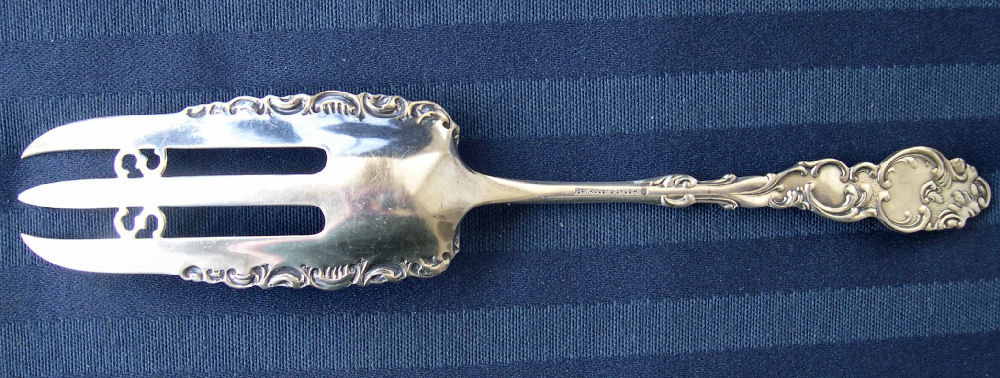
Pastry fork
A fork designed for pastries, with a widened tine for cutting.

Andy Li · CC0
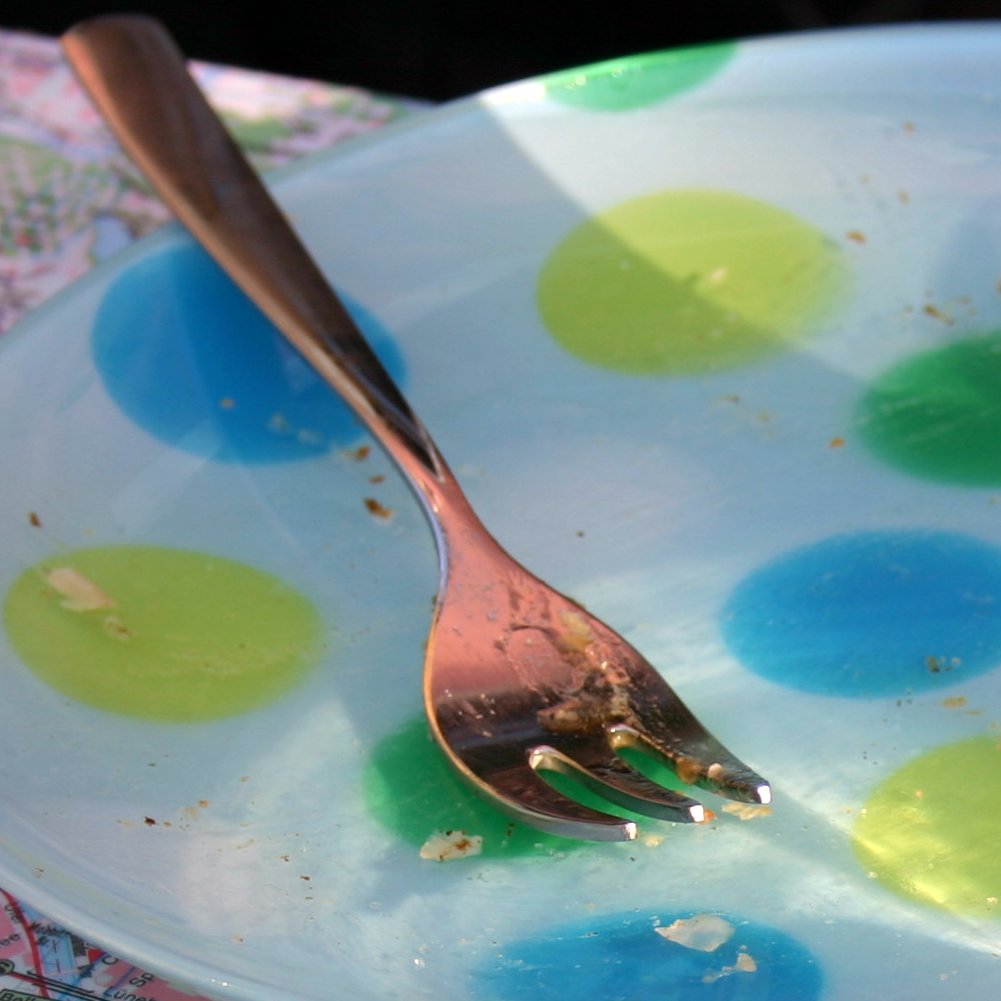
A pastry fork, also known as a dessert fork, pie fork, or cake fork, is a utensil designed for eating pastries and other desserts from a plate. It typically has three or four tines, with the three-tine version featuring a larger, flattened, and beveled tine on the side, while the four-tine version often has tines connected by bars, a design mostly dated pre-1920. The fork is designed for right-hand use, with the left side widened to cut food when pressed down; left-handed versions have the right side widened instead. Pastry forks were part of the American 'fanaticism for forks' in the late 19th century, driven by etiquette books that since at least 1864 suggested avoiding knives on pastry and cutting with a fork's edge, and by the demand for stronger tines in mass-produced forks.
- type
- Utensil
- common_names
- Pastry fork, dessert fork, pie fork, cake fork
- tine_count
- Three or four
- size_range
- 100 mm (4 in) to 190 mm (7.5 in)
- notable_patent
- Anna M. Mangin, U.S. patent 470005A, March 1, 1892 (for a kitchen tool, not a table fork)
- era_of_popularity
- Late 19th century
Lore & Background
Pastry forks emerged during the late 19th-century American 'fanaticism for forks,' when etiquette books from at least 1864 advised cutting pastry with a fork's edge instead of a knife. Cheaper mass-produced forks had weaker tines, creating demand for utensils strong enough to break through layers of food. Reed and Barton patented a 'Cutting-Tined Fork' in 1869, and thickened-tine forks became common by the early 1880s. Anna M. Mangin was awarded a patent on March 1, 1892, for a 'pastry fork,' but U.S. patent 470005A described a kitchen tool for mashing dough, not a table fork.
Reader's Guide
The pastry fork's significance lies in its role as a specialized utensil that reflects late 19th-century dining etiquette and the industrial response to consumer needs. Its design—with a widened, beveled tine for cutting—allowed diners to follow etiquette rules that forbade using a knife on pastry. The fork also illustrates the overlap between utensil categories: the same barred design was used for salad and fish forks, and manufacturers could market the same utensil as a pastry fork, salad fork, or small fish fork. This ambiguity created both social awkwardness—as noted in etiquette guides—and marketing opportunities. The pastry fork remains a part of fine place settings, sometimes distinguished from a pie fork, and its legacy includes influencing the design of salad forks, which also adopted a widened tine for cutting lettuce. The fork's history shows how material constraints (weak tines) and social rules (etiquette) drove innovation in flatware.
Did You Know?
- Pastry forks range in size from 100 mm (4 in) to 190 mm (7.5 in).
- The barred design on four-tine pastry forks is mostly dated pre-1920.
- Anna M. Mangin's 1892 patent for a 'pastry fork' actually described a kitchen tool for mashing dough.
- The same barred design was used for salad forks and fish forks in some silverware patterns.
Cultural and Linguistic Landscape of Cutlery
The way a fork is named and classified shifts dramatically depending on where you are in the world. In the United States, the word cutlery typically refers only to knives and cutting instruments, while the broader family of eating implements goes by the names silverware or flatware. Outside American English, however, cutlery encompasses every fork, spoon, and related utensil, and the term flatware takes on a different meaning entirely, describing open-shaped vessels like plates and bowls rather than the utensils themselves. Ireland adds its own flavor to the vocabulary, calling all tableware delph, a phonetic rendering of Delft, the Dutch town long associated with delftware production. Beyond nomenclature, cultural practice shapes whether a fork appears on the table at all. Middle Eastern, Indian, and Polynesian dining traditions frequently reduce tableware to shared serving dishes, substituting bread or leaves for individual plates and often dispensing with cutlery altogether. The number, variety, and quality of items set before a diner are governed by religion, cuisine, the size of the party, and the formality of the occasion, with special events calling for noticeably finer pieces.
Materials and the Industrial Transformation
Cutlery has traditionally been forged from metal, with stainless steel dominating modern production, though larger serving pieces such as ladles can still be turned from wood. In parts of Asia, porcelain spoons have found a place at the table, and chopsticks themselves are crafted from wood, bamboo, metal, ivory, or plastic, reflecting the wide material palette available to different cultures. Before the era of mass manufacturing, every plate, bowl, and utensil was shaped from whatever local materials a household could access, wood being the most common starting point. The industrial revolution and advances in ceramic production changed that calculus, making affordable tableware accessible to far more people. Today, ceramic tableware—whether earthenware, stoneware, bone china, or porcelain—represents a global market valued at roughly 2.2 billion dollars, with China leading exports followed by Portugal, Germany, Thailand, and the United Kingdom. Finished sets are typically sold for four, six, eight, or twelve diners, while individual pieces remain available for those building a collection incrementally.
The Long Road from Trencher to Plate
For most of human history, the flat serving surface we now take for granted did not exist in its current form. The earliest pottery found across cultures was devoted to pots and jars for storage and cooking, not flat dishes. Wooden plates may have been common in prehistory, but wood decays, leaving few physical examples for archaeologists. Among ancient elites, precious metals were the preferred material for table vessels, with China and Japan as notable exceptions that favored lacquerware and later fine porcelain. In Europe, class was written in metal: silver and gold graced wealthy tables, while pewter served the middling and poorer, a pattern stretching from the Greeks and Romans through the eighteenth century. Religious doctrine also shaped choices; Muhammad's counsel against dining on gold, echoed by Persian and Byzantine elites, spurred the growth of Islamic pottery. The medieval trencher, a thick slice of stale bread serving as a disposable plate, lingered in French kitchens until the 1650s, while Italian maiolica had been in use since the fifteenth century. At a 1565 Este family wedding in Ferrara, twelve thousand painted plates were deployed, though honored guests likely ate from precious metal.
Sustainability and the Disposable Dilemma
Single-use tableware, crafted from paper, plastic, wood, or bagasse, has become a ubiquitous part of modern dining, yet it now faces mounting regulatory pressure. England is set to ban single-use plastic plates and cutlery beginning in October 2023, following a similar prohibition that took effect across the European Union in July 2021. Canada is also moving toward comparable legislation, signaling a broader global shift away from disposable plastic. These bans do not, however, represent an entirely new concept. In South and Southeast Asian cultures, banana leaves have long served as plates, and the kulhar, a traditional handle-less pottery cup from South Asia, is typically undecorated, unglazed, and meant to be disposable. The environmental concerns driving these legislative moves echo older practices of using readily available, low-impact materials at the table. Meanwhile, the broader tableware landscape continues to adapt: unusual dining locations demand that standard settings be modified, and the quality and elaboration of tableware remain closely tied to the formality of the occasion, whether a casual family meal or a formal service set for a special event.
Gallery

Frequently Asked Questions
What is a pastry fork and what is it used for?
A pastry fork is a small table utensil purpose-built for handling pastries, pies, and other plated desserts. It goes by several common names, including dessert fork, pie fork, and cake fork, and typically measures between 100 mm and 190 mm in length.
How does a pastry fork differ from a standard dinner fork?
The defining feature is a widened, beveled tine on one side that lets the user press down to slice soft baked goods without reaching for a knife. It is shaped for right-hand use by default, with the cutting edge on the left, while left-handed versions flip that arrangement to the right side.
What tine configurations exist for pastry forks?
Most pastry forks come in either a three-tine or a four-tine layout. The three-tine model includes one larger flattened tine for cutting, whereas the four-tine version often has crossbars joining the tines, a style that largely disappeared after the early 1920s.
When did pastry forks become a popular household item?
They rose to prominence in the late 19th century, riding a wave of American enthusiasm for dedicated forks for nearly every type of food. That era of highly specialized tableware peaked around the 1890s before more general-purpose designs took over.
Is there a notable patent connected to pastry forks?
Anna M. Mangin was granted U.S. patent 470005A on March 1, 1892, though it actually covered a kitchen tool rather than a table fork. It is frequently mentioned in discussions of the period's surge of fork-related inventions.
More in Furniture & Household Items 1-24
Spotted an error? Know more?
This is a living reference — every entry is fact-audited, and reader corrections feed straight into our audit queue. Suggest an edit · See this site's audit record