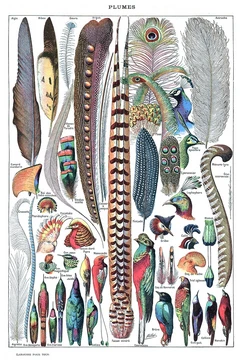
Quill
Feather pen used for writing before modern dip and fountain pens.

A quill is a writing implement crafted from a large bird's molted flight feather. It was the standard tool for ink writing before the dip pen, fountain pen, and ballpoint pen emerged. Because it lacks an internal ink reservoir, a quill must be dipped into an inkwell repeatedly while writing.
Quills became the dominant writing instrument in medieval Europe, as they worked well with parchment and vellum. They allowed for smaller lettering than the earlier reed pen. Beyond text, quills were used for manuscript decorations and illustrations, though many illuminators preferred fine brushes. The flexible, shapable nib enabled a wide range of calligraphic scripts. The best quills came from the first flight feather on a wing; feathers beyond the sixth were often considered less ideal but could still be used for less demanding work. The decline of the quill began gradually in the late 18th century with the introduction of early steel pens, becoming more pronounced in the early 1800s.
Today, quills are rarely used for everyday writing but are still produced as specialty items for hobbyists. Some modern quills feature metal nibs or are fitted with a ballpoint pen to eliminate the need for ink. In the U.S. Supreme Court, goose-quill pens are placed at the two counsel tables each session day; most lawyers appear only once and take the quills home as souvenirs, a tradition dating to the Court's earliest sessions. In Jewish tradition, scribes still use quill pens, called *kulmus*, to write Torah scrolls, Mezuzot, and Tefillin.
The shaft of a flight feather is long and hollow, ideal for pen-making. The strongest quills come from the first flight feathers shed during a bird's annual molt. While some claim feathers from the left wing suit right-handed writers and those from the right wing suit left-handed writers, quills are usually cut to six to eight inches, making such curvature considerations unnecessary. Goose feathers were most common for regular writing; swan feathers, being scarcer and more expensive, were used for larger lettering. Other feathers—from crows, eagles, owls, turkeys, and hawks—were also used, depending on availability and desired line quality. Crow quills were especially useful for small writing, such as accounting. Each bird supplied only about ten to twelve good quills.
- Primary era
- 7th–8th centuries through early 1800s
- Decline
- Gradual decline beginning in the late 18th century with early steel pens, accelerating in the early 1800s
Lore & Background
Quills were the instrument of choice in medieval Europe due to their compatibility with parchment and vellum. Before this, the large reed pen had been used, but smaller letters were able to be achieved using a quill. The shapable and flexible nib allowed for a variety of different strokes, spawning a wide array of calligraphic scripts throughout history. Quills are denominated from the order in which they are fixed on the wing, with the first flight feather being the most preferable; feathers beyond the sixth flight feather are often considered less ideal but can still be used for less demanding work.
The best quills were usually made from goose, swan, and later turkey feathers.
Reader's Guide
Quills represent a pivotal technology in the history of writing, serving as the primary instrument for centuries of European manuscript production and legal documentation. Their flexibility allowed for the development of diverse calligraphic scripts, and their compatibility with parchment and vellum made them indispensable in medieval Europe. The decline of quills began with the invention of the steel dip pen in Great Britain in the early 1800s, but they have persisted as specialty items for hobbyists, calligraphers, and historical reenactors. Notably, twenty goose-quill pens are still placed at the four counsel tables each day the U.S. Supreme Court is in session, a tradition dating to the earliest sessions of the Court. The quill's symbolism endures in administrative and political contexts, appearing on seals and coats of arms. While rarely used for everyday writing, the quill remains a tool of choice for select writers who value the ability to cut the nib for greater freedom in calligraphic scripts.
Did You Know?
- Thomas Jefferson bred geese at Monticello to supply his need for quills.
- In Jewish tradition, quill pens called kulmus are still used by scribes to write Torah scrolls.
- Crow quills were particularly useful for writing small, such as accounting.
More in Feathers 1-24
Spotted an error? Know more?
Reader corrections go straight into our review queue. Suggest an edit · How this site is sourced