Alula
A bird's thumb-like winglet aiding slow flight and landing.

Pearson Scott Foresman · Public domain
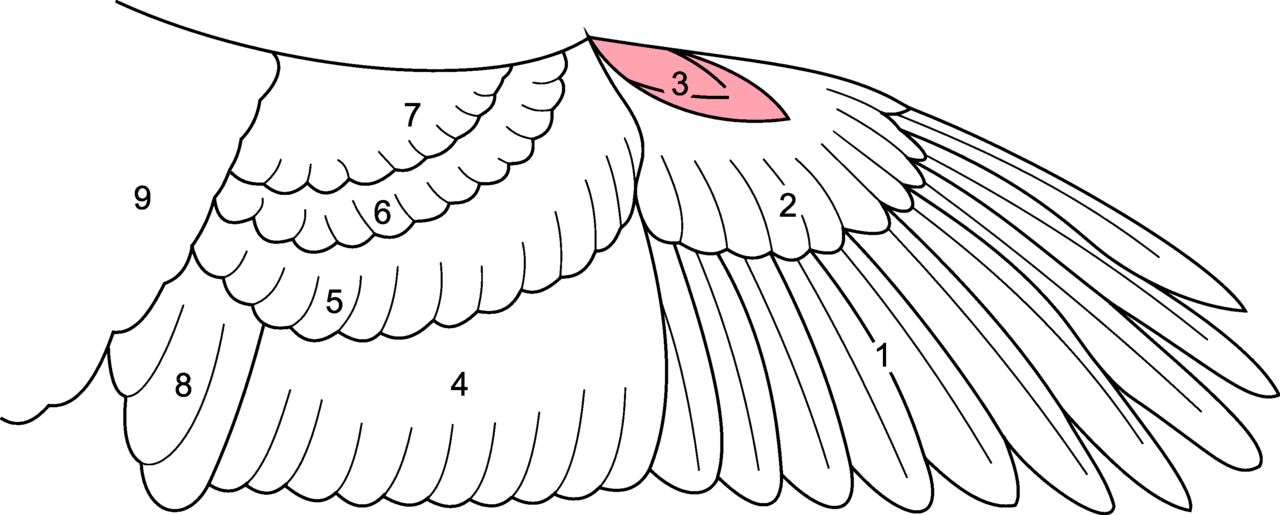
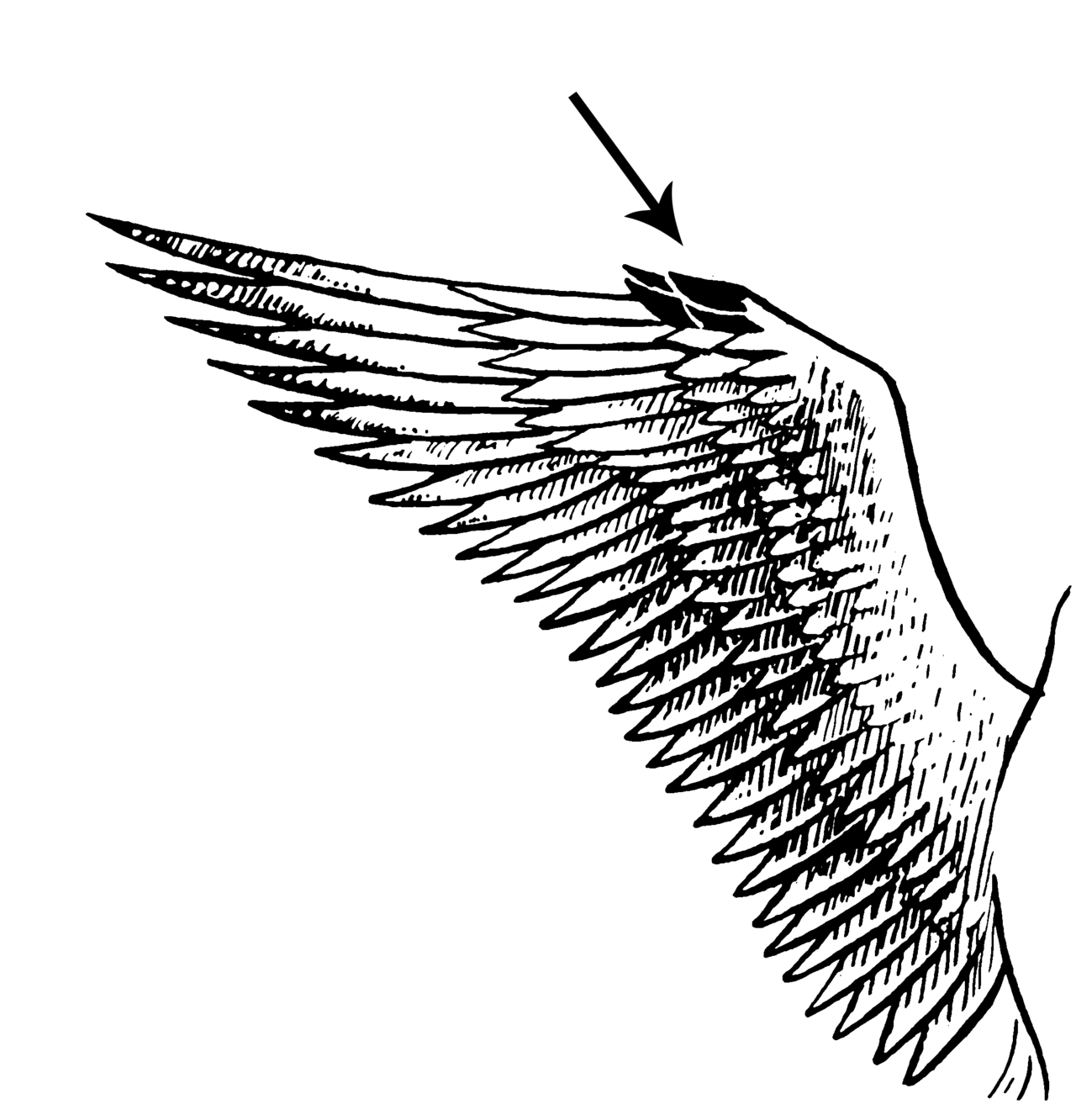
The alula, also known as the bastard wing (plural alulae), is a small projection on the anterior edge of the wing of modern birds and a few non-avian dinosaurs. The word is Latin and means 'winglet,' the diminutive of ala, meaning 'wing.' It is the freely moving first digit, a bird's 'thumb,' and typically bears two to five small flight feathers, with the exact number varying widely by species. Minor covert feathers overlie these flight feathers, which are asymmetrical, with the shaft running closer to the anterior edge.
- Field
- Avian anatomy and flight
- Known for
- Functioning as a leading-edge slot to allow higher angles of attack without stalling during slow flight or landing
Lore & Background
In most situations, the alula is held flush against the wing, but it can be manipulated. When flying at slow speeds or landing, the bird moves its alula slightly upwards and forward, creating a small slot on the wing's leading edge. This functions like the slats on an aircraft wing, allowing a higher angle of attack and lift without stalling. The tip of the alula forms a tiny vortex, acting as a vortex generator that forces airflow to better bind to the wing. During stretching of the wing downward, the alula is abducted and can be clearly viewed.
In falcons, the alula is more prominent and provides a degree of control when the wing is cupped or tucked in a dive or stoop. The alulae are particularly notable in peregrine falcons.
The presence of an alula has been confirmed in several extinct ancient relatives of modern birds, including Eoalulavis hoyasi (an enantiornithine from the mid-Cretaceous, 115 mya) and the earlier Protopteryx fengningensis. Since these species are not closely related to modern birds, it is hypothesized that either the alula evolved twice, or it did so more than 130 million years ago.
Reader's Guide
The alula is significant as a key adaptation for avian flight, particularly for slow-speed maneuvers and landing. Its function mirrors that of leading-edge slats on fixed-wing aircraft, allowing birds to achieve high angles of attack without stalling. The presence of an alula in ancient birds such as Eoalulavis hoyasi and Protopteryx fengningensis indicates that this structure has a long evolutionary history, dating back at least 115 million years. The uncertainty over whether the alula evolved once or twice highlights ongoing questions in paleontology about convergent evolution in flight adaptations. In falcons, especially peregrine falcons, the alula's prominence aids control during high-speed dives. Understanding the alula helps clarify the mechanics of bird flight and the evolutionary pathways that led to modern avian capabilities. Its legacy extends to biomimicry, as engineers have studied its vortex-generating properties to improve aircraft design.
Did You Know?
- When flying at slow speeds or landing, the bird moves its alula upwards and forward to create a slot on the wing's leading edge.
- The tip of the alula forms a tiny vortex that forces airflow to better bind to the wing, acting like a vortex generator.
- The presence of an alula has been confirmed in the ancient birds Eoalulavis hoyasi (115 mya) and Protopteryx fengningensis.
Anatomy & Structure
The alula—often called the "bastard wing"—is a compact, freely articulated projection situated along the front edge of a bird's wing. Its name derives from Latin, where it functions as a diminutive of ala, the word for wing, essentially translating to "little winglet." Structurally, the alula represents the bird's first digit, the anatomical equivalent of a thumb, and it moves independently from the rest of the wing. In most species, this small structure carries between three and five narrow flight feathers, though the precise count shifts from one bird to another. A set of smaller covert feathers drapes over these primaries, adding a layer of protection and smoothing. What makes the alula's plumage aerodynamically interesting is its asymmetry: just as the larger feathers along the wing's trailing edge are built with the shaft positioned nearer to the front edge, the alula's feathers share this same off-center construction. This structural detail is not merely decorative; it is fundamental to how the alula interacts with airflow during flight. The alula is not exclusive to living birds—fossil evidence confirms its presence in certain non-avian dinosaurs as well, linking this feature to a much broader evolutionary story.
Aerodynamic Function
Under normal cruising flight, the alula rests flat against the main wing, nearly invisible. But when a bird slows down—approaching a perch, a branch, or the ground for a landing—it subtly rotates the alula upward and forward. This small gesture opens a narrow gap, or slot, along the wing's leading edge. The effect mirrors the extendable slats engineers build into the leading edges of commercial aircraft: the slot lets the wing sustain a steeper angle of attack and generate more lift without the airflow separating and causing a stall. Beyond the slot effect, the very tip of the alula spins up a miniature vortex. This tiny swirl of air acts much like a vortex generator on an airplane wing, energizing the boundary layer and forcing the oncoming airflow to cling more tightly to the wing surface. The result is smoother, more controlled flight at low speeds. There is also a moment of clear visibility: when a bird stretches its wing downward toward the ground, the alula abducts away from the wing surface, making the small structure and its feathers plainly visible to an observer.
Specialized Roles in Raptors
While the alula serves a general low-speed function across most bird species, it takes on a particularly dramatic role in falcons. In these raptors, the alula is noticeably more prominent than in many other birds, and its aerodynamic contribution becomes critical during high-speed hunting maneuvers. When a falcon cups or tucks its wings to execute a dive—known as a stoop—the alula provides a degree of fine control that helps the bird manage the aerodynamic forces encountered at such velocities. The peregrine falcon is singled out in the literature as having alulae that are especially notable, suggesting that in this species the structure plays a particularly important role in controlling flight during the stoop. In this context, the alula is not merely a passive slot-opening device; it is an active control surface that the falcon manipulates to maintain stability and adjust its trajectory. The fact that a structure so small relative to the overall wing can exert meaningful influence at such speeds underscores the precision of avian flight mechanics and the evolutionary refinement of even the most minor anatomical features.
Deep Evolutionary History
The alula is not a recent innovation. Fossil evidence has confirmed its presence in several extinct lineages that are not closely related to living birds, pushing the origin of this structure deep into the Mesozoic. One well-known example is Eoalulavis hoyasi, an enantiornithine from the mid-Cretaceous period, roughly 115 million years ago. Even earlier in the record, the species Protopteryx fengningensis also displays an alula. Because these ancient birds belong to distinct evolutionary branches—enantiornithines versus the lineage that eventually gave rise to modern birds—their shared possession of an alula raises a profound question for evolutionary biologists. Either this anatomical feature evolved independently on two separate occasions, a case of convergent evolution, or it was already present in a common ancestor more than 130 million years ago. The second possibility would mean the alula has been a stable, conserved feature of avian and near-avian flight for well over a hundred million years, a remarkable testament to the functional importance of this small but critical structure.
Gallery



Frequently Asked Questions
What is the Alula?
The alula is a small, freely moving projection on the front edge of a bird's wing, essentially serving as the bird's anatomical 'thumb' (the first digit). Its Latin name literally means 'winglet,' a diminutive form of the word for wing.
What does the Alula actually do in flight?
It functions as a leading-edge slot, letting a bird hold a higher angle of attack without the wing stalling. This makes it indispensable during slow-flight maneuvers and the critical moments of landing.
How many feathers does the Alula carry?
Most species sport two to five small, asymmetrical flight feathers on the alula, though the exact count shifts widely from one bird to another. A few tiny covert feathers drape over the top of those flight feathers.
Why is the Alula called the 'bastard wing'?
That is simply an older English anatomical nickname for the same thumb-like structure, reflecting its small, secondary position relative to the main wing. It is a historical label rather than a negative one, and the scientific term 'alula' is preferred in modern usage.
Is the Alula unique to modern birds?
Not quite—a few non-avian dinosaurs also possessed this structure, indicating it predates the bird lineage. In living birds, each alular feather is asymmetrical, with its shaft positioned closer to the front edge to optimize that slot effect.
More in Feathers 1-24
Spotted an error? Know more?
Reader corrections go straight into our review queue. Suggest an edit · How this site is sourced