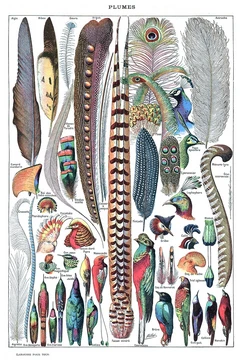
Conservation and restoration of feathers
Practice of maintaining and preserving feathers or featherwork objects.

The conservation and restoration of feathers is the practice of maintaining and preserving feathers or featherwork objects. It requires knowledge of feather anatomy, properties, specialized care procedures, and environmental influences. This practice may be approached through preventive and/or interventive techniques.
- Field
- Conservation and restoration
- Known for
- Preservation of feathers and featherwork objects
Lore & Background
Feathers are made of keratin, a protein common in many animals, and consist of about 91% protein, 8% water, and 1% lipids. There are two basic types: pennaceous (contour) and plumulaceous (down). The feather has two main sections: the shaft (composed of the calamus or quill and the rachis) and the vane (made of interconnecting barbs, barbules, and hooklets called hamuli). Feathers in museum collections are often part of composite objects such as hats, fans, jewelry, and spiritual objects, serving utilitarian, cultural, artistic, or natural history and taxidermy purposes.
Reader's Guide
Deterioration of feathers can be caused by pests (including insects like carpet beetles, hide beetles, larder beetles, and clothing moths; fungi such as Chrysosporium keratinophilum, Aspergillus, and Penicillium; and vertebrate pests like rodents), physical forces (impact, shock, vibration, pressure, abrasion), light (which affects pigmented feathers more than structurally colored ones, and can cause brittleness from UV exposure), incorrect temperature (warmth increases mold and pest activity, and can cause oil expulsion from taxidermy skins), temperature fluctuations (causing differential expansion and contraction in composite objects), incorrect relative humidity and water (high RH above 65% promotes mold and pest activity, and can cause fading of artificial dyes; water can cause bleeding or staining of artificially dyed feathers), and pollutants (gaseous pollutants like sulfur dioxide, hydrogen sulfide, nitrogen oxides, ozone, organic acids, peroxides, formaldehydes; and particulate pollutants like dust, soot, smoke, pollen, soil). Theft is also a risk for rare or valuable feathers. Preventive conservation emphasizes accurate record keeping, proper display and storage conditions using acid-free, pH-neutral, or un-buffered materials, and climate control to mitigate these agents of deterioration.
Did You Know?
- The two main sections of a feather are the shaft and the vane.
- Over 2500 species of mites are linked with birds, including those that live on feather plumage and within quill structures.
- Exposure to UV light can cause feathers to become brittle.
The Architecture of a Feather
Feathers are biological structures composed predominantly of keratin, the same protein found throughout the animal kingdom, accounting for roughly 91 percent of their mass, with the remaining share split between water (about 8 percent) and lipids (roughly 1 percent). Broadly, feathers divide into two categories: pennaceous (contour) feathers and plumulaceous (down) feathers, each serving distinct protective roles on a living bird. Every feather, regardless of type, is organized into two principal regions: the shaft and the vane. The shaft itself has two components. The calamus, sometimes called the quill, is the hollow segment that anchors the feather into the skin follicle. Extending from it is the rachis, a solid rod to which the barbs attach. The vane, considered the most substantial part of the feather, fans out on either side of the rachis and is constructed from an intricate network of interconnecting barbs, finer barbules, and tiny hooklets called hamuli. Understanding this layered architecture is essential for any conservator, because the specific vulnerabilities of each component, whether hollow or solid, interlocking or free-standing, dictate how a feather responds to handling, environmental stress, and biological attack.
Biological Agents of Decay
Because feathers are overwhelmingly protein, they present an attractive food source to a wide range of organisms. In living birds, chewing lice of the order Mallophaga can infest plumage and progressively degrade feather material, while more than 2,500 species of mites are associated with birds, some dwelling on the plumage surface and others burrowing within the quill structure. Interestingly, current research hints that at least some of these mites may actually benefit the host by consuming harmful bacteria and fungi, forming a symbiotic relationship. In museum and collection settings, the threat shifts to insects that gravitate toward protein-rich material. Carpet beetles, hide beetles, larder beetles, and clothing moths are the most common culprits, leaving behind lost feather material, burrowed or grazed surfaces, and characteristic frass. Fungi represent another serious danger: keratinophilic species such as Chrysosporium keratinophilum can ultimately consume an entire feather, while Aspergillus and Penicillium produce black and green discoloration. Rodents and other vertebrates compound the problem by gnawing on specimens, using them for nesting, or introducing additional insects and mites after death.
Environmental and Physical Stressors
Beyond biological threats, feathers face a constellation of environmental and physical hazards. Light is particularly insidious: pigmented coloration, whether from melanin, carotenoids, or psittacofulvins, fades more readily than structural coloration, and artificially dyed feathers are even more vulnerable. Most visible fading occurs quickly upon initial exposure, after which the rate stabilizes, while ultraviolet radiation additionally renders feathers brittle. Temperature plays a dual role. Warmer conditions accelerate mold and fungal growth, boost pest breeding activity, and can drive residual oils out of taxidermy skins, leading to feather loss. One study indicated that carotenoid color is most stable at temperatures below freezing. Fluctuating temperatures compound the problem by causing expansion and contraction cycles that work components free of one another in composite objects. Relative humidity above 65 percent encourages mold and pest proliferation and intensifies chemical reactions that fade dyes. Humidity swings impose differential stress on mixed-material objects, and temperatures dropping below the dew point can trigger condensation. Physically, feathers are extraordinarily fragile; impact, shock, vibration, pressure, and abrasion can easily bend or break them, and abrasion can alter structural color.
Feathers in the Museum and Conservation Practice
In museum and institutional collections, feathers rarely appear in isolation. They are typically embedded in composite objects such as hats, fans, jewelry, and spiritual or ceremonial items, where they serve utilitarian, cultural, artistic, or natural-history and taxidermy purposes. This embedded nature makes conservation especially complex, because the feather must be considered alongside the other materials to which it is attached, and environmental fluctuations can cause those different materials to expand and contract at different rates, gradually working the feather free of its matrix. The discipline of feather conservation and restoration therefore demands a working knowledge of feather anatomy, the physical and chemical properties of keratin, specialized care procedures, and the full spectrum of environmental influences that drive deterioration. Practitioners generally approach their work through two complementary strategies: preventive conservation, which aims to eliminate or reduce the conditions that cause damage in the first place, and interventive conservation, which addresses damage that has already occurred. Because many of the deterioration mechanisms, including pest infestation, fungal growth, light fading, humidity-driven chemical change, and mechanical stress, can be mitigated through proper environmental management and careful handling, the preventive approach often represents the most effective and least invasive path to preserving featherwork for future generations.
Frequently Asked Questions
What is conservation and restoration of feathers?
It is the dedicated practice of keeping individual feathers and featherwork objects in good condition over time. The field sits within the broader discipline of conservation and restoration, with a specific focus on preserving feather-based materials.
What knowledge does a feather conservator need?
Practitioners must understand feather anatomy, the physical properties of the material, and how environmental factors like light, humidity, and temperature can cause deterioration. They also need to be familiar with specialized care procedures tailored to delicate feather structures.
What are the main approaches in feather conservation?
The practice can be carried out through preventive techniques, which aim to stop damage before it happens, or interventive techniques, which address damage that has already occurred. Many conservators blend both strategies depending on the condition of the feather or object.
Why is feather conservation important?
Feathers and featherwork objects are fragile and highly susceptible to environmental degradation, making active preservation essential. Without proper care, irreplaceable natural and crafted feather items can lose their structure, color, and integrity permanently.
What kinds of objects fall under feather conservation?
The field covers both single feathers and larger featherwork objects that incorporate feathers as a material. Any item whose value depends on the integrity of its feather components can be a subject of conservation and restoration work.
More in Feathers 1-24
Spotted an error? Know more?
Reader corrections go straight into our review queue. Suggest an edit · How this site is sourced