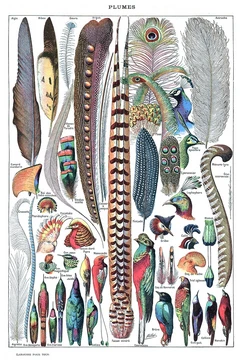
Afterfeather
Secondary tuft at the base of certain feathers, aiding insulation.

The afterfeather is a secondary tuft of barbs arising from the base of a feather's shaft, distinct from the main vane. It is not simply the fluffy part of a down feather; rather, it is an accessory structure found on some contour feathers and other feather types, often contributing to insulation.
- Type
- Feather structure
- Function
- Thermal insulation
- Composition
- Keratin proteins
- Related to
- Contour feathers, down feathers, semiplumes
- Key feature
- Secondary tuft arising from the feather's base
Lore & Background
The source article describes down feathers as fluffy because they lack barbicels, so the barbules float free of each other, allowing the down to trap air and provide excellent thermal insulation. However, this structure is not an afterfeather; an afterfeather is a separate tuft that can appear on various feather types, including contour feathers. Standard ornithological classification recognizes multiple feather types: contour feathers, down feathers, filoplumes, bristles, and semiplumes, not just two basic types.
Reader's Guide
The afterfeather, as a component of down feathers, is significant for its role in thermal insulation. The source article explains that down feathers lack barbicels, which allows the barbules to float freely and trap air, providing excellent insulation. This property is why down is used in high-class bedding, winter clothing, and outdoor bedding such as quilted coats and sleeping bags. The article also notes that goose and eider down have great loft, the ability to expand from a compressed state to trap insulating air. The afterfeather's structure is an example of the complex integumentary appendages found in vertebrates, formed in follicles that produce keratin proteins. Its function in insulation is critical for birds, helping them maintain body temperature in cold environments.
Did You Know?
- Down feathers are fluffy because they lack barbicels, allowing barbules to float free and trap air for insulation.
- Goose and eider down have great loft, expanding from a compressed state to trap insulating air.
- Feathers are among the most complex integumentary structures found in vertebrates.
- Ornithologists classify feathers into multiple types including contour feathers, down feathers, filoplumes, bristles, and semiplumes.
Frequently Asked Questions
What is an afterfeather?
An afterfeather is a small secondary tuft of barbs that grows out from the base of a feather's shaft, separate from the main vane above it. It is an accessory structure attached to an existing feather rather than a standalone feather type of its own.
Is an afterfeather the same thing as down?
No—people often conflate the two because both look soft and fluffy, but an afterfeather is a tuft anchored to the lower shaft of a contour or semiplume feather. Down feathers are a distinct category that lack a central shaft entirely and grow independently from the skin.
What is the function of an afterfeather?
Its main job is thermal insulation: the loose barbs trap a layer of still air close to the bird's body, reducing heat loss. It works in concert with the main vane and true down to keep the bird warm in cold conditions.
Where exactly on the feather is the afterfeather located?
It arises from the lower portion of the calamus (the hollow shaft base), near the point where the feather is embedded in the skin. Because it sits below the main vane, it is often less conspicuous and can be hard to spot without pulling the feather apart.
What is an afterfeather made of?
Like every part of a feather, it is built from keratin proteins organized into fine, loosely arranged barbs. Unlike the tightly interlocked barbules of a contour vane, these barbs form a soft, open tuft that prioritizes air trapping over aerodynamic shape.
More in Feathers 1-24
Spotted an error? Know more?
Reader corrections go straight into our review queue. Suggest an edit · How this site is sourced