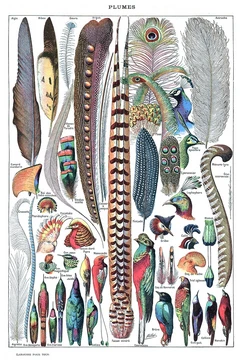
Plumage
The feather covering of birds, studied in plumology.

Plumage, or feathering, is the layer of feathers covering a bird, including their pattern, color, and arrangement. The study of plumage is known as plumology. Plumage varies between species and subspecies, and can differ by sex, age, and sometimes color morph.
- Field
- Ornithology
- Known for
- Layer of feathers covering birds; patterns, colors, and moult cycles
Lore & Background
Most birds moult twice a year, producing a breeding and a non-breeding plumage. One moult, usually after breeding, is complete; the other, before breeding, is often partial. Some large birds like eagles replace flight feathers slowly year-round. Many ducks have males with bright breeding plumage and a drab eclipse plumage afterward. Many passerines have only one moult per year, with plumage changes from feather wear. Young birds have juvenile plumage, replaced by first-winter plumage; long-lived birds like gulls may have multiple immature plumages.
Eclipse plumage is a dull, female-like appearance in many male ducks after breeding. They shed all flight feathers simultaneously, becoming flightless briefly. Some ducks remain in eclipse for one to three months; others retain it until spring. In contrast, hummingbirds and most lek-mating passerines retain bright plumage year-round.
Color polymorphism occurs in some birds, such as true owls, nightjars, skuas, and cuckoos, with brown and grey morphs. Other polymorphisms include melanic/nonmelanic forms, face color in Gouldian finches, and courtship types in male ruffs. The Humphrey–Parkes terminology uses terms like pre-basic moult and basic plumage, but is little-known outside a small circle of US professionals.
Reader's Guide
Plumage is central to avian biology, influencing identification, behavior, and evolution. The article describes how plumage varies by species, sex, age, and season, with moult cycles adapting to ecological needs—such as the flightless eclipse period in ducks or continuous feather replacement in eagles. Color polymorphism, as seen in owls and cuckoos, adds complexity to population dynamics. The Humphrey–Parkes terminology offers a systematic naming approach but remains obscure. Abnormal plumages, including albinism and melanism, highlight genetic and pigmentary mechanisms. Understanding plumage aids conservation, taxonomy, and studies of sexual selection. The article emphasizes that plumage patterns are organized, not haphazard, and that moult timing and completeness vary widely. This knowledge informs field guides, breeding programs, and evolutionary research. The rarity of complete albinism and its survival challenges underscore natural selection's role. Overall, plumage science integrates anatomy, genetics, and ecology, making it a key topic in ornithology.
Did You Know?
- Most birds moult twice a year, resulting in a breeding plumage and a non-breeding plumage.
- Many male ducks moult into a dull eclipse plumage after breeding and become flightless for a short period.
- Color polymorphism in plumage occurs in true owls, nightjars, skuas, and some cuckoos.
- Complete albinism in birds is rare, though precise frequency estimates vary and are often cited as much rarer than one in 1800 individuals.
More in Feathers 1-24
Spotted an error? Know more?
Reader corrections go straight into our review queue. Suggest an edit · How this site is sourced