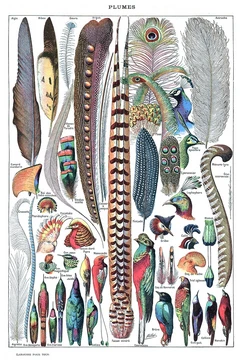
Flight feather
Feathers enabling flight, with specialized roles across species.

Flight feathers (Pennae volatus) are the long, stiff, asymmetrically shaped, but symmetrically paired pennaceous feathers on the wings or tail of a bird. Those on the wings are called remiges, while those on the tail are called rectrices. Their primary function is to aid in the generation of both thrust and lift, thereby enabling flight. In some species, these feathers also serve additional functions related to territorial displays, courtship rituals, or feeding methods.
- Type
- Anatomical structure
- Location
- Wings and tail of birds
- Primary function
- Generation of thrust and lift for flight
- Subtypes
- Remiges (primaries, secondaries) and rectrices
- Notable variations
- Owls have serrations for silent flight; woodpeckers have stiff rectrices for bracing
Lore & Background
Remiges are divided into primary and secondary feathers based on their position along the wing. Primaries are attached to the manus and are the longest and narrowest, providing most thrust during flapping flight. Secondaries are attached to the ulna, are shorter and broader, and help create the airfoil shape for lift. Tertiary feathers on the brachium are not considered true remiges. The calami of flight feathers are protected by covert feathers, or tectrices, which vary widely in size; the upper tail tectrices of the male peafowl form its elaborate train. Some birds, such as those in over 40 non-passerine families, lack the fifth secondary feather, a condition known as diastataxis.
Reader's Guide
Flight feathers are essential for avian flight, providing both thrust and lift. Their structure and arrangement vary among species, reflecting adaptations to different ecological niches. For example, owls have serrations on their remiges for silent flight, aiding hunting, while woodpeckers have stiff rectrices for bracing against tree trunks. The moult of flight feathers can impair flight, leading to various strategies such as dropping all feathers at once or extending moult over years. The development of remiges in hoatzin nestlings is delayed due to their use of claws for climbing. The outermost primaries of large soaring birds often have notches or emarginations that create gaps at the wingtip, increasing lift. The alula feathers, though not true flight feathers, aid slow flight by preventing stalling. Overall, flight feathers are a key evolutionary innovation that has enabled birds to occupy diverse aerial habitats.
Did You Know?
- Owls have tiny serrations on the leading edge of their remiges that help them fly silently.
- Woodpeckers have extra-stiff rectrices that help them brace against tree trunks while hammering.
- The outermost primary, called the remicle, is often rudimentary or absent in many birds.
- The upper tail tectrices of the male peafowl, not its rectrices, form its elaborate train.
More in Feathers 1-24
Spotted an error? Know more?
Reader corrections go straight into our review queue. Suggest an edit · How this site is sourced