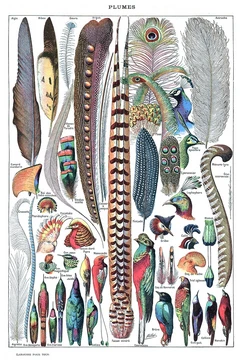
Feathers: The Evolution of a Natural Miracle
A natural history book on feathers' evolution and human use.

Feathers: The Evolution of a Natural Miracle, a natural history book by American conservation biologist Thor Hanson, came out in hardcover from Basic Books in 2011, with a paperback edition following in 2012. Written for a general audience, it explores the significance of feathers, their evolutionary path, and their history both in nature and in human use. The book earned several honors, including the Pacific Northwest Booksellers Association Award, the SB&F Prize in the Young Adult Science Book category, and the John Burroughs Medal.
Hanson, whose research spans forest fragmentation, conservation policy, and tropical wildlife, got the idea for the book after a run in Kenya. He had been brainstorming a story involving vulture feathers when, later that day, a turkey vulture dropped a feather at his feet while he watched the birds near a roadkill deer. Taking the coincidence as a sign, he decided to write about feathers. This is his second book, following *The Impenetrable Forest: My Gorilla Years in Uganda* (2008).
The book is divided into five parts. "Evolution" covers the scientific debate over how feathers developed, starting with the 1861 discovery of *Archaeopteryx* and the clash between Richard Owen and Thomas Henry Huxley. Hanson visits the Wyoming Dinosaur Center to see an *Archaeopteryx* specimen and interviews ornithologists Richard Prum and Alan Feduccia, as well as paleontologist Xing Xu. Prum’s developmental theory—focusing on how feathers grow rather than their function—is supported by Xu’s fossils like *Beipiaosaurus* and *Microraptor*. The section also touches on feather growth in thin-billed prions and the role of the Sonic hedgehog gene.
"Fluff" looks at how feathers regulate body temperature. Hanson attends a winter ecology course led by biologist Bernd Heinrich in western Maine, observing how golden-crowned kinglets survive nights as cold as −17 °F (−27 °C). He also interviews Travis Stier at the Pacific Coast Feather Company about human use of down for pillows and comforters, and discusses how birds cool off in heat or during exertion.
"Flight" examines competing theories on the origin of feathered flight. Hanson interviews Prum, Feduccia, Xu, and ornithologist Ken Dial, who described wing-assisted incline running. The "ground-up" view is one of the perspectives covered.
"Fancy" covers feathers in sexual selection and human fashion.
Quick Facts
- Author
- Thor Hanson
- Country
- United States
- Subject
- Evolutionary biology
- Genre
- Non-fiction
- Published
- 2011 (Basic Books)
- Pages
- 336
- Awards
- John Burroughs Medal / Pacific Northwest Booksellers Association Award
- Isbn
- 978-0-465-02013-3
Facts from the source article.
Lore & Background
Thor Hanson is a conservation biologist whose published research includes the impact of forest fragmentation on bird nest predation and the behavior of Neotropical monkeys and birds. He received a Ph.D. from the University of Idaho in 2006. Hanson's interest in feathers began after observing vultures in Kenya; while brainstorming a new book, he considered a story involving vulture feathers, and later that day a vulture dropped a feather at his feet during a run. This coincidence led him to write Feathers.
The book is divided into five parts: 'Evolution' covers the scientific debate over feather evolution, interviewing ornithologists Richard Prum and Alan Feduccia and paleontologist Xing Xu. 'Fluff' discusses feathers' role in regulating bird body temperature and human use of feather insulation. 'Flight' explores how flight might have evolved, including wing-assisted incline running described by ornithologist Ken Dial. 'Fancy' addresses sexual selection and human fashion, with interviews from costume designers on the Las Vegas Strip and in New York City. 'Function' covers adaptations such as waterproofing, fly fishing, and quill pens.
Critical reception to Feathers has predominantly been positive. In 2012 it won the Pacific Northwest Booksellers Association Award and the SB&F Prize in the Young Adult Science Book category. In 2013 it was awarded the John Burroughs Medal. An essay-length adaptation appeared in the January–February 2012 edition of Audubon.
Reader's Guide
Feathers: The Evolution of a Natural Miracle serves as a comprehensive introduction to the biology, evolution, and cultural history of feathers, written for a general audience. The book synthesizes interviews with leading scientists—including those who disagree on key points, such as whether birds evolved from theropod dinosaurs—and presents multiple viewpoints on the origin of flight. By covering topics from thermal insulation to fashion and fly fishing, it demonstrates the broad significance of feathers in both nature and human society.
The book's significance is underscored by its awards from the Pacific Northwest Booksellers Association, the American Association for the Advancement of Science, and the John Burroughs Medal, which recognize excellence in natural history writing. Its accessible style and Hanson's enthusiasm have been widely praised. The work also highlights ongoing scientific debates, such as the 'ground-up' versus 'tree-down' theories of flight evolution, without resolving them, making it a valuable resource for understanding the complexity of evolutionary biology.
Did You Know?
- Hanson decided to write the book after a vulture dropped a feather at his feet during a run, coinciding with an idea he had earlier that day.
- The book includes an interview with Ken Dial, who described wing-assisted incline running as a model for the origin of avian flight.
- Feathers won the John Burroughs Medal in 2013.
More in Feathers 1-24
Spotted an error? Know more?
Reader corrections go straight into our review queue. Suggest an edit · How this site is sourced