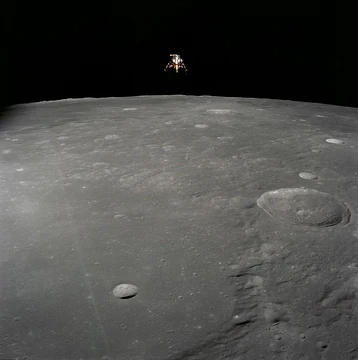
Lunar Precursor Robotic Program
NASA robotic missions preparing for crewed lunar exploration.

NASA’s Lunar Precursor Robotic Program (LPRP) sends robotic spacecraft to the Moon ahead of planned astronaut missions. Its job is to collect information on lunar radiation, surface images, scientifically interesting areas, temperature and light conditions, and possible resources.
Two LPRP missions—the Lunar Reconnaissance Orbiter (LRO) and the Lunar Crater Observation and Sensing Satellite (LCROSS)—lifted off together on June 18, 2009, from Cape Canaveral Air Force Station in Florida. An uncrewed Atlas V rocket carried both probes toward the Moon. Their goals included producing a 3D map and searching for water, with help from the Hubble Space Telescope, which had been in orbit since its 1990 launch. This was the first U.S. Moon mission in more than ten years; Neil Armstrong’s first steps on the Moon had occurred on July 20, 1969, and this launch came 32 days before the 40th anniversary. LRO entered a low orbit around the Moon, while LCROSS performed a swing-by maneuver to enter a different orbit, setting up a planned collision with the lunar surface months later. That impact—of the Centaur upper stage and the LCROSS spacecraft—was scheduled for October 9, 2009, at 11:31 UT (7:31 a.m. EDT, 4:31 a.m. PDT), give or take 30 minutes. NASA predicted the dust plume from the Centaur impact would be visible through telescopes with apertures as small as 10 to 12 inches (300 mm).
**Program history** The program started under NASA’s Science Mission Directorate (SMD) as the Robotic Lunar Exploration Program (RLEP). Goddard Space Flight Center (GSFC) took over management in February 2004, with the goal of launching robotic Moon missions to prepare for future human exploration. In 2005, responsibility shifted to NASA’s Exploration Systems Mission Directorate (ESMD), and management moved to Ames Research Center (ARC). In 2006, the program was renamed the Lunar Precursor Robotic Program, and management was reassigned to Marshall Space Flight Center (MSFC). The total cost was US$583 million: $504 million for the 4,200-pound (1,900 kg) LRO probe and $79 million for the LCROSS satellite.
**LRO** The Lunar Reconnaissance Orbiter was the first LPRP mission. Goddard Space Flight Center managed it from 2004. LRO launched on an Atlas V 401 rocket from Cape Canaveral Air Force Station on June 18, 2009, at 5:32 p.m. EDT (2132 GMT), after a 20-minute delay due to thunderstorms.
- Program name
- Lunar Precursor Robotic Program (LPRP)
- Agency
- NASA
- Total cost
- US$583 million
- First launch
- June 18, 2009
- Notable missions
- Lunar Reconnaissance Orbiter (LRO), Lunar Crater Observation and Sensing Satellite (LCROSS), Lunar Atmosphere and Dust Environment Explorer (LADEE)
- Management centers
- Goddard Space Flight Center, Ames Research Center, Marshall Space Flight Center
Lore & Background
The LPRP began as the Robotic Lunar Exploration Program (RLEP) under NASA's Science Mission Directorate, with management assigned to Goddard Space Flight Center in February 2004. In 2005, responsibility moved to the Exploration Systems Mission Directorate and Ames Research Center, and in 2006 the program was renamed and management reassigned to Marshall Space Flight Center. The program launched its first two missions, LRO and LCROSS, on June 18, 2009, from Cape Canaveral Air Force Station aboard an Atlas V rocket. This marked the first United States mission to the Moon in over ten years, launching 32 days before the 40th anniversary of Neil Armstrong's first step on the Moon.
Reader's Guide
The Lunar Precursor Robotic Program was significant for restarting U.S. lunar exploration after a decade-long hiatus. Its LRO mission provided high-resolution 3D maps, identified safe landing sites, and studied lunar resources and radiation, supporting the goal of returning astronauts to the Moon by 2020. The LCROSS mission aimed to detect water by crashing a spent rocket stage into a permanently shadowed lunar crater and analyzing the ejecta plume. The program also included the later LADEE mission, which studied the lunar exosphere and dust. Data from LPRP missions were processed by the Lunar Mapping and Modeling project to create detailed topographic maps and solar radiation models, aiding decisions on lunar outpost designs. The program's legacy lies in its foundational data for future human exploration and international collaboration, such as the hypothetical International Lunar Network.
Did You Know?
- The LRO and LCROSS were launched together on June 18, 2009, after a 20-minute delay due to thunderstorms.
- The LCROSS mission planned to crash the 2,300-pound spent Centaur rocket upper stage into a dark lunar crater at over 9,000 km/h.
- The projected lunar impact of the Centaur and LCROSS spacecraft was on October 9, 2009, at 11:30 UT ± 30 minutes.
- The LRO carried seven main instruments, including the Cosmic Ray Telescope for the Effects of Radiation (CRaTER) and the Lunar Orbiter Laser Altimeter (LOLA).
More in Exploration of the Moon 1-24
Spotted an error? Know more?
Reader corrections go straight into our review queue. Suggest an edit · How this site is sourced