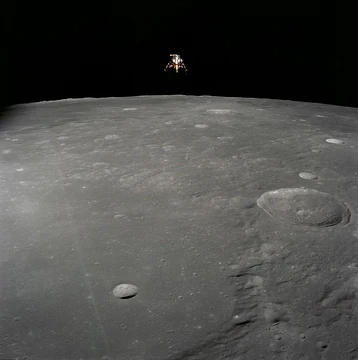
DARPA lunar programs
DARPA programs aim to build a commercial lunar economy.

The DARPA lunar programs are a series of initiatives by the U.S. agency DARPA aimed at developing shareable, scalable commercial systems for a lunar economy. Recognizing recent advances in lunar exploration, DARPA envisions a cislunar and lunar economy of scientific research and commercial development over the next decade. Since 2023, two programs have been launched: Lunar Guidelines for Infrastructure Consortium (LOGIC) and the 10-Year Lunar Architecture (LunA-10). A third initiative, Novel Orbital and Moon Manufacturing, Materials, and Mass-efficient Design (NOM4D), was publicly announced in 2023.
- Third program kickoff
- 2023 (NOM4D)
- Long term goal
- Explore lightweight raw materials transformed and assembled in orbit for large space structures
Lore & Background
The DARPA lunar programs began with the 10-Year Lunar Architecture (LunA-10), announced in August 2023. This seven-month capability study seeks to create core technology concepts for adaptable, expandable systems that can be shared, minimizing lunar footprint and creating monetizable services. The study focuses on transit/mobility, energy, and communications, based on a September 2021 PwC Australia report. In December 2023, 14 companies were funded to complete the study by June 2024, including Blue Origin, SpaceX, and Northrop Grumman, which provided a conceptual study of a 'lunar railroad' network.
In October 2023, DARPA selected the Johns Hopkins University Applied Physics Laboratory to administer LOGIC as a permanent, self-sustaining forum for collaboration among industry, academia, and government to identify critical lunar infrastructure interoperability needs. Separately, NOM4D, publicly announced in 2023, explores using lightweight raw materials transformed and assembled in orbit. In February 2025, DARPA shifted its final phase from laboratory experiments to small-scale orbital demonstrations, with a long-term objective of developing large space structures for cislunar applications.
DARPA has coordinated with NASA to make LunA-10 complementary to NASA's architecture studies. An update in April 2024 noted that many industry proposals relied on the viability of in-situ resource utilization and low enough launch costs.
Reader's Guide
The DARPA lunar programs represent a strategic shift toward commercial and scalable infrastructure for a lunar economy, distinct from traditional government-led exploration. By focusing on interoperability, shared systems, and monetizable services, these initiatives aim to lower barriers for private-sector participation in cislunar development. The LOGIC consortium provides a permanent forum for setting standards, while LunA-10 identifies foundational sectors—transit, energy, communications—that underpin other industries like construction, mining, and medicine. NOM4D's in-space manufacturing could enable large structures like 100-meter antennas, enhancing situational awareness for crewed missions. The programs complement NASA's architecture, emphasizing coordination rather than duplication. Their significance lies in fostering a self-sustaining lunar economy, though success depends on factors like in-situ resource utilization and launch costs. The inclusion of major aerospace firms and startups signals broad industry interest, but the programs remain in early study phases, with outcomes uncertain.
Did You Know?
- LunA-10 was announced in August 2023 and funded 14 companies in December 2023 to complete a study by June 2024.
- Northrop Grumman provided a conceptual study of a 'lunar railroad' network for commercial ventures.
- NOM4D was publicly announced in 2023 and explores using lightweight materials assembled in orbit for large space structures.
- LOGIC is administered by the Johns Hopkins University Applied Physics Laboratory as a permanent, self-sustaining forum.
The Vision for a Commercial Lunar Economy
DARPA's lunar programs represent a deliberate pivot toward building the economic scaffolding of a cislunar and lunar civilization. Rather than focusing on a single mission or vehicle, the agency framed its effort around creating interoperable, growable commercial platforms that could underpin a decade-long era of scientific research and commercial development in the Moon's vicinity. The programs were launched in the context of accelerating advances in lunar exploration, and DARPA explicitly positioned them as complementary to existing government architecture studies rather than duplicative. Since 2023, two distinct programs have been brought online, each targeting a different layer of the problem: one addressing the architectural and interoperability questions of shared lunar infrastructure, and the other tackling the manufacturing and materials challenges of building large structures in orbit. Together, they sketch a picture in which the Moon is not merely a destination for flag-planting expeditions but a working environment where multiple stakeholders can operate, trade, and expand their capabilities over time. The emphasis on shared and scalable systems signals that DARPA envisions an ecosystem rather than a single proprietary platform.
LunA-10 and the Industry Consortium
Announced in August 2023, the 10-Year Lunar Architecture capability study, known as LunA-10, set out to produce core technology concepts for adaptable, expandable systems designed to interoperate and be shared among future lunar users. The study was deliberately scoped toward commercial and economic applications, with an explicit exclusion of military uses. Its three foundational focus areas—transit and mobility, energy, and communications—were drawn from a September 2021 market assessment report by PwC Australia, which identified the key sectors and challenges facing a developing lunar economy. In December 2023, fourteen companies received funding to complete the study by June 2024, including SpaceX, Blue Origin, Northrop Grumman, Firefly Aerospace, and Honeybee Robotics. Northrop Grumman, for instance, was tasked with a conceptual study of a lunar railroad network. DARPA coordinated closely with NASA to ensure LunA-10 would complement rather than overlap with NASA's own detailed architecture work for lunar and Martian exploration. By April 2024, industry participants were reporting that many of their proposals hinged on the viability of in-situ resource utilization and on launch costs falling low enough to make sustained lunar operations economically sensible.
LOGIC and the Governance Question
The Lunar Guidelines for Infrastructure Consortium, or LOGIC, addresses what might be called the governance and interoperability gap in commercial lunar development. Its stated purpose is to convene industry, academia, and government in a structured forum where participants can identify the critical interface and interoperability needs that will determine whether separate commercial lunar systems can actually work together. In October 2023, DARPA selected the Johns Hopkins University Applied Physics Laboratory to administer LOGIC, with the specific mandate that it function as a permanent, self-sustaining, and independent collaboration body. This choice of a university research laboratory as the steward of the consortium is notable: it suggests DARPA wanted the forum to outlast any single funding cycle and to remain insulated from the shifting priorities of any one agency. By positioning LOGIC as a standing body rather than a time-limited study, the program creates a continuous channel through which emerging commercial actors can align their technical standards before hardware is committed. In a sector where no single entity controls the lunar surface, such a coordination mechanism becomes as critical as the hardware itself.
NOM4D and the Push Toward Orbital Manufacturing
Kicked off in 2022, the Novel Orbital and Moon Manufacturing, Materials, and Mass-efficient Design initiative—pronounced nomad—takes a fundamentally different approach to the lunar infrastructure problem. Rather than launching finished structures from Earth, NOM4D explores the use of lightweight raw materials that are shipped to orbit and then transformed and assembled in place. The program's central challenge is overcoming the difficulties of constructing large-scale structures in the microgravity environment by developing and testing new in-space manufacturing capabilities. In February 2025, DARPA made a significant programmatic shift, moving the final phase of NOM4D from laboratory experiments to small-scale orbital demonstrations, a step that signals growing confidence in the underlying concepts. One of the initiative's long-term objectives is to develop space-based antennas up to one hundred meters in width, designed to enhance situational awareness in the cislunar region during crewed lunar missions. NOM4D is explicitly framed as complementary to LOGIC and LunA-10, forming part of a broader DARPA portfolio that addresses manufacturing, architecture, and governance as interdependent layers of a future lunar economy.
Frequently Asked Questions
What are the DARPA lunar programs?
They are a set of U.S. government initiatives run by DARPA to create shared, scalable commercial infrastructure for a future lunar economy. The overarching aim is to build a sustainable cislunar and lunar commercial ecosystem—spanning both scientific research and private development—within roughly the next decade.
Which specific programs make up DARPA's lunar effort?
As of 2023, the effort includes LOGIC (Lunar Guidelines for Infrastructure Consortium), LunA-10 (10-Year Lunar Architecture), and NOM4D (Novel Orbital and Moon Manufacturing, Materials, and Mass-efficient Design). NOM4D was the third initiative publicly announced that same year.
What is the long-term vision behind NOM4D?
NOM4D focuses on exploring how lightweight raw materials can be processed and assembled in orbit to construct large space structures. This represents a mass-efficient approach to manufacturing that moves production off Earth's surface.
Why do DARPA lunar programs matter for the broader lunar exploration landscape?
They shift the focus from one-off government missions toward building reusable, commercial-grade systems that multiple partners can share. This is meant to make a sustained lunar economy practical rather than relying solely on national space agencies.
When did DARPA kick off its lunar programs?
The programs were launched starting in 2023, with LOGIC and LunA-10 debuting first and NOM4D following as a third announced initiative. All three are part of a coordinated push to establish lunar commercial infrastructure over the coming decade.
More in Exploration of the Moon 1-24
Spotted an error? Know more?
Reader corrections go straight into our review queue. Suggest an edit · How this site is sourced