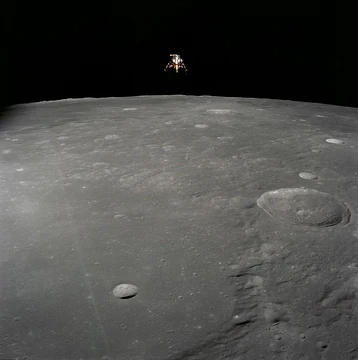
Human Lunar Return study
NASA study exploring architectures for a crewed lunar return.

NASA Langley Research Center / NASA · Public domain
The Human Lunar Return (HLR) study was a NASA initiative begun in September 1995 to identify methods for conducting future human spaceflight missions to the Moon. The study concluded with a final briefing on August 7, 1996, and was considered to have laid the foundation for human space activity over the following three decades.
- Projected cost
- Cost estimates not commonly cited in established sources
Lore & Background
The Human Lunar Return study began in September 1995 as a NASA effort to outline a feasible approach for returning humans to the Moon. The final briefing occurred on August 7, 1996, and the study was seen as laying 'the foundation for human space activity over the next three decades.' The proposed mission would last 16 days, with 10 days spent on the lunar surface. The architecture included an open-cockpit lunar lander weighing 4,565 kilograms (10,064 lb) including fuel, and a lunar habitat with an inflatable hull delivered in advance of the crew. To protect against cosmic rays and solar particle events, the habitat hull was to be at minimum 5 grams per square centimetre (1.1 oz/in2) thick and filled with either water or polyethylene. The study explored various mission architectures and did not specify a fixed launch date from the ISS.
Reader's Guide
The Human Lunar Return study represents a pivotal planning effort by NASA in the mid-1990s to re-establish a human presence on the Moon. Its projected cost of $2.5 to $4 billion over five years, requiring two Space Shuttle and three Proton launches, highlighted the logistical and financial challenges of lunar exploration. The study's goal of returning 300 kilograms of lunar material to Earth underscored a scientific focus. Though the mission did not fly, the HLR study informed later lunar exploration concepts and demonstrated NASA's ongoing interest in crewed missions beyond low Earth orbit. Its legacy lies in the technical and programmatic groundwork it laid for subsequent lunar initiatives.
Did You Know?
- The study called for a 16-day mission with 10 days on the lunar surface.
- The lunar lander was an open-cockpit design weighing 4,565 kg including fuel.
- The habitat hull required a minimum thickness of 5 g/cm² and could be filled with water or polyethylene for radiation protection.
- The study explored multiple architectures and did not assign a specific launch date from the ISS.
Origins & Strategic Vision
In the mid-1990s, NASA recognized the need for a deliberate path forward to put humans back on the Moon. In September 1995, the agency formally launched the Human Lunar Return study, a focused effort to identify the technical, logistical, and architectural options available for future crewed lunar missions. The work moved with urgency: just under a year later, on August 7, 1996, the team delivered its final briefing, wrapping up the study's core recommendations. NASA framed the effort not as a single flight plan but as a generational blueprint, describing it as the groundwork for three decades of human activity in space. The study thus functioned as a thinking tool, giving engineers and policymakers a shared vocabulary and a set of baseline assumptions from which more ambitious programs could eventually take shape.
Mission Architecture & Crew Operations
The HLR team envisioned a 16-day expedition, with ten full days devoted to work on the lunar surface itself. At the heart of the design was a deliberately lightweight architecture. The lunar lander, described as an open-cockpit vehicle, was baselined at 4,565 kilograms (10,064 pounds) including its fuel load. Rather than launching the habitat alongside the crew, the plan called for a small pressurized module with an inflatable hull to be pre-positioned on the Moon. To shield the astronauts from cosmic rays and potential solar particle events, the habitat shell had to be at least 5 grams per square centimetre (1.1 ounces per square inch) thick and packed with either water or polyethylene. All hardware and the two-person crew would first be ferried to the International Space Station aboard two Space Shuttle flights, after which the first HLR mission was scheduled to depart in August 2001. A headline scientific objective was to haul 300 kilograms (660 pounds) of lunar samples back to Earth for laboratory analysis.
Launch Manifest & Budget
Getting two astronauts and a compact habitat structure to Aristarchus crater required a carefully sequenced launch campaign. The study's baseline called for a total of five heavy-lift launches: two Space Shuttle flights to deliver components and crew to the ISS, and three Proton rocket launches to send the habitat and other elements to the lunar surface. The entire five-year development and execution timeline carried a projected cost in the range of $2.5 billion to $4 billion, encompassing design, testing, manufacturing, and actual flight operations. The choice of Aristarchus crater as the landing site reflected the study's emphasis on a focused, achievable first mission rather than a sprawling exploration campaign. The two-astronaut crew size kept life-support and lander mass within the lightweight architecture the team had baselined, while the Proton launches provided the heavy-lift capability needed to move the inflatable habitat and its shielding materials to the Moon without relying solely on the Shuttle's payload bay.
Place in the Broader Lunar Vision
The Human Lunar Return study did not exist in isolation. It was closely linked to NASA's broader Vision for Space Exploration framework and appeared alongside related concepts such as Mars to Stay in the agency's internal reference materials. The HLR's emphasis on a pre-positioned habitat, a lightweight lander, and a short but scientifically productive surface stay gave subsequent architects a concrete reference point for what a minimal two-person lunar expedition would require in terms of launches, radiation shielding, and habitat volume. By establishing specific mass, cost, and schedule baselines during 1995 and 1996, the team created a shared technical vocabulary that could anchor more ambitious planning discussions. The August 2001 departure date, the Aristarchus crater landing site, and the 300-kilogram sample-return goal all served as touchstones against which later proposals could be measured. In this sense, the HLR functioned less as a single mission plan and more as a common baseline from which the next generation of lunar architecture studies could branch out.
Gallery
Frequently Asked Questions
What is the Human Lunar Return study?
The Human Lunar Return (HLR) study was a NASA initiative launched in September 1995 to explore possible architectures and methods for sending crews back to the Moon. It wrapped up with a final briefing on August 7, 1996.
What was the main goal of the Human Lunar Return study?
Its core purpose was to identify viable approaches and system architectures that could support future crewed lunar missions. In short, it was a planning exercise to figure out how a human return to the Moon could actually be done.
Why is the Human Lunar Return study considered important?
NASA regarded the study as having laid the foundational groundwork for human space activity over the subsequent three decades. It set early architectural thinking that later lunar-return programs would build upon.
Who conducted the Human Lunar Return study?
It was carried out internally by NASA as a dedicated study effort. No external contractor or international partner is typically credited as the lead in established accounts.
Is there a widely cited cost estimate for the Human Lunar Return study?
Not really. Cost figures associated with the HLR study are not commonly referenced in the established public sources, making it one of the less numerically detailed NASA planning documents from the mid-1990s.
More in Exploration of the Moon 1-24
Spotted an error? Know more?
Reader corrections go straight into our review queue. Suggest an edit · How this site is sourced