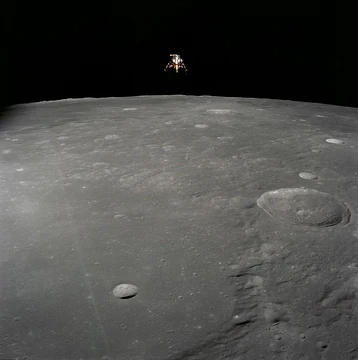
Lunar habitation
Human habitation on the Moon via surface habitats.

Lunar habitation is the presence of humans living on the Moon, typically within surface structures that may form part of a larger base. So far, the only such habitats ever built and used were the short-term Apollo Lunar Modules, beginning with *Eagle* at Tranquility Base. As of 2024, two major initiatives—the American-led Artemis program and the Chinese-led International Lunar Research Station—are working toward creating permanent settlements on the lunar surface.
Building on the Moon offers practical advantages. Lunar soil and rock can be used for construction, especially for shielding against cosmic radiation. Because the Moon’s gravity is much weaker than Earth’s, launching objects from its surface into space requires far less energy and propellant. This could make the Moon a source of building materials for nearby space. Some proposals suggest using electric mass drivers or momentum exchange tethers instead of rockets to move cargo off the Moon. The Moon’s gravity, about one-sixth of Earth’s, may also be important for human health and fetal development, though whether it is sufficient is still unknown. The Moon is also the closest large body in the solar system, consistently about 384,400 km away, closer than most asteroids.
Observatories built on the Moon from local materials could avoid the cost of launching telescopes into space. Lunar soil, though abrasive for moving parts, has been studied for potential use in construction, but proposals for mixing it with carbon nanotubes and epoxies to create large mirrors remain speculative and unverified in real-world projects. The Moon is nearby, has no atmospheric blurring, and offers permanently dark, cold craters near the poles ideal for infrared telescopes. Radio telescopes on the far side would be shielded from Earth’s radio noise. A lunar zenith telescope could be built cheaply using ionic liquid. A farm at the lunar north pole could provide eight hours of sunlight per day during the local summer by rotating crops in continuous sunlight, with artificial temperature control, radiation protection, and pollination. One estimate suggests a 0.5-hectare farm could feed 100 people.
However, the Moon presents serious challenges. The long lunar night makes solar power unreliable, and equatorial areas face extreme temperature swings from about 95 K to 400 K.
- First habitat
- Apollo Lunar Module (Eagle, Tranquility Base)
- Current programs
- Artemis (US-led), International Lunar Research Station (Chinese-led)
- Distance from earth
- ~384,400 km
- Surface temperature range
- ~95 K to ~400 K
- Gravity
- Roughly one sixth of Earth's
- Radiation dose
- First measured on lunar surface by Apollo missions
Lore & Background
Lunar habitats have been designed for many proposed moonbases. The only erected habitats were the temporary Apollo Lunar Modules, with Eagle of Tranquility Base being the first. As of 2024, the Artemis program and the International Lunar Research Station aim to establish permanent settlements. The Moon's gravity, about one sixth of Earth's, may be vital for fetal development and long-term health, though whether it is adequate is uncertain.
Reader's Guide
Lunar habitation offers advantages such as using lunar materials for construction and shielding from cosmic radiation. The Moon's low gravity reduces energy needed to launch objects into space, potentially making it a source of construction materials. However, challenges include the long lunar night (354 hours), extreme temperature swings, lack of atmosphere, and abrasive, toxic moon dust. Volatiles like nitrogen and hydrogen are depleted, though water ice exists in polar cold traps. Nuclear fission reactors could provide steady power, and lunar soil mixed with carbon nanotubes and epoxies could build large telescopes. The Moon's proximity to Earth and stable distance make it a key site for future space infrastructure.
Did You Know?
- The only lunar habitats erected as of 2024 were temporary Apollo Lunar Modules, such as Eagle of Tranquility Base.
- The Moon's gravity is roughly one sixth of Earth's.
- Water ice on the Moon was indicated by earlier missions, and the 2009 LCROSS mission detected water in a plume from a permanently shadowed crater, but it did not prove its existence for the first time.
More in Exploration of the Moon 1-24
Spotted an error? Know more?
Reader corrections go straight into our review queue. Suggest an edit · How this site is sourced